
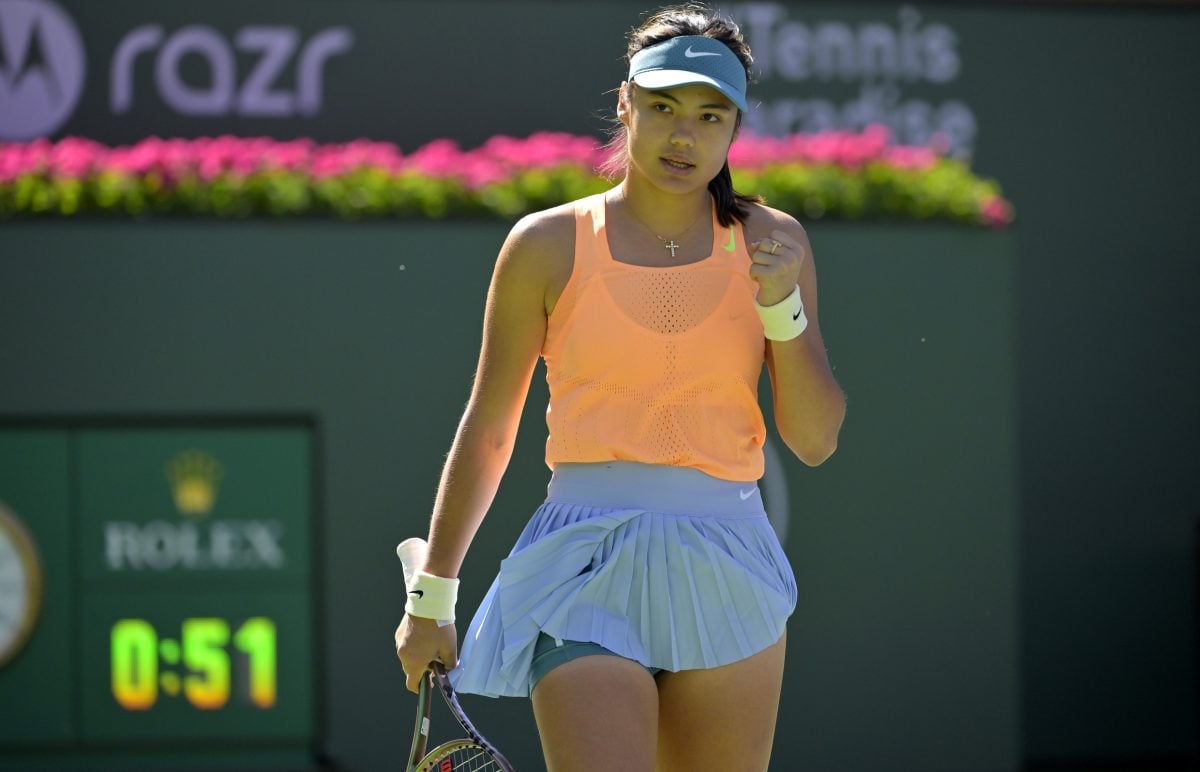
Emma Raducanu was ranked 150th in the world and had played exactly one Grand Slam main draw in her life. Then she walked into the 2021 US Open as a qualifier and proceeded to do something that had never been done before in the Open Era: win the whole thing without dropping a set. Ten matches. Zero sets lost. It was one of the most extraordinary tennis performances of the 21st century.
Four and a half years later, Emma Raducanu has not won another title. Not a WTA 250. Not a WTA 125. Nothing. And this week at Indian Wells, she gave an interview to BBC Sport that finally made plain what many in tennis have suspected for some time. Emma Raducanu, for all her staggering talent, is simply not serious about becoming the player she could be.
Her words, not a paraphrase: she does not want a coach who will come in, tell her how to play, and expect her to listen. She wants to return to her “natural way of playing,” because that approach has apparently been “coached out of her.” She is heading into her tenth coaching arrangement in five years, this time an informal, no-commitment setup with former commentator Mark Petchey. Petchey himself has acknowledged that he cannot be a full-time presence due to his media commitments.
Let that sit for a moment. A 23-year-old Grand Slam champion, with every resource in the world at her disposal, has just publicly announced that she does not really want to be coached.
The Carousel
The coaching carousel has been the defining story of Raducanu’s post-US Open career, and at this point, it is impossible to write it off as bad luck or circumstance. She has cycled through Andrew Richardson (fired immediately after winning the US Open), Torben Beltz, Dmitry Tursunov, Sebastian Sachs, Nick Cavaday, Vladimir Platenik (a brief two weeks), Francisco Roig, and now back to Petchey on an informal basis. Tursunov, a sharp and experienced coach, walked away from her during a trial period and publicly flagged concerns about working with her. Platenik lasted only one match and said she was “feeling stressed.” Roig, who had coached Rafael Nadal to 16 of his 22 Grand Slams, could not make it to six months.
The most telling departure may still be the one that received the least attention. When Platenik left, he framed it in sympathetic terms, saying he understood the pressure she was under. Yet the subtext was unmistakable: even after one match, something was not right. That is not a coaching problem. That is a player problem.
Patrick Mouratoglou, who coached Serena Williams to ten of her Grand Slam titles, has been blunt about Raducanu’s instability. He has said that the constant churn in her team is one of the worst things she could be doing to her development, and that her injuries and results are a direct consequence. Kim Clijsters, a four-time Grand Slam champion, admitted on a podcast that she was genuinely confused by the constant changes, and raised a question nobody wants to answer directly: who is actually making these decisions?
A Coach Who Agrees
Now Raducanu has given us the answer herself. Her criterion for a good coaching relationship, laid out in her own words, is essentially this: someone who will accept her or agree with her.
“I would rather someone not come in and tell me ‘let’s do this’, and I disagree with it, but have to listen to them.”
This is a remarkable thing for a professional athlete to say. Every great champion in tennis has, at some point, had to surrender instinct to a coach’s vision and trust the process. Novak Djokovic went to Boris Becker. Serena went to Mouratoglou. Andre Agassi famously rebuilt his entire game under Brad Gilbert despite initial resistance. The entire premise of elite coaching is that an experienced outside observer can see things you cannot see from inside the baseline, and that sometimes you have to do what they say, even when it feels wrong.
Raducanu has now had nine coaches tell her things she did not want to hear. Her response, each time, has effectively been to move on and find someone more agreeable. In that sense, the BBC interview is not so much a revelation but rather a confession.
The Wasted Gift
To understand how frustrating this trajectory is, you have to go back and watch the 2021 US Open. Not just the highlights. Take in the matches. Notice the way she absorbed pace and redirected it. Watch the footwork. Recognise the relaxed, almost detached poise with which she handled pressure points. Her return of serve was elite-level. Her first strike was legitimate. She was hitting winners from positions where most players are scrambling just to stay in the point.
That was not a fluke of scheduling or an easy draw. She beat Belinda Bencic and Maria Sakkari. She beat Bencic when Bencic was the fourth seed and playing some of the best tennis of her career. Nobody in that draw handed her anything. So the talent is real. That was never the question. The question has been whether she would do the work to build on it, and increasingly the answer looks like no.
Since then, her record against Top 10 players is 3-17. Her best result in a Grand Slam since Flushing Meadows was a fourth round at Wimbledon in 2022. She has reached one WTA final, at a 125-level event in Romania just last month, which she lost to a home crowd favorite. For a player of her supposed caliber, that is a sparse return.
The standard defenxe at this point is injuries. Raducanu has had surgeries on both hands and an ankle, and has dealt with a string of fitness issues that have disrupted her seasons. That is real, and it deserves genuine sympathy. Yet it also raises uncomfortable questions. Elite players with high injury rates almost invariably need more coaching stability, not less, because rebuilding physically requires a consistent technical framework. Raducanu has done the opposite by cycling through coaches during recoveries in a way that has guaranteed she never builds proper continuity.
There is also the schedule point. She has said she wants to play fewer tournaments in 2026 than the 22 she played in 2025. Given her injury history, that is defensible. But it also fits an established pattern of someone who is always finding reasons to do less rather than more.
None of this is to say Raducanu is a bad person, or even a bad tennis player. She is clearly bright, clearly likeable, and still capable of producing moments that remind you what she might have been. The Miami Open run in 2025, where she beat Emma Navarro and Amanda Anisimova back-to-back, was genuinely exciting. When she is engaged and on form, she is still among the more watchable players on Tour.
But “watchable in the third round” is not what was supposed to happen. When you win a Grand Slam at 18 without dropping a set, the world reasonably expects you to become a contender. Iga Swiatek also won her first Major as a relative unknown outsider at the 2020 French Open. She went back, kept the same coach for years, did the work, and is now one of the great champions of her generation. The contrast is not subtle.
What Raducanu has done instead is spend four-and-a-half years in a slow, graceful retreat from the demands of elite tennis. Each coaching change buys her a little more distance from the accountability of having to actually compete at the level the 2021 US Open suggested she could reach.
The BBC interview this week was supposed to be about Indian Wells. Instead, it became, unintentionally, a kind of mission statement. She does not want a full-time coach because the scrutiny is uncomfortable. Why would anybody want someone to tell them what to do? She wants to play her natural game and trust her instincts. She is 23, ranked 24th in the world, and the greatest achievement of her career is now approaching its fifth anniversary without a repeat.
The talent was always there. The seriousness never followed. That is the tragedy of Emma Raducanu, and at this point, it is starting to look permanent.
Main Photo Credit: Jayne Kamin-Oncea-USA TODAY Sports