
Calgarians are being asked to cut back on water use starting Monday as crews begin repairs on one of the city’s most critical pieces of infrastructure.
The restrictions are tied to reinforcement work on the Bearspaw South feeder main, a major pipeline that carries about 60 per cent of Calgary’s drinking water, which must be temporarily shut down while crews stabilize vulnerable sections of pipe.
City officials say the work is expected to take about four weeks and will require residents and businesses across Calgary to conserve water while the system operates at reduced capacity.
“For us to really support our frontline crews, the first responders, we need to all collectively take part at this time,” said Calgary mayor Jeromy Farkas.
“Every drop counts.”
While the feeder main is shut down, Calgary’s Glenmore Water Treatment Plant will supply most of the city and will operate at full capacity.
Outdoor water use will not be permitted during that time, and residents are being encouraged to reduce indoor consumption wherever possible.
City officials say even small reductions could help keep the system stable and potentially save lives when water is needed for emergencies.
Some small measures to take include limiting showers to three minutes or less, only flushing toilets when necessary and running only full loads for laundry machines or dishwashers.
“If we can overall reduce the load on the system by about three per cent over the next few weeks, that allows us to be able to have enough water to ensure that the fire department can respond to calls,” Farkas said.
“It’s a frustrating situation to be in, but what I can tell you is that we are moving faster than anything we’ve ever done before to be able to fix this once and for all.”
Repairs planned at 9 locations
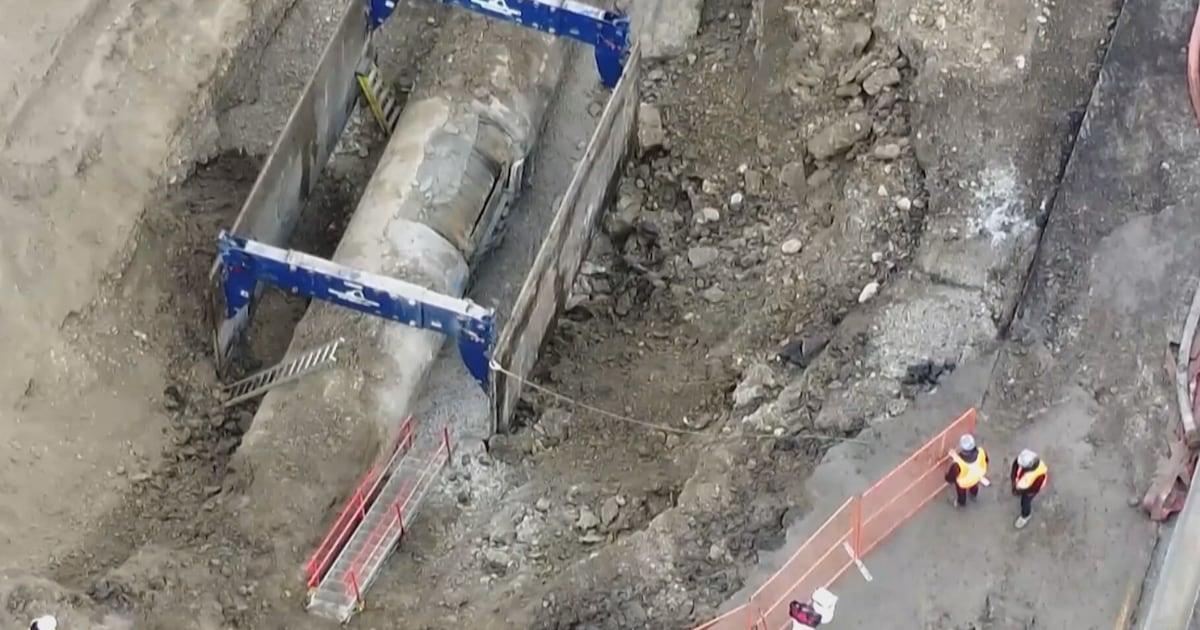
Construction crews will reinforce nine sections of the pipeline identified as most vulnerable.
Six of the repair sites are located along 16 Avenue N.W. near Sarcee Trail, while three others are in the Point McKay Park area.
According to city officials, the work involves excavating around the pipe, inspecting it and then reinforcing it with steel rebar and concrete before restoring the line to service.
“For the next three weeks, you will see traffic impacts at 16 Avenue and Sarcee Trail,” said Melanie Gray, a senior project engineer with the City of Calgary.
“For the first few days, it’s a lot of excavating material, getting down to the existing pipe, and then we will do a quick pipe inspection, and then most of the work will start after that.”
Gray said the pipe will be wrapped in rebar before concrete is poured to reinforce it.
“Then we pour concrete on the pipes which will take about seven days to cure,” she said.
“Following that is backfill and putting the pipe back into service.”
The repairs are being prioritized following inspections that identified several weakened sections of pipe after previous failures.
Replacement pipeline already under construction
The current repairs are intended to stabilize the existing feeder main while the city builds a new pipeline designed to replace it.
Gray said construction on the replacement pipe began earlier this year and is already underway at several sites.
“They started in January,” she said.
“You’ll see at five different locations work is already underway on construction of shafts for the micro-tunneling portion.”
Another phase of the project involving open-trench construction is expected to begin later this spring.
Originally planned as a multi-year project, the timeline has been accelerated by deploying multiple construction crews.
“By fast-tracking this, we have three crews on site,” Gray said.
“And so that’s why we’re able to get this done in such a short amount of time.”
City officials expect the new pipeline to be operational later this year, aiming for a December completion date.
Hundreds of millions earmarked for water infrastructure
The feeder main project is part of a much larger effort to upgrade Calgary’s water infrastructure.
City administration has asked council to approve hundreds of millions of dollars in additional funding to accelerate several projects tied to the system.
The total cost associated with the Bearspaw feeder main replacement and related upgrades is estimated at roughly $439 million.
Most of that funding — about $318 million — is earmarked for constructing a new steel pipe parallel to the existing feeder main.
City officials have also set aside about $40 million for reinforcement work on the existing pipe, including the repairs scheduled to begin this week.
Additional funding is planned for further stabilization work, including installing a liner inside the current pipe to strengthen it while the new pipeline is built.
Overall, the city is proposing more than $600 million in additional capital funding in the coming years to help fast-track water infrastructure projects.
Much of that spending would be financed through self-supported municipal debt, with potential increases to water rates expected in the future.
“There will be costs associated with this,” Farkas said.
“But based on the fact that this is infrastructure that will last for tens of years, maybe 50 years or maybe 100 years, we can spread out the cost of that over the lifetime of the asset, which means we’re going to be working as hard as we can to reduce any of the short term volatility in rates.
Farkas adds that Calgary is also looking at options including collaborating with the federal government and the provincial governments as part of some of their new grant streams.
“We are going to continue to be asking for support from the province and the feds to be able to help, and that’s not unprecedented,” he said.
“We saw about $200 million was granted to Montreal to be able to fix some of their water system for a high-density housing development. We see specific money that’s being made available in the provincial budgets around freshwater, stormwater, wastewater, rehabilitation as well, so we’re going to continue to advocate.”
Residents dealing with construction disruptions
Residents living near the construction sites say the work has already caused traffic disruptions in nearby communities.
Laura Kornfeld, who lives in the Montgomery neighbourhood near 16 Avenue N.W., says detours and heavy traffic have become a concern.
“We have road closures. We have really bad detours. We have angry traffic coming through, and it makes it very dangerous for my kids to go outside our house, to be honest,” she said.
“We’re in a playground zone, and people are ripping through at 55 km/h, so we really need drivers to slow down.”
Kornfeld says residents understand the need to repair the pipe but say the disruptions can be difficult.
“It’s a bit of a balancing act,” she said.
She also encouraged Calgarians who may not live near the construction sites to still follow the restrictions.
“If you’re not directly impacted, it’s hard to believe it’s even happening in your city,” Kornfeld said.
“But if you don’t experience that, how would you know? So, I would just say to anyone in Calgary, please follow the restrictions as best you can.”
Businesses worried about impact
Some businesses that rely on water are also watching the situation closely.
Chris Gitzel, owner of King’s Irrigation, says restrictions during peak landscaping season could have significant consequences for companies in the irrigation industry.
“If the city puts in restrictions later this year as harsh as Level 4, which just restricts all water for us, it will certainly destroy our business,” he said.
Gitzel added that many irrigation companies already use technology designed to reduce water use and are willing to compromise.
“We’re trying our best to conserve water,” he said.
“But irrigation-wise, it’s scary for us because like when the big break happened two years ago, it was after we had a lot of business already done. Whereas if the city shuts off water in May, a lot of people may have to leave their irrigation systems off for a lot longer.”
Gitzel says the city also needs to do a better job of communicating with business owners who rely on water use for their customers.
“We’ve heard the city say they talk with people in the industry, but they don’t. I mean, we’re one of the bigger companies and I’ve talked with other bigger companies, and they don’t really talk to us so it would be nice if they got our input.”
Broader concerns about water infrastructure
The repair project has also raised broader concerns about the condition of Calgary’s water infrastructure.
Ward 10 Coun. Andre Chabot said he has been receiving frequent updates about water main breaks in the northeast.
“I’m getting almost daily updates of a water main break in different parts of my community,” he said.
“When you’re looking at 300 breaks annually, and you’re getting daily updates, you can’t help but raise the question of, ‘Do we have a problem in the northeast?’”
Chabot acknowledged freeze-thaw cycles can cause breaks, but said the number of incidents remains concerning.
“All I know is I’m getting too many breaks for me to not be concerned,” he said.
Despite the disruptions, Chabot said it is essential for residents to reduce water use while the repairs are underway.
“This isn’t just a matter of, ‘You should do this,’ it’s, ‘You must’ do this,” Chabot said.