
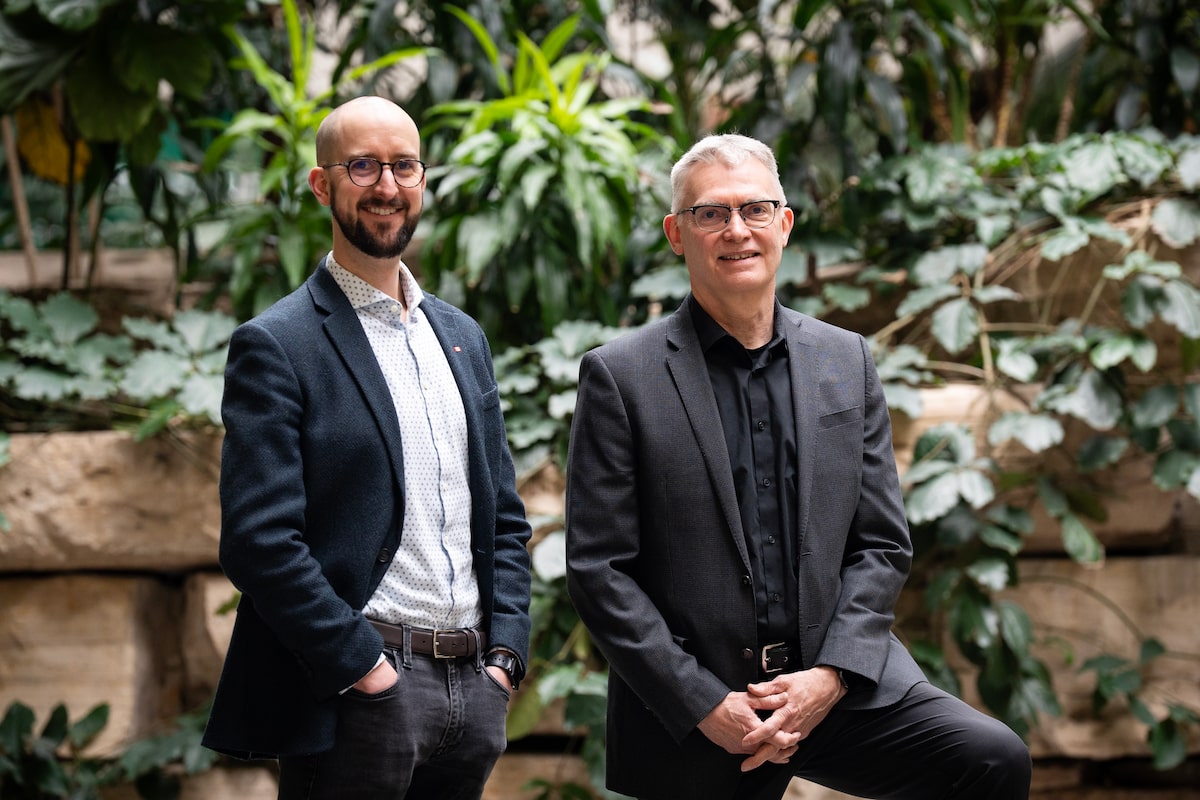
Co-founders of Kavenex Energy, Adam Le Dain and Brad Allison, at the company headquarters in Calgary.Todd Korol/The Globe and Mail
A Calgary-based startup has attracted sizable private investment for its plans to drill for geological hydrogen, a carbon-free resource its founders say has the potential to provide major energy and climate benefits for Canada.
Kavenex Energy is working to nail down its first target sites, where it could begin drilling in 2027 or 2028. Its long-term strategy calls for production of hydrogen in various parts of the country, using tried-and-true techniques developed over decades for oil and gas.
Under its strategy, “off-takers” such as power plants, steel mills and ammonia facilities would be located atop hydrogen pools to make use of the gas, rather than requiring long-distance transport. However, the search for natural hydrogen buried deep underground is still in its embryonic stages in Canada.
Adam Le Dain, Kavenex’s co-founder and vice-president of finance and corporate development, said the search for geological hydrogen currently counts as frontier exploration, but if it’s successful the gas could play an important role in the transition to clean energy, while employing scientific and technical skills that many workers across the country already have.
The other potential benefits include economic development involving an inexpensive primary energy source and fertilizer feedstock that do not contribute to climate change or require government subsidies, Mr. Le Dain said in an interview.
B.C. pulp mill puts green hydrogen to the test
He and Kavenex president and fellow co-founder Brad Allison have moved the company’s activities beyond the initial resource scoping stage, and their staff are into the geoscience and geophysical work that precedes drilling.
“We’re just starting to collect more precise proprietary data that’s hydrogen focused, and that is our step prior to drilling wells to validate the thesis and kind of kickstart the full resource delineation and commercial production process,” Mr. Le Dain said.
So far, privately held Kavenex has raised $28-million for its exploratory efforts, and has signed a partnership deal with Denver-based Koloma Inc., a leading hydrogen explorer, to employ some of its knowhow within Canada. Koloma has secured more than US$400-million from such investors as Breakthrough Energy Ventures, Khosla Ventures, Mitsubishi Heavy Industries and United Airlines.
Mr. Le Dain declined to name the venture capitalists and strategic investors backing the company, though he said they are comfortable with the risks and are willing to be patient as exploration proceeds.
Before establishing Kavenex last year, he worked in such fields as energy investment banking, private equity and clean tech. Mr. Allison was previously senior exploration executive at Husky Energy Inc., which was acquired by Cenovus Energy Inc.
Kavenex is among a number of companies looking to develop commercial volumes of hydrogen from geological formations, rather than the more common, and carbon-intensive, method of producing it as a product of oil and gas processing. It can also be produced from water through electrolysis, which does not emit carbon but is costly because of its high energy use.
Renewable energy deals dry up in Alberta as Nova Scotia takes the lead, report says
Natural hydrogen is a product of water interacting with iron-rich rocks that are billions of years old or uranium undergoing radioactive decay, and Canada has high potential. About half of the country is Canadian Shield, and accumulations there are possible, said Daniel Coutts, a research scientist with the Geological Survey of Canada. The rocks are of the age and type that could generate hydrogen, though those areas are still virtually untested.
Sedimentary basins, where natural gas has been produced, have a higher likelihood of hydrogen, especially deep below or on the edge of known gas pools, he said. That would include Alberta, Saskatchewan, parts of Manitoba and the Northwest Territories, as well as Quebec and the East Coast.
There have been some positive early signs. Saskatchewan-based MAX Power Mining Corp. said early this year that its first well, drilled 140 kilometres south of Saskatoon, confirmed the presence of natural hydrogen in a geological system known as the Genesis Trend. It began drilling a second well at the end of February.
Mr. Le Dain said the principals formed Kavenex because of what they see as a chance to build an industry that could offer significant new economic benefits, as oil and gas did in the 1900s.
He said there are few other sources that have hydrogen’s prospects, other than, perhaps, nuclear. “But after that, I think this deserves to be in the same conversation in terms of it as having the potential to make a globally relevant difference from a CO2 perspective,” he said.