
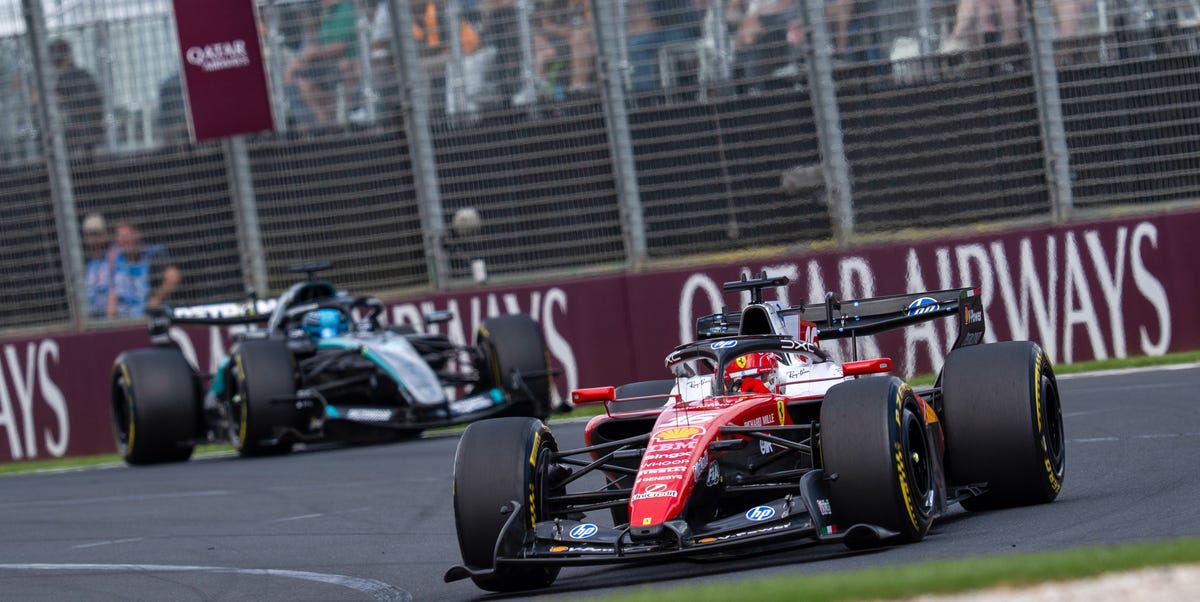
There were 120 overtakes in Sunday’s Grand Prix vs. 45 last year, and an increase of 266%, but they mean something different now. With an increase of that much, it’s clear that this and many other metrics won’t be exactly helpful in creating quantified comparisons as well as a true eye test.
The first 15 laps of the 58-lap Grand Prix felt the most wild and different from the last era. At lights out, Charles Leclerc rocketed from fourth to first, expected with Ferrari figuring out the starts in the new cars faster than the other 10 constructors.
Lights out happened fast, not as fast as Oscar Piastri DNS’d his home race, but fast. In his podium interview, Leclerc commented that the FIA starter was a bit cheeky, throwing the lights out as early as possible, knowing the teams were adjusting to the new start-up procedure.
“I think the person that is switching off the lights has been quite cheeky,” Leclerc said. “So, I think that played a little bit into our hands.”
The first pole sitter and winner of the new era, George Russell, lost the lead four times, with Leclerc and him trading positions through the opening laps. But the passes for position all came when the driver in the back was able to attack with their aero boost while the lead car was depleted and recharging their battery, a give and take.
The reigning champion, Lando Norris, finished fifth and battled in the closing laps with Max Verstappen, who finished in sixth as the last car on the lead lap after starting 20th. Norris told the media following the race that he felt the passes were ‘artificial’.
“[V]ery artificial depending on what the PU decides to do and what it randomly does at times,” Norris said.
Norris added safety concerns to the new overtake boost as the grid learns its limitations.
“Depending on what people do, you can have a 30, 40, or 50 kph speed difference. So when someone hits another car at that speed, you’re going to fly, and you’re going to go over the fence, and you’re going to do a lot of damage to yourself and maybe others. That’s a pretty horrible thing to think about.”
Norris’ feelings were shared with Leclerc during the podium round table, and as the driver who used the new tool the most efficiently, agrees that it changes things, but in a way he believes the competition will adjust to.
“I kinda agree, it will definitely change the way we go about changing and overtaking. Before it was more about who is bravest at breaking the latest, maybe now, there’s a bit more of a strategy mind behind every move you make, because every boost button activation, you know, you’re going to pay the price big time after that. So you’re always trying to think multiple steps ahead to try and end up eventually first, but it’s a different way to go about racing for sure.”
As we go through an era change at F1, it’s important that with every metric we’re now comparing apples to oranges, and at the start, it’s easy to moan and complain about how different the oranges are.
A common complaint, seen countless times online, is ‘the passes are only happening because of battery saving and active aero’, vs. ‘the passes are only happening because of DRS’. As the year and the era go on, we’ll remember we’re still talking about fruit, slightly smaller, less reliable, fruit.
With three straight weekends of Grands Prix, the grid, the media, and the fans will have ample opportunity to learn the new systems and, more so, the best way to evaluate what’s happening lap to lap and race to race. Early on, it seems the cars’ instability will lead to greater parity. In race one, we saw eight teams in the points. Now all 11 teams get to work on fixing their own unique issues, mitigating the new risks, and building speed.
Related Stories
Victoria Beaver is a nomadic sports writer who spends her time hopping between race tracks and hippie farms. She’s covered every corner of motorsports that will let her in from 410 Sprints to NASCAR to Supercross. Her daily driver is a 2010 Subaru that she refused to do the smallest amount of preventative maintenance on. Instead, she spends her free time and money building a 42-foot Skoolie to one day travel the country full time.