
Get the best of Vancouver in your inbox, every Tuesday and Thursday. Sign up for our free newsletter.
As famously kitsch-cool as Vancouver’s Waldorf Hotel might be, the East Side venue in many ways remains one of Vancouver’s enduring mysteries. How has one of North America’s original tiki locales flown under the radar for large stretches of its post-1950s existence—often under-utilized and arguably under-appreciated by the city it calls home?
On a surface level, that once again seems to be the case today. To drive by the Waldorf is to note that the marquee out front promises nothing more than a burger and beer for $19” at the hotel’s streetfront Howe Sound Taphouse & Kitchen. Log on to the Waldorf website and you get an “Upcoming Events” page reading “no events at the moment”.
That lack of nightly activity is on brand for anyone who has followed the Waldorf over the decades.
One of the first temples of tiki in North America, and boasting three distinct Polynesian-themed rooms, the space has moved in and out of the spotlight over the years. That has a lot to do with the way the neighbourhood around it has changed, suggests Vancouver historian and author Aaron Chapman. When the hotel was built in the ’50s, there were families and houses in the area. That shifted when rezoning reshaped the East Van neighourhood as an industrial pocket.
“As the patrons have come and gone, it’s kind of amazing that it’s still there, because it could have easily been sold and demolished multiple times,” Chapman tells the Straight. “But it’s hung in there while so many other great places downtown—like the Cave—didn’t.”
A faux-exotic hotspot in the ’50s and ’60s, the Waldorf was largely forgotten in the disco-obsessed ’70s—a suddenly kitsch-uncool relic from a bygone era located in an industrial part of town. Vancouver rediscovered the magic of the Waldorf during the ‘90s lounge boom, and then it faded back out of sight, until a group headed by local legend Tom Anselmi reimagined it as a much-loved cultural hub in 2010.
That most recent golden era ended instantly in 2013, when the Waldorf was put up for sale and then purchased by the Solterra Group of Companies, which develops condos. The sale sparked a massive public outcry, leading Solterra to state that it had no intention of demolishing the three tiki venues in the Waldorf.
Following that, things again went quiet for a stretch until the launch of the Tiki Bar, a retro-minded 2018 cocktail program featuring Polynesian classics like the mighty Mai Tai. Briefly, the Waldorf once again became a modern-day destination for tiki enthusiasts, with imbibers making the pilgrimage to experience a room famous for its towering palm trees, bamboo bar, black velvet Edgar Leeteg paintings, and a twinkling-light-studded starscape ceiling.
And then the world shifted overnight, with lasting implications for everyone.
The Waldorf Tiki bar, which comes complete with fake palm trees and black velvet paintings by Edgar Leeteg.
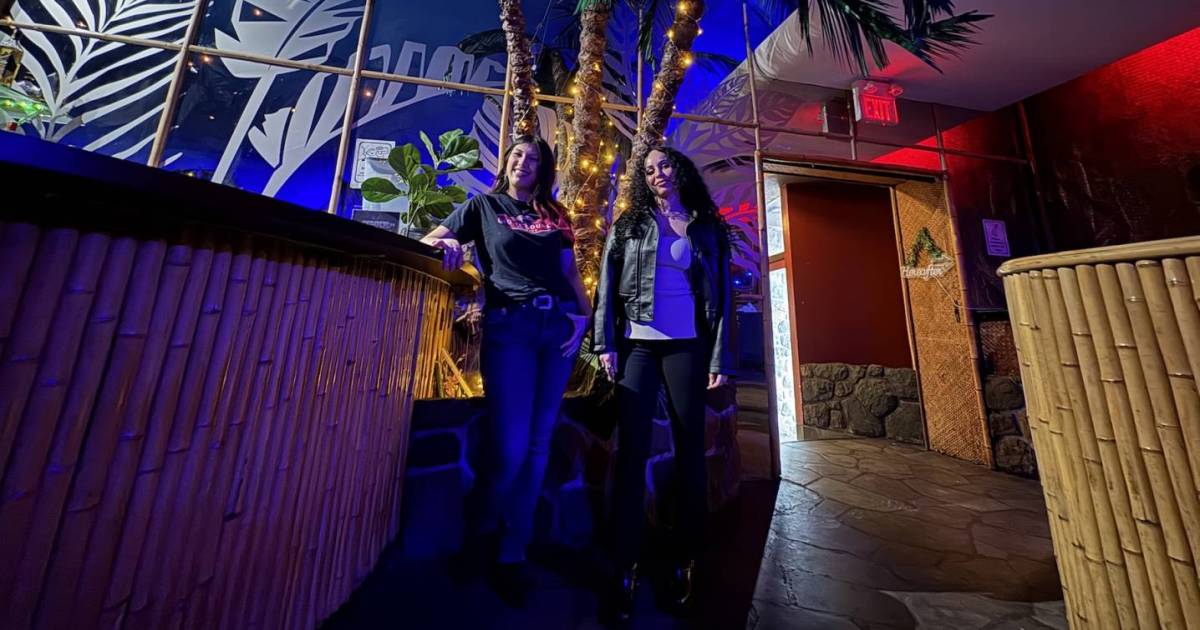
IT’S A RAINY weekday morning, and the Straight is at the Waldorf with Sara Nokhaili, who heads up group sales and events with Viaggio Hospitality Group, which currently manages the Waldorf. At her side is Junita Thiessen, general manager of Howe Sound Taphouse & Kitchen, which serves as the Waldorf’s streetfront business.
“COVID-19 was a huge blow,” Nokhaili says. “With the pandemic, obviously, they had to shut down the hotel and tiki rooms. And then I believe, after the pandemic, they were closed for two or maybe almost three years.”
Since then there have been changes. Most notably, the Howe Sound Taphouse & Kitchen replaced the former Nonna’s Table Pizzeria & Restaurant in 2023. The Waldorf’s inner tiki rooms continue to stay largely untouched since original owner Bob Mills built his dream shrine to Polynesian culture in the mid-1950s.
Magnificent as those rooms are, as the world returned to normalcy, Vancouver once again seemed to forget about the Waldorf post-COVID.
“I think that was partially because of our location as well,” Thiessen says. “We don’t have the foot traffic. So a lot of business that we have had over the past two years has been people who live in the community who have started to hear about us.”
While the hotel’s street-front Howe Sound brewery is indeed open for business—pizza, burgers, and beers draw nearby workers from the area—Thiessen and Nokhaili acknowledge the perception that the locale’s fabled tiki rooms are sitting dark and unused. In fact, they say the opposite is true. It’s more that you have to be in the know, rather than just dropping by unannounced the way you would at, say, the Shameful Tiki on Main.
On that front, Nokhaili wants to send Vancouver a message: at the moment, the Waldorf isn’t programming its own events, be that launching cocktail, music, or burlesque nights. Instead, it’s currently hosting events from outside groups.
“We do have a vision of reopening to the public,” Nokhaili says. “But for now, we’re just happy with hosting private events and just being a part of anyone’s celebration. Basically, that can be birthday parties, reunions, wedding receptions, or, really, any event that you think can be hosted.”
So, if you can dream up something you’d like to do at the Waldorf, the fabulous tiki rooms can be your blank canvas. All you have to do, she continues, is reach out with an inquiry, and then start spreading the wordto family, friends, or your fellow Vancouverites. Indeed, from beer-soaked crust-punk concerts with the legendary Dayglo Abortions, to tropical-themed theatre experiences, to burlesque extravaganzas, the Waldorf is actually often anything but empty most weekends.
“The first shift I ever worked in the clubs downstairs, they got me to work one of the fetish nights, and I didn’t know that there was going to be naked butts,” Thiessen says with a laugh. “ ‘Like, what the heck?’ It’s very funny to be shaking a cocktail while someone’s shaking their ass.”
If the walls of the Tabu room could talk, the stories might start with the tale of Travis Scott rolling up to play a show in 2014.
OVER THE COURSE of its history, the Waldorf has had plenty of legendary highs. An on-the-cusp-of-stardom Travis Scott played the spot on New Year’s Eve in 2014, famously starting out a sweat-drenched and now fabled set by screaming, “Nobody chills in the back!!!!!”.
EDM superstar Skrillex camped at the Waldorf during a three-day residency in 2012, working on a film soundtrack in a recording studio run out of the basement, and mixing drinks for staff in his downtime. Superstars like Katy Perry and the Black Keys made sure to stop by while in town. Local art stars like Douglas Coupland and Rodney Graham made for celebrity sightings.
The attraction of the Waldorf didn’t start in modern times.
Iconic Vancouver impresario Hugh Pickett was a frequent flyer in the ’60s, bringing young breakouts like comedian Phyllis Diller and actress Angela Lansbury to the Moderne-style hotel, built in 1948 by hotelier Bob Mills and designed by Mercer & Mercer Architects.
The Waldorf quickly became a community hub, even as—after zoning changes—the area’s turn-of-last-century residential houses started to be knocked down for commercial and industrial buildings that dominate the area today.
A big draw was the Waldorf’s contribution to the original tiki boom, which started with Canadian and American soldiers returning to North America after being stationed overseas in the South Pacific. With their over-the-top Polynesian decor and exotic drinks, iconic spots like the Tonga Room & Hurricane Bar in San Francisco, Hala Kahiki in Chicago, and Don the Beachcomber in Los Angeles offered an immersive taste of Hawaii without having to get on a plane.
The Waldorf was in that first-wave boom.
Heritage Vancouver describes the early evolution of the hotel as follows: “In 1954-55 the same architects [Mercer & Mercer] modified and expanded the building to accommodate the now famous “Tahitian Cocktail Lounge” (Tiki Lounge), an additional lounge, a descending spiral staircase, a restaurant and six more hotel rooms. The Tiki Lounge features a midnight blue half-domed ceiling reflected in a wall of mirrors to complete the illusion of a night sky, with inset twinkling star-lights. The effect is heightened by fake palm trees, bamboo matting, floral carpets, and a series of superb black velvet paintings, by Edgar Leeteg (1904-1953) the artist who invented the genre. The same attention to detail was lavished on the Polynesian décor in the Cabaret Room. Exotic Polynesian scenes, in the murals created by the well-known artist Peter Hopkinson, are framed by a colonnade of bamboo-shaped columns and bamboo-covered walls.”
Amazingly, little today has been altered in the rooms, which can be rented out as individual standalone venues. Hopkinson’s dramatic Polynesian murals still adorn the walls of the Tabu room, which has hosted concerts ranging from Vancouver indie upstarts Japandroids to early ’00s anti-pop renegade EMA. With its thatched roof and bamboo support poles, the Hideaway room feels like happy hour in the South Pacific, with the only thing missing being the parrots.
“Why did no one ever come in and go, ‘We’re going to rip this all out?’ ” asks Chapman. “I don’t know. I think it might be because of its location. It’s also sort of existed in, to use the old phrase, ‘splendid isolation’ from downtown Vancouver. That probably helped it avoid the winds of fate that buffeted so many of the other unique places that we had in Vancouver—like Clancy’s Sky Diner, the restaurant you walked into that was supposed to be like an airplane on the inside—when you walked in you saw moving pictures and paintings. Imagine how great that would be to go to today. It’s been gone for decades.”
Given the reemergence of tiki as a cultural phenomenon in North America, one might also wonder why the Waldorf hasn’t been able to capitalize on that the way other Vancouver rooms have. Try, for example, getting a last-minute reservation at Main Street’s beautifully detailed and perpetually packed Shameful Tiki.
“It would be great to see something like the Shameful Tiki happen there,” Chapman opines. “It begs the question of why the Shameful Tiki could do so well on Main, but they haven’t been able to do it there. I’m hoping that the future might answer that.”
Thiessen notes that she interviewed for her position over Zoom. She was floored when she laid eyes on the Waldorf’s tiki rooms for the first time.
“When I saw this place and I took a little tour around, I remember telling my friends that it was like adult Disneyland,” she recalls. “So cool. There’s always another room for you to go into. I’ve been working here for two and a half years and I swear to God, I’m always finding a new space that I’ve never looked in. It’s just a really cool vibe. I love the tiki aesthetic—I think it’s super sick. And I love kitsch. I think we do kitsch very well, but you know, with a little bit more class.”
The Hideaway room feels like happy hour in the South Pacific.
NOKHAILI NOTES THAT the Waldorf’s current management team with Viaggio Hospitality Group is committed to bringing the hotel back to its full glory as an arts and culture mainstay. She adds that, even though it’s used for high-profile film and television shoots, the Waldorf also prides itself on being a space that’s affordable.
“One thing that I need to mention as well, and that’s something that I think is one of our strengths, is that we don’t have a real rental fee,” Nokhaili says. “We have a minimum spend, so that actually works out for a lot of people. We don’t only work with corporate clients—we also work with just regular people who are wanting to celebrate their 50th birthday. With different minimum spends for the different venues here, that’s something that’s hard to find in Vancouver.”
Just as important to the Waldorf is a commitment to inclusivity. That starts with Vancouver’s LGBTQ2S+ community, which often does ticketed events.
“I think of us as a really vibrant spot for a lot of queer events, especially drag events,” Thiessen says. “That’s kind of been our bread and butter over the last two years.”
The Waldorf has also proven an unlikely venue for punk acts like grease-painted miscreants Powerclown, which are normally found in more grimy and dive-like environs.
“We ask of groups the basics—‘Please don’t break anything,’ ” Nokhaili says. “Don’t jump on anything. But I would confidently say, just from experience working at different venues, that we are the most flexible venue in Vancouver.”
And should you want to re-create a time when Don the Beachcomber and Trader Vic were unleashing North America’s first great tiki wave in the ’50s, the Waldorf can help there too, and not just with a period-specific backdrop that couldn’t possibly be more authentic. You provide the vision for your event, the Waldorf will provide the bar staff.
For now, then, this chapter of the Waldorf’s history is being written by those looking to book a place to celebrate, the draw being rooms that are more mind-warpingly unique than, well, pretty much any space you can think of renting in Vancouver.
Chapman thinks that might change, sooner than later. The city, he says, has an enduring treasure tucked away on Hastings Street.
Boding well for the Waldorf’s future is that condos continue to spring up all over a neighbourhood that continues to gentrify. Those moving in will inevitably end up looking for someplace cool to become their favourite neighbourhood haunt. And they’ll do worse than a tropical oasis that’s marked by faux-Polynesian palm trees, revered Leeteg paintings, and tropical bamboo-themed hideaways.
“While it’s interesting to look at the Waldorf’s past, it’s almost a more interesting question now to go, ‘What is that place’s future?’ ” Chapman says. “That area of town has become more residential in the past 10 years. And I think it might spell the future success of a place like the Waldorf.”
In the meantime, he suggests that Vancouver be thrilled that the tiki temple is still there.
“In the 1970s in particular, we didn’t have a great appetite for heritage preservation in Vancouver,” Chapman offers. “We were thinking of getting rid of the Orpheum and a lot of other stuff. Close to the moon landing, people became so excited about the future, so trends toward architecture became quite modern.
“Think of the law courts building,” he continues, “which looks like something that could have been a Stanley Kubrick design. It was like, ‘We’re going to get rid of this neon, and anything else that’s a bit kitschy.’ Why, through that period, one of the best tiki bars in Vancouver, and maybe Western Canada, never got imploded or changed is beyond me. But that’s one of the many things that make it unique. The fact that it’s been retained the way it has makes for a little miracle on Hastings Street.”
The Waldorf has somehow survived over the decades despite being on a stretch of Hastings not known for its foot traffic.