
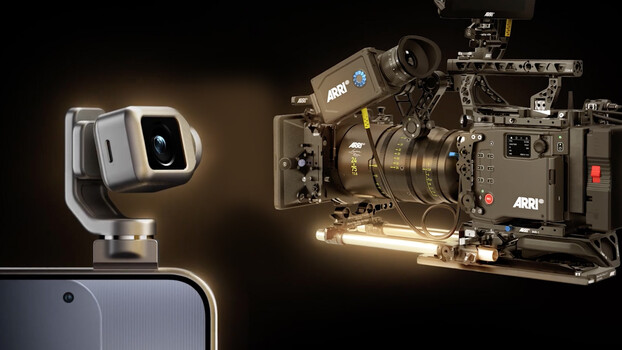
Camera brands collaborating with mobile phone companies is nothing that is particularly new. We saw this with Zeiss, with Leica, and even Hasselblad. But even this collaboration took me by surprise. That is, between Honor and none other than ARRI, with the Honor Robot Phone.
ARRI is responsible for creating some of the best cinema cameras that have been released. If you find yourself on a high-end film or television set, chances are they’re using an ARRI camera, whether it be an Arriflex, if they’re on film, or an ARRI Alexa, Alexa 35, Mini LF, or Mini. For over 100 years, ARRI has been a staple in the professional filmmaking community. But just recently, they announced a partnership with the smartphone company Honor to create a robot AI smartphone. And the initial images and videos took me by surprise. But maybe not for the reason you’d think.
See, it isn’t just about ARRI making this collaboration using their imaging technology in a phone. But this particular smartphone has a gimbal. Yes, you read that correctly, a built-in gimbal on your phone. At the back of the phone, you will see the camera module. In the top left corner of the phone is what looks like a little protector that you can slide, similar to various phone cases that have a camera protector on them. But when you slide this, it’s not a protector but rather a cover for the built-in gimbal. In their press videos and launch media, it looks like the gimbal is not only a filmmaking tool but is also the center of their onboard AI robot assistant, who can give real-time feedback, including nodding the camera yes or no, as well as functioning as a higher-quality, front- and rear-facing camera while also allowing you to do gimbal moves with your smartphone camera.
Think of this now like if you had the stabilized DJI Osmo Pocket attached to your phone. That’s kind of what we’re getting here. Now, while I haven’t personally seen any photo or video samples out of this smartphone, they’re saying they take the imaging technology from ARRI, mixing it with computational photography that you would find in a smartphone to create a theoretically better image. I can attest, having used ARRI cameras myself, to the quality of their cameras and that it is no mistake why the film industry loves them so much.
In today’s evolving digital landscape, many companies have to pivot from the traditional way of doing things. We saw this when RED Digital Cinema was acquired by Nikon, and even ARRI was rumored to be up for sale during last year. So this play at the mobile market might be a way for ARRI to expand their market share and tap into a market that they had otherwise not been a part of.
Prior to this, ARRI exclusively dealt with the professional filmmaking market, offering cameras up to $100,000 as well as many filmmaking accessories that came with an equally high price tag, but nowhere in the prosumer or consumer market would you really see them. That is, up until now with this particular phone.
Now, I would have to take a look at this myself to tell you about the image quality as well as the usability of this, and ultimately if it is a gimmick or if it is a great phone and potentially even better camera.
We have seen phone cameras now being stabilized, although mostly through digital software. But now we are getting real physical stabilization in terms of having that camera on a super-small gimbal. In truth, I’m almost not sure what to think of this, and only time will tell when this phone comes out. But it is very interesting to see and will likely have a lot of cinephiles, who already have a love for ARRI cameras, checking out this phone. I don’t know if it is something that I would personally be picking up, but even so, it is something that I would be interested in checking out, having worked with ARRI cameras before.
Whether gimmick or not, this is an interesting evolution in smartphone technology as well as AI integration. It will be yet to be seen if this is something that stays and continues to evolve the market or if it quickly passes. Regardless, it is refreshing in some ways to see companies pushing the envelope again when it comes to smartphone technology.