

An in-depth analysis of what Edmonton’s new trade acquisitions can bring to the team
At the 2026 NHL Trade Deadline, the Edmonton Oilers acquired exactly three players, and they all came from one team.
Looking at the types of players that the team acquired, it is evident that there was one specific area that Edmonton’s management was keen to address at this deadline: defensive play.
The need was obvious. In nine of their last 11 games, the Oilers have allowed four or more goals. Overall, they rank 27th in the NHL in goals allowed per hour on the season. Of course, a big part of this has been the wildly inconsistent performance of their goaltending, but the issues run far deeper. Per CSA Hockey, the Oilers’ skater group ranks a lowly 28th in the league in scoring chances allowed per hour, and data from Dimitri Filipovic and SportlogIQ paints a similar picture, with the Oilers sitting at 27th in slot shots allowed and 26th in inner‑slot shots allowed as of March 4.
In other words, it can’t all be pinned solely on the netminders.
Keeping that in mind, let’s take a closer look into Edmonton’s trade deadline acquisitions and examine how each player might help stabilize the team in their own end.
*All stats via EvolvingHockey, Natural Stat Trick, PuckIQ, and AllThreeZones
Connor Murphy
For years, the Oilers have needed a top-four right-defenceman for their second pair. With the arrival of Connor Murphy, that hole may finally be filled.
To begin with this analysis, here is a brief overview of some of Murphy’s key underlying numbers:
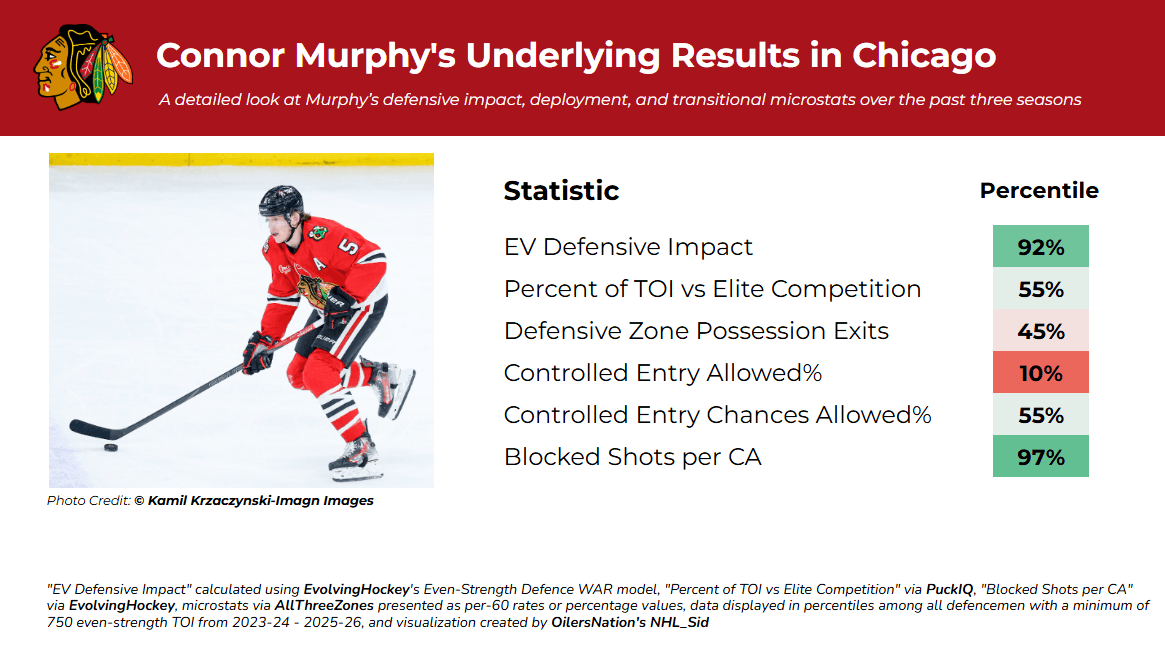
The first number that should stand out here is Murphy’s even-strength defensive impact, which ranks in the 92nd percentile. In simpler terms, what this means is that Murphy’s impact (adjusted for teammates and competition) on suppressing scoring chances is superior to 92 per cent of all NHL defencemen over the past three seasons.
In fact, Murphy’s EV Defence impact ranks third among all defencemen in 2025-26 alone. Not bad.
What exactly makes Murphy so strong defensively is interesting. On the one hand, Murphy’s controlled entry allowed percentage ranks in the 10th percentile. What this means is that Murphy is rather passive at defending the blue line, as opponents are able to carry the puck in on him more often than they can against most defencemen.
However, once the puck does get into the zone, he shuts things down quickly. First, this is evident from the fact that despite the high volume of controlled entries allowed against Murphy, he does not allow a high volume of chances off those entries, ranking above average in that metric. And where he specifically thrives is at defending the cycle.
Murphy is perhaps the textbook definition of an effective “cycle-buster.” Though he may not be the most aggressive entry defender, he is absolutely an aggressive in-zone defender. Murphy is excellent at using his size and physicality along the boards to disrupt plays and break up passing lanes. He is also superb at defending the front of the net and taking away the middle of the ice, as seen by the fact that Chicago sees a significant reduction in slot shots with Murphy on-ice. Even when opponents do manage to get pucks through, Murphy excels at getting in the way, ranking in the 97th percentile in blocked shots per on‑ice attempt against.
In terms of breakout passing, Murphy ranks in the 45th percentile in possession exits per hour over the past three seasons, which is slightly below-average. However, I do think it’s worth noting that his net results are dragged down by his season in 2023-24, and his exit efficiency is much better over the two most recent seasons specifically. All things considered, it is reasonable to say that Murphy is not a spectacular puck-mover, but this is certainly not a glaring flaw either.
In regards to all of these numbers, one may point out that Murphy has primarily played in a third-pairing role this season. Fair. However, Murphy’s overall percentage of TOI spent against elite competition (i.e. opposing top lines) over the past three seasons ranks roughly in the 55th percentile, which is standard for a second-pair defenceman. Furthermore, Murphy spent significant time in Chicago’s top-four in the prior two seasons, and has consistently maintained good-to-great defensive impacts in essentially every season since 2015-16. Thus, the defensive ability to play in a top-four role is absolutely there.
And, not to mention, the Blackhawks currently have the best penalty-kill in the NHL, and Murphy led Chicago with 172 minutes on that PK unit prior to the trade. It’s yet another reflection of his strong in‑zone defensive play.
Overall, Murphy is a true defensive stalwart. On paper, he should be incredibly useful for an Oilers team that can’t keep the puck out of their net.
Deployment-wise at five-on-five, I think the Oilers have a variety of options. Ideally, I believe Murphy would be best suited to play with Jake Walman, who has mightily struggled defensively this season. In fact, among all defencemen with a minimum of 400 minutes at five-on-five this season, Walman ranks dead last in goals allowed per hour. It is important to note that he has dealt with multiple injuries this season, but nevertheless, he could certainly benefit from a stable defensive partner to help him out on his own end. In return, Walman’s puck‑moving strengths would complement Murphy’s game and balance the pairing both ways. In theory at least, they should stylistically pair well.
The Oilers also have the option of deploying Murphy with Mattias Ekholm while Walman is paired alongside Evan Bouchard. Ekholm and Murphy could potentially form a strong defensive shutdown pair, while Walman and Bouchard would be a dynamic offensive pair that could be consistently deployed with Connor McDavid and Leon Draisaitl.
However, I don’t know if it would be best to pair Murphy with Nurse. Stylistically, I believe the ideal partner for Nurse is someone who excels at moving the puck and denying zone entries, which does not fit Murphy’s style. That’s not to say it’s an impossible fit, but I believe Murphy seems better suited next to Walman or Ekholm.
Jason Dickinson
At first glance, Jason Dickinson seems to be a very unimpressive player. He has just 13 points in 47 games with Chicago this season, and in his 11-year NHL career, he has reached double-digit goals just once.
But, offence is not the reason why the Oilers wanted him. What gives Dickinson the potential to be an extremely useful player for Edmonton is his ability as a defensive matchup centre.
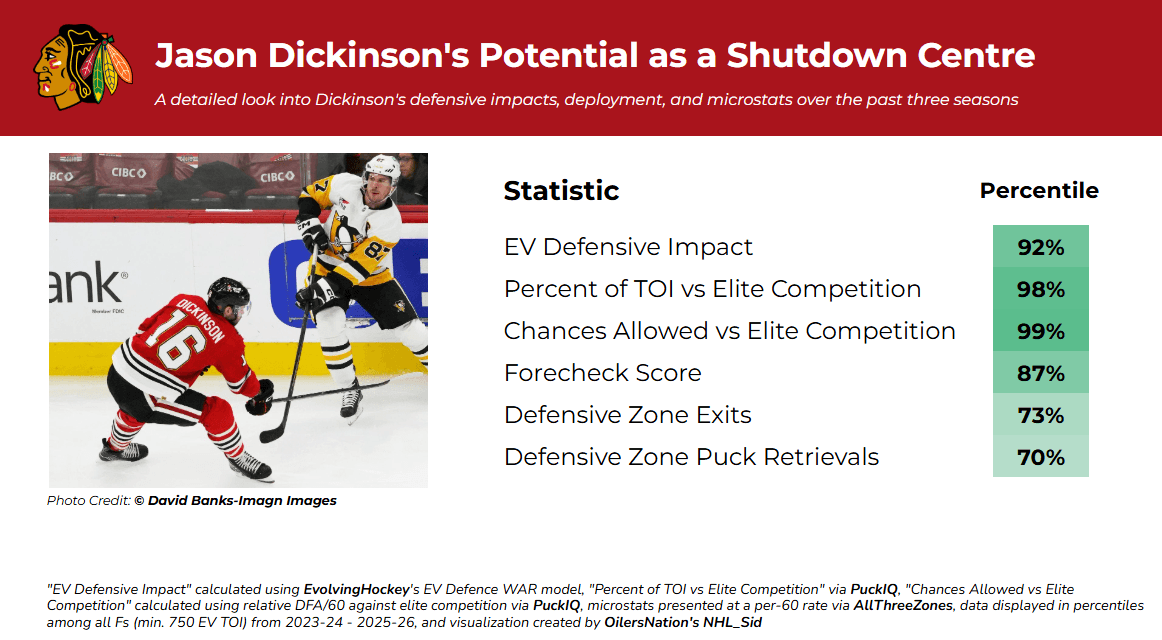
Similar to Murphy, Dickinson’s even-strength defence ranks in the 92nd percentile. And, what might make Dickinson’s results even more impressive is the environment in which he has produced these results.
Over the past three seasons, Dickinson has spent more than 41 per cent of his five‑on‑five minutes matched against elite competition. That’s the ninth‑highest rate among all NHL forwards, ahead of stars like McDavid, Draisaitl, and MacKinnon, as well as perennial Selke candidates such as Hischier and Cirelli.
It manages to get even better when you look at his results specifically in the minutes against elite competition. He ranks second among all forwards in suppressing dangerous shots relative to his teammates. Take note that this isn’t just some small-sample fluke either; this is 993 TOI, almost a full thousand minutes spent going head‑to‑head with the best players in the league and limiting their chances.
Stylistically, Dickinson excels in a variety of areas. He’s an effective forechecker who can force turnovers and retrieve dump‑ins, helping his team sustain pressure and spend less time defending. He’s also strong in his own end, consistently winning battles, recovering loose pucks, and moving the puck out of the zone with success. Like Murphy, he also adds even more physicality and uses his stick well to disrupt the cycle, and was a big part of Chicago’s fantastic PK unit.
In terms of deployment, the most obvious way to deploy him is as a matchup centre against opposition top lines, exactly the role he handled in Chicago. Vasily Podkolzin, a strong defensive winger and relentless forechecker, looks like a natural fit beside him, and the two were already used together in Dickinson’s Edmonton debut. In theory, a dedicated matchup line built around those two could help stabilize Edmonton defensively and free up Connor McDavid and Leon Draisaitl to start more shifts in the offensive zone against weaker competition.
Note that McDavid’s line away from Draisaitl this season has only been a modest net positive this season (+2 goal differential). I don’t think quality of competition is the main culprit, but weaker matchups could, in theory, be beneficial. Per PuckIQ, McDavid has averaged 2.9 goals per 60 against elite competition in the past two seasons, but that number is at 3.2 against the “middle” competition tier, and an even better 3.9 against the “gritensity” competition tier. In addition, Draisaitl’s possession results against “gritensity” have been outstanding in 2025-26 (62 DFF%). And so the addition of Dickinson may not only improve the team defensively, but also potentially increase the offensive output of their superstars.
There’s also the option of using Dickinson on the wing. If there is ever a time that McDavid or Draisaitl’s lines are bleeding goals against, I could absolutely see Dickinson slot in nicely on one of their wings. For example, on paper, a Dickinson – Draisaitl – Roslovic line could fare well, where Roslovic is the offensively minded complementary winger and Dickinson the defensive.
With all of that in mind, I believe that the extent to which Dickinson has success in Edmonton will be heavily impacted by coaching. The list of new forwards that have come into Edmonton and seen a decline in their performance continues to increase, with Andrew Mangiapane the most recent example. Sure, Mangiapane had seen a significant decline in his production ever since his shoulder surgery, and so it can’t all be blamed on coaching. However, Mangiapane also had strong defensive results in his final seasons with Calgary and with Washington, and yet he wound up having a -17 goal differential at five-on-five with Edmonton.
Dickinson is certainly a much stronger defensive player than Mangiapane, and stylistically, he’s the type of forward Kris Knoblauch may appreciate compared to someone like Jeff Skinner, for example. Nevertheless, the concern remains for me.
My fear is that Knoblauch won’t use Dickinson in the role he’s actually built for, slotting him in as another run-of-the-mill bottom-six forward instead of leaning into his true potential as a matchup centre. And if his linemates are shuffled around every other night, as has often been the case with the forward lines this season in general, it will certainly be difficult for him to build any chemistry or establish a consistent role in Edmonton. I strongly believe there is real upside here for Dickinson to become a legitimately useful piece for the Oilers, but if not utilized properly, he may not be much more than a forgettable depth player.
And so, Dickinson’s performance in Edmonton will be a big test for this coaching staff. It will be a measure of whether they can actually get the most out of their players.
Colton Dach
The third player that Edmonton acquired is 22-year-old forward Colton Dach, drafted in the 2nd round of the 2021 NHL Draft by Chicago. Having played 79 games in his NHL career thus far, I think the graphic below is an accurate summary of his NHL performance thus far:
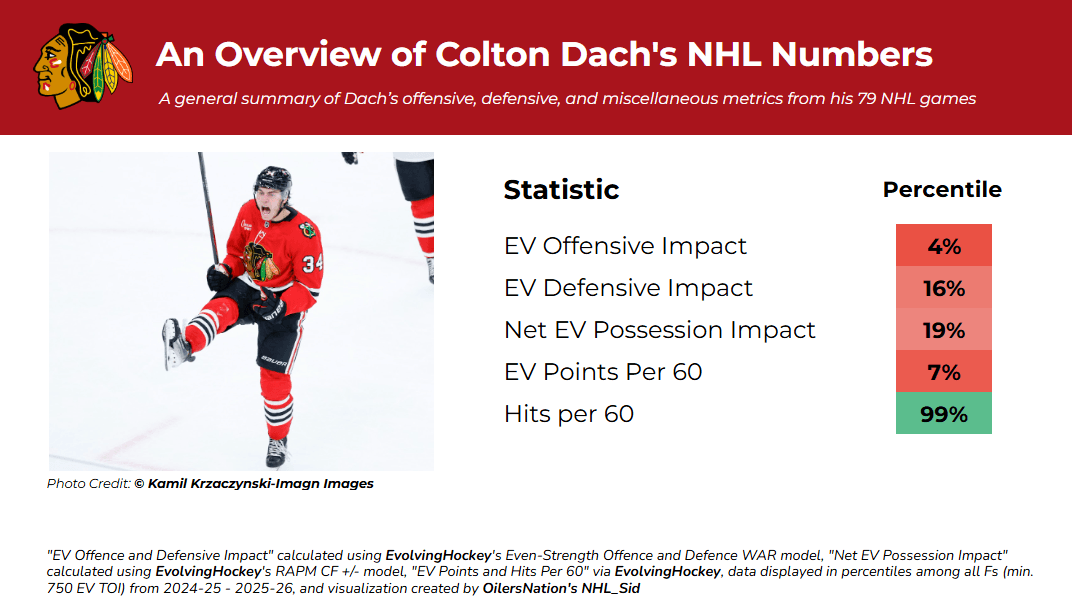
Overall, Dach’s offensive and defensive numbers at the NHL level are well below average. With a team-worst 37 per cent expected goal share, the Blackhawks have been hemmed into their own zone at even worse rates with Dach on-ice, and his production hasn’t anywhere near enough to make up for it.
He hits a lot and… yeah, that’s pretty much been it so far.
Will he make an impact in the NHL this season? I’m highly skeptical. A stint in Bakersfield is probably the best path for him right now. Still, after watching the team’s current bottom-six post a worse goal differential than the teams iced during the Peter Chiarelli era, it’s not the worst idea in the world to give Dach a brief look on Edmonton’s fourth line for a few games just to see what he could bring on a better team.
ARTICLE PRESENTED BY bet365