
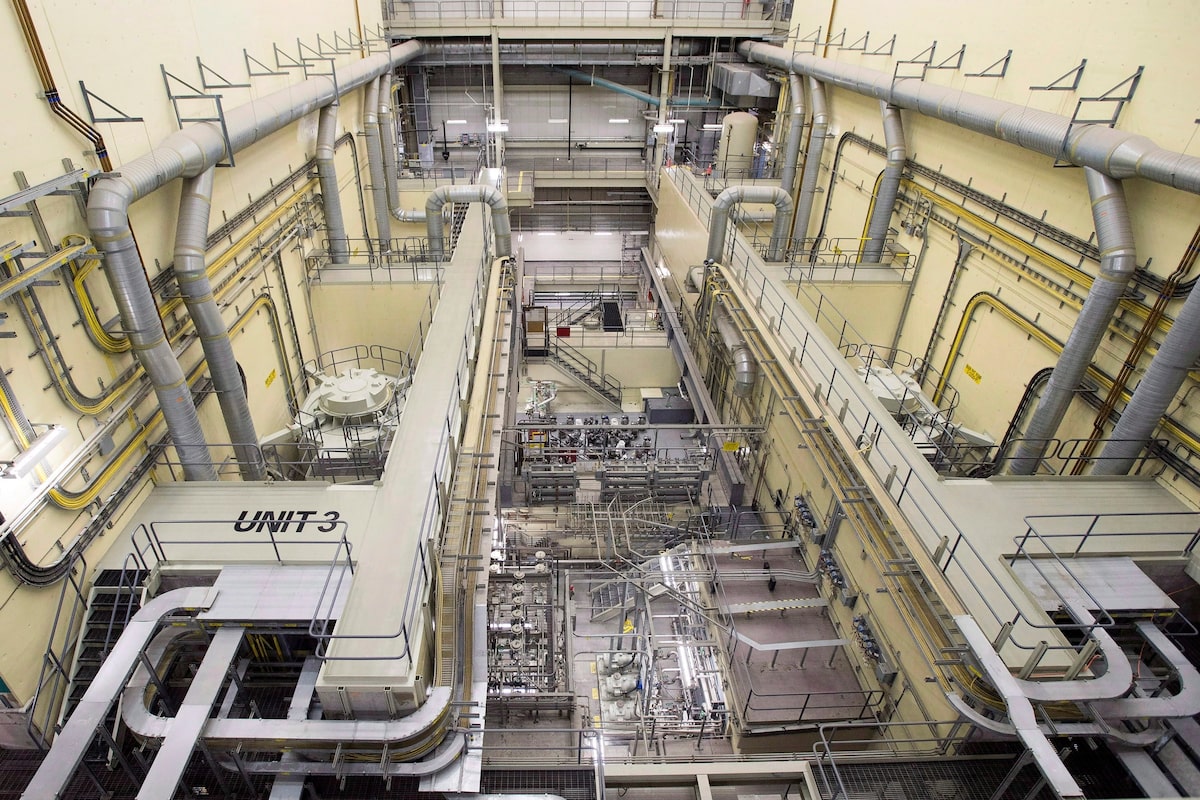
Reactor number 3 at the Darlington nuclear facility in Courtice, Ont.Frank Gunn/The Canadian Press
In the nuclear industry it is practically gospel: Canada isn’t populous or wealthy enough to purchase a smorgasbord of different nuclear reactors. Yet after years of lukewarm efforts by Canadian utilities and governments to reach a consensus on which ones to buy, there are few indications that one is emerging.
In January, Saskatchewan’s government announced it had begun evaluating large nuclear reactors for potential deployment. Jeremy Harrison, a minister whose responsibilities include the Crown-owned SaskPower, said the utility will study the readiness of reactors to be built, vendors’ ability to support licensing and construction, and their track record of executing previous projects.
Ontario’s utilities have been asking similar questions for several years. In 2023 Bruce Power began hunting for a reactor for Bruce C, a proposed four-unit station at its facility near Tiverton, Ont. Ontario Power Generation recently began its own search for a huge plant dubbed Wesleyville, planned in Port Hope, Ont.
Observers have long warned that given Canada’s population and economy, utilities, private developers and provinces must co-ordinate procurement of reactors – an approach sometimes dubbed “fleet-based deployment.” But it hasn’t arrived yet.
Indeed, among those few proponents that have publicly committed to specific models, at least three have already wavered on their decisions. The situation underlines how tentative plans for nuclear expansion in Canada remain, even as governments forecast spiking demand for electricity in the immediate future and consider their options for generating that power.
Natural Resources Minister heads to Poland to promote Canada’s nuclear energy expertise
All 25 reactors built in Canada during the 1960s through the 1990s featured Canada deuterium uranium (Candu) technology developed by Atomic Energy of Canada Ltd., a Crown corporation. One benefit was that later Candus, such as those at the Bruce B and Darlington stations, proved significantly more reliable than earlier ones in that they suffered fewer outages. Similar dynamics applied when those stations required midlife overhauls. Another advantage was that utilities could share operational experience through the Candu Owners Group (now known as Conexus Nuclear).
By the time the federal government began promoting small modular reactors (SMRs), though, the Candu’s monopoly seemed precarious, and international vendors arrived promoting early-stage designs. In 2018 the government published a “roadmap” for SMRs, recommending stakeholders settle on a small number of finalized designs.
Jeremy Whitlock, a nuclear consultant and adjunct professor at McMaster University, wrote in an e-mailed response to questions that fleet-based deployment is vital for nuclear. “There is simply not enough infrastructure, resources, and (currently at least) work force to support multiple lines of technology,” he wrote.
A report released in February by Clean Prosperity, a Toronto-based energy and climate policy think tank, asserted that one necessary precondition for nuclear expansion is that all proponents converge on three designs at most: one “large” design with a capacity of 1,000 megawatts or more (enough to power a large city), one “small” reactor with an output around 300 megawatts, and one “micro” reactor putting out less than 20 megawatts.
Opinion: How will free-spending Ford pay for Ontario’s $400-billion nuclear plans?
Brendan Frank, Clean Prosperity’s head of policy development, said a first-of-a-kind reactor is far too expensive; the industry needs to learn how to build subsequent units more cheaply to compete with other generation options. “Your chances of doing that are significantly higher if you build the same reactor design over and over and over again,” he said.
The BWRX-300 from U.S.-based GE Vernova Hitachi Nuclear Energy has seemingly emerged as the lone contender among the larger SMRs. Yet only OPG has committed to build one.
As for large and micro-reactors, no firm orders have been placed in Canada. However attractive fleet-based deployment might seem, it might be difficult to achieve. Selecting a model has numerous implications, from securing a fuel supply to managing the resulting waste; what’s best for Ontario mightn’t seem so for Saskatchewan or New Brunswick.
Nuclear power is among the few generation options that has grown more expensive, and eliminating pricing competition by sourcing from a single reactor vendor won’t help.
Options are limited. AtkinsRéalis Group Inc. ATRL-T, the company which purchased Atomic Energy of Canada’s reactor business more than a decade ago, is developing an updated 1,000-megawatt Candu dubbed the Monark. Its most significant home-court advantage is that utilities and their workers are already familiar with operating and maintaining Candus. Moreover, its supply chain is on Canadian soil, an appealing feature amid surging economic nationalism. Its greatest vulnerability might be its readiness: The Canadian Nuclear Safety Commission says it has not yet begun a preliminary assessment of the Monark, known as a vendor design review.
AtkinsRéalis, Turkish company to explore building Candu reactors
The CNSC reviewed the Monark’s most obvious competitor more than a decade ago. It concluded there were “no fundamental barriers” to licensing Westinghouse Electric Co.’s AP1000. Although AP1000s have been built in China and the U.S., the American projects suffered disastrous setbacks during construction. Souring Canada-U.S. relations further diminish the AP1000’s appeal.
GE Vernova Hitachi, which designed the BWRX-300, faces similar obstacles in marketing its larger Advanced Boiling Water Reactor. Dark horses include the European Pressurized Reactor, a French design, and the South Korean APR-1400.
If fleet-based deployment is to succeed in Canada, Ontario appears to be the most credible co-ordinator. Between Bruce C and Wesleyville, it might purchase up to 14 large reactors.
Neither OPG nor Bruce Power specified reactors in their regulatory applications, which are intended to encompass a variety of options. Bruce Power’s chief operating officer, James Scongack, said since late 2023 his company has sought information from reactor vendors, a process intended to ascertain which reactors are ready to be constructed and at what cost. The process “was really designed to look at what are all the technologies available for new nuclear, assess them, review them, narrow them down,” he said.
Citing confidentiality agreements, Mr. Scongack declined to discuss which ones had emerged as front-runners. But “we’re now very focused on options that would not be a surprise to you.”
The Ontario government announced last summer a body called the New Nuclear Technology Panel, composed of senior executives from OPG, Bruce Power and the government, and instructed it to co-ordinate a technology selection decision. But the panel has not been established, and there is no timeline for doing so.
Lately, Ontario Energy Minister Stephen Lecce has spoken emphatically about the importance of promoting Canadian technology and supply chains – comments suggesting strong support for Candus.
“My first preoccupation is: What is going to advance the national interest of Canada in a post-Trump world,” he told The Globe in late January.
Opinion: Canada needs to step up. We need Candu nuclear technology
“We need to be fiercely protective of our intellectual property, of Canadian technology for Candu, a large-scale [reactor] that is made in Canada, stored in this country, a supply chain that is Canadian, a work force that is mature and Canadian.”
But a different champion could emerge in Saskatchewan. As far back as 2022, SaskPower selected the BWRX-300. Yet just two years later, SaskPower announced it had signed an agreement with Westinghouse to evaluate other models including its AP300, a direct competitor.
That sudden interest in Westinghouse didn’t come out of nowhere. The uranium giant Cameco Corp. CCO-T, based in Saskatoon, is one of the province’s most influential companies. In 2023 it purchased a 49-per-cent stake in Westinghouse.
Mr. Harrison said the AP300 is no longer under consideration, and SaskPower confirms it’s planning to announce a proposed site for building BWRX-300s later this year. But SaskPower won’t make a final investment decision until at least 2029, leaving plenty of time to pivot again.
And that’s one reason Saskatchewan’s decision to explore large reactors could be highly significant. Mr. Harrison said the province is prepared to go its own way. And while SaskPower will consider candidate reactors on their merits, he added that local companies’ interests are an important consideration.
“We are really very, very proud of Cameco, a great Saskatchewan company,” Mr. Harrison said. “To be a 49-per-cent owner of this iconic American company, Westinghouse Electric, is really a quite an amazing story for a company that began life as a Crown corporation.”
He added: “Without question, benefits to the supply chain in Saskatchewan is a part of the consideration. We’ve been very upfront about that.”
Energy Alberta, a nascent developer with a long-standing proposal to build a four-reactor plant in Peace River, Alta., offers perhaps the most striking example of indecision. It had selected the Monark, but late last year announced it was considering Westinghouse’s AP1000s instead.
New Brunswick selected two reactors for construction at its Point Lepreau station nearly a decade ago. But neither the ARC-100 nor the SSR-W appear to be nearing a completed design; their vendors (ARC Clean Technology and Moltex Energy Canada, respectively) have few employees and have struggled to raise capital.
NB Power’s chief executive officer, Lori Clark, said her utility remains committed to building reactors. But it has come around to fleet-based thinking: it no longer wants to build a first-of-a-kind, or one-of-a-kind, reactor, because they are inevitably costlier. Provincial officials have expressed interest in a variety of different reactors over the past year, including the BWRX-300, AP1000 and Candu.
“We want to watch what’s happening in Ontario, because they are much bigger player in the nuclear field than we are.”