
Summary
The Norwegian company Marinvest Energy AS wants to build Canada’s third largest LNG export facility on the shores of the St. Lawrence River in Quebec
The company has a non-disclosure agreement with Ottawa which prevents discussion of the proposal with “officials outside the federal government”
Quebec is an ideal location for ships headed to Europe, but a similar proposal was rejected in 2021 over concerns about risks posed to Indigenous communities and the environment
We’re trying out staff-written summaries. Did you find this useful? YesNo
As the war in the Middle East escalates and oil and gas prices surge, a secretive liquefied natural gas (LNG) project proposed for Quebec is steadily advancing.
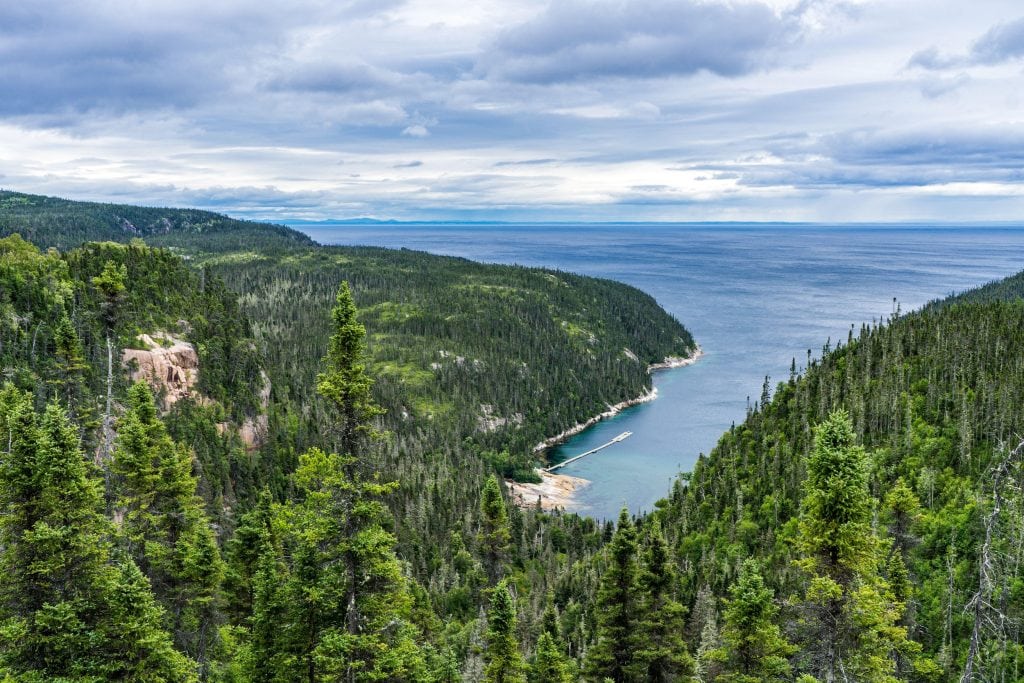
The LNG project would ship liquefied gas from the deepwater port of Baie-Comeau, a small city on the shores of the St. Lawrence River, to global markets.
The project would require a new pipeline — through a small portion of northern Ontario and a swath of Quebec — to send mostly fracked gas from Western Canada to Baie-Comeau, in the province’s Côte-Nord region.
But you won’t find any information about this major resource project on the website of Marinvest Energy AS, the Norwegian company behind it.
Nor will you find any information about the Baie-Comeau LNG project on any federal government website, even though access to information documents reveal Prime Minister Mark Carney’s Liberal government has established a multi-departmental “deal team” to facilitate the project.
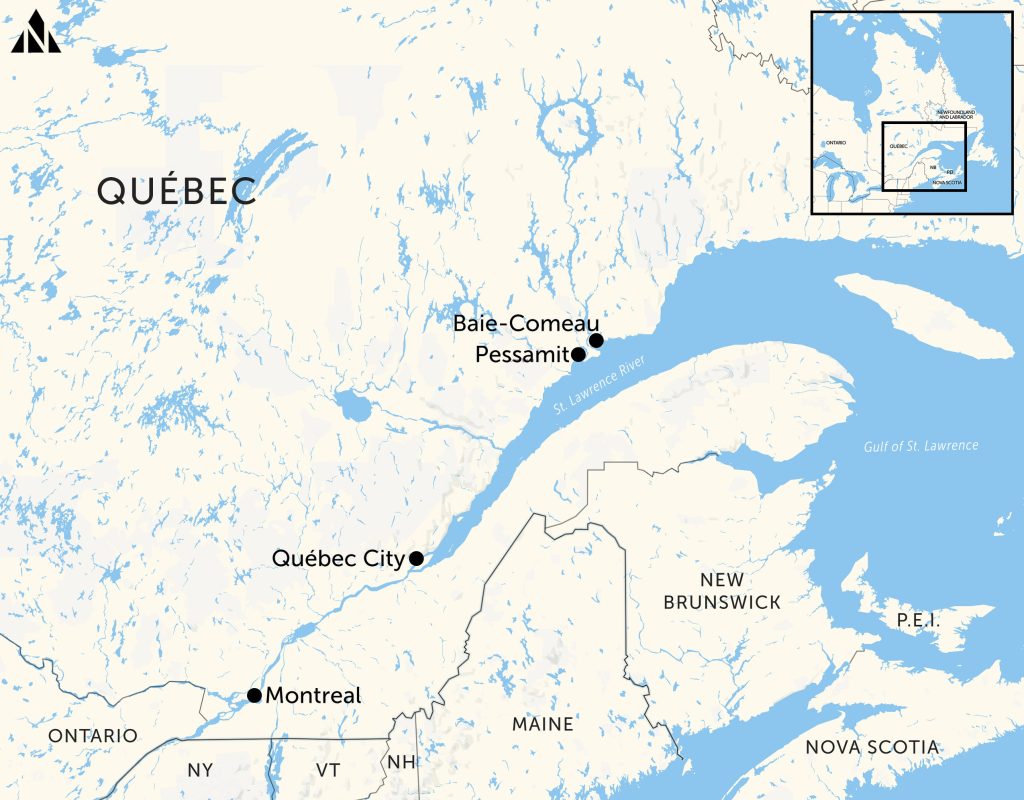 Baie-Comeau is a small Quebec city where a Norwegian company wants to build an LNG export facility. In 2021, the Quebec government rejected a similar proposal, unconvinced the benefits outweighed risks such as threats to fish, caribou and the ancestral lands of Pessamit and other Innu communities. Map: Shawn Parkinson / The Narwhal
“There’s been no public announcement, no project description and nothing has been made public,” Louis Couillard, Greenpeace Canada’s climate campaigner, told The Narwhal. “I’m just puzzled at how a project can move along like this without an official proposal.”
In an emailed statement, Marinvest Energy AS confirmed it is in discussions with First Nations as it develops the project and said it will not be giving an interview “at this stage.” In an emailed response to questions, the Quebec government said it never publicly discusses talks it may “have, or not have” with project promoters.
That leaves Montreal-based Couillard and others in the dark, except for information gleaned from access to information requests that are heavily redacted. One thing they do reveal is Marinvest has a non-disclosure agreement with the government of Canada “such that this project is not to be discussed with officials outside the government.”
So, what else do we know about the Baie-Comeau LNG project?
And can it go ahead even though another Quebec LNG export proposal was soundly rejected by the provincial and federal governments only a few years ago? At issue then were risks posed to Indigenous communities, beluga whales and attempts to slash greenhouse gas emissions.
Read on.
First of all, what exactly is the Baie-Comeau LNG proposal?
Here’s what we know.
The project has four components: a gas pipeline, an undisclosed “renewable energy supply,” port infrastructure and gas liquefaction and storage.
That information comes from Invest in Canada, the federal agency that promotes direct investments by foreign companies. It is included in 137 pages of documents Greenpeace obtained through federal access to information legislation and shared with The Narwhal.
 “There’s been no public announcement, no project description and nothing has been made public,” Louis Couillard of Greenpeace Canada said. Photo: Justin Tang / The Canadian Press
The pipeline and renewable energy supply “would be developed in partnership with First Nations,” according to the documents, which say the project is in the “pre-planning stage.”
The documents also say Marinvest “claims it is making progress on project development” and the company may reach out to Canada’s new Major Projects Office with a project description in early 2026.
In an emailed response to questions, a spokesperson for Canada’s Major Projects Office said the project has not “been referred” to the office and “nor has the Impact Assessment Agency of Canada received an initial project description, which would start the impact assessment process.” The spokesperson said to contact Marinvest Energy for details about the project.
How big is the Baie-Comeau LNG project?
In a word, big. Really big. “It’s a huge project in terms of the volume [of] exports that they want to do,” Couillard said.
Neither the company nor the Quebec or federal governments have released information about the volume of LNG the company plans to export. But a company representative earlier told Le Devoir the project would export about ten million tonnes of LNG per year.
That compares to about three million tonnes in annual exports from the Cedar LNG project in B.C., about two million tonnes annually from B.C.’s Woodfibre LNG project and about 12 million tonnes annually from the recently approved Ksi Lisims LNG export project, also in B.C.
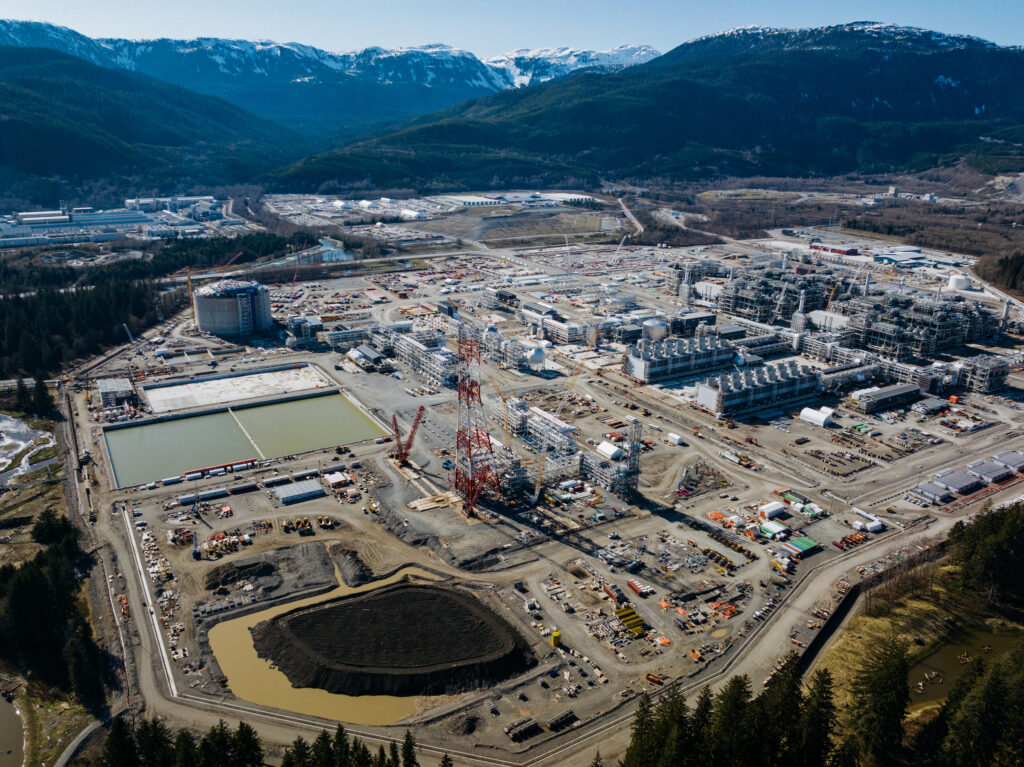 The proposed LNG facility in Baie-Comeau would be the third largest in the country. The LNG Canada facility in Kitimat, B.C., is currently the second largest. Photo: Marty Clemens / The Narwhal
It would make Baie-Comeau Canada’s third largest LNG export project, after Ksi Lisims and LNG Canada, the country’s first, in Kitimat, B.C.
The access to information documents lift the veil — a wee bit— on the federal government’s level of commitment to the project.
“Given the scale and significance of this energy infrastructure project, we’d like to establish a monthly coordination call to keep federal partners informed of the latest developments,” Anne-Sophie Proutiere, senior federal partnerships advisor for Invest in Canada, wrote to her colleagues last May, according to the documents.
“These ‘deal team’ calls will also serve as a forum for departments to provide guidance and support to facilitate the investment,” Proutiere wrote.
Proutiere’s email was sent to colleagues in a variety of departments, including Fisheries and Oceans Canada and the Impact Assessment Agency of Canada. The subject line was “monthly coordination call — Marinvest Energy project”.
Another email said the calls would “coordinate federal FDI [foreign direct investment] efforts to support this investment in Canada.”
What’s the big deal about secrecy?
The documents also reveal the non-disclosure agreement Marinvest has with Canada.
Duff Conacher, cofounder of Democracy Watch, a non-profit organization promoting government accountability and corporate responsibility, warns against fast-tracking major resource project decisions like the Baie-Comeau LNG project and failing to consult with the public and stakeholders before final decisions are made.
Fast-tracking “usually leads to waste, and harm and corruption and boondoggles that actually don’t further the public interest,” Conacher said in an interview.
“It’s just impossible for people sitting behind closed doors in Ottawa in the government to make good decisions about anything, because they need to connect to the reality of the impact of the decisions and action,” he said. “And the only way to do that is to consult with the public in a meaningful way before making the decision.”
Conacher said fast-tracking decisions about major resource projects usually slows them down “because once the public learns about it, the pushback is greater than if people had been consulted in the first place.” That pushback can lead to court cases and other challenges, he pointed out.
Dive deeper on this topic
The Carney government has demonstrated a lack of commitment to transparency in many areas of government actions, he said.
Couillard said he’s worried people who would be impacted by the Baie-Comeau LNG project and the project’s pipeline won’t have the information “necessary to understand what’s being fast-tracked in their backyards.”
Phew, that’s a lot. So who’s behind the Baie-Comeau LNG project?
Greg Cano, who is connected to B.C.’s contentious Coastal GasLink pipeline, is the chief operating officer for Marinvest Energy Canada, a subsidiary of Marinvest Energy AS.
According to Cano’s LinkedIn profile, he’s a mechanical engineer who is an executive sponsor and former chief operations officer for Pacific Atlantic Pipeline Construction Ltd, a subsidiary of Italy’s Bonatti Group.
That name might sound familiar — the pipeline construction company was a primary contractor for the Coastal GasLink pipeline, which ships gas from northeast B.C. to the LNG Canada export terminal in Kitimat. Pacific Atlantic Pipeline Construction made the news in 2022 when Coastal GasLink terminated the company’s contract, alleging poor performance.
You might be scratching your head by now, thinking Cano’s name also sounds vaguely familiar. Based in Calgary, he’s the former longtime director of project planning and execution for TransCanada, a major North America pipeline company now called TC Energy. TC Energy co-owns and operates the Coastal GasLink pipeline.
And gas for the Baie-Comeau LNG project would be shipped to the new pipeline through TC Energy’s network, according to Couillard.
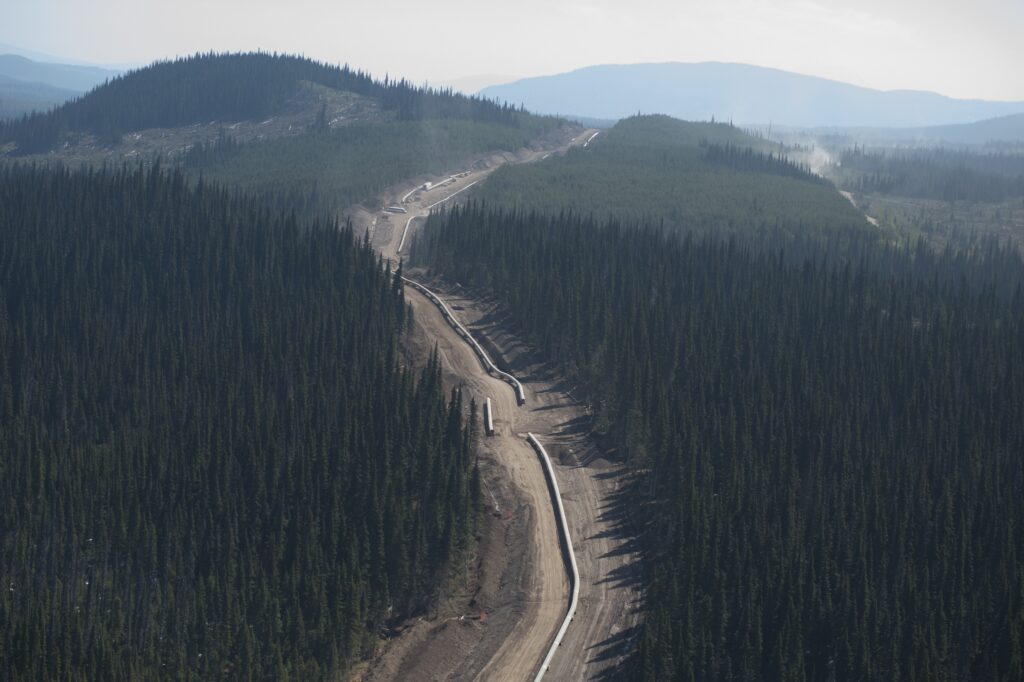 The chief operating officer for Marinvest Energy Canada is Greg Cano, formerly the director of project planning and execution for TransCanada, which became. TC Energy. The major North America pipeline company co-owns and operates the Coastal GasLink pipeline in B.C. Photo: Matt Simmons / The Narwhal
If you live on Vancouver Island, there’s all the more reason to recognize Cano’s name. He was the former project lead for the Steelhead LNG, an export project proposed for Vancouver Island that was halted in 2019.
The Narwhal reached out to Cano by email but did not hear back.
Marinvest Energy AS declined an interview request. “In a spirit of respect and transparency, our priority is to continue discussions with First Nations communities in order to further develop the project’s concepts,” Justin Meloche, the company’s media relations director, said in an emailed statement.
“Additional information will be made public once the project has reached a more advanced stage and when concrete elements can be shared responsibly,” Meloche added.
Marinvest Energy registered to lobby the federal government in May 2025. The company said it would engage with the Prime Minister’s Office, the Impact Assessment Agency of Canada, Fisheries and Oceans Canada, Finance Canada, Natural Resources Canada and the Canada Infrastructure Bank.
The stated goal was to determine “the applicable conditions for implementing a transformative and beneficial energy project for the future of Quebec and Canada.”
Since then, five lobbyists from National Public Relations have filed reports saying they lobbied federal departments, agencies and the Prime Minister’s Office.
The access to information documents note Marinvest is also in discussion with Alberta and Quebec representatives.
“They’ve been lobbying [for] their project behind the closed door for over a year,” Couillard pointed out. “But for the public, there’s absolutely no info except what we find through .”
“We’re in the dark right now in regards to the regulatory stages that this project is in.”
Would the Baie-Comeau LNG project export fracked gas?
Yes. The vast majority — 80 to 90 per cent — of natural gas from Western Canada is extracted through hydraulic fracturing, commonly known as fracking. The access to information documents state the gas for the project would come from Western Canada.
Steven Haig, a policy advisor for the International Institute for Sustainable Development’s energy program, pointed out fracking is a “particularly emissions-intensive method for producing natural gas.
“And also, by nature of the process … there are significant risks of methane leaks, which add to the emissions associated with the production,” Haig said in an interview. Methane is a potent greenhouse gas that traps heat in the atmosphere, contributing to global warming and climate change. It can also cause respiratory and cardiovascular issues.
Dive deeper on this topic
What about Indigenous communities near the LNG terminal and along the pipeline route?
Couillard isn’t convinced a majority of Indigenous communities will support the Baie-Comeau LNG project even after consultations.
“Quebec has a problem,” he said. “It’s all unceded. There’s no treaties here. So technically, all these communities need to give their free, prior and informed consent for the project to go ahead.” The Assembly of First Nations of Quebec and Labrador formally — and vocally — opposed TransCanada’s bid to build the Energy East bitumen pipeline, which was cancelled in 2017.
The documents obtained by Greenpeace and other environmental groups list Indigenous communities and organizations that could be affected by the pipeline and LNG project, but all further information is redacted.
In Ontario, those communities include Apitipi Anicinapek Nation, Métis Nation of Ontario (region three), Taykwa Tagamou Nation, Beaverhouse First Nation, Matachewan First Nation and potentially Mattagami First Nation and Temagami First Nation.
The Impact Assessment Agency of Canada recommended Marinvest engage with about two dozen Indigenous communities and organizations in Quebec, according to the documents. They include many Cree, Algonquin, Atikamekw and Innu communities, such as Pessamit, an Innu community about 60 kilometres south of Baie-Comeau.
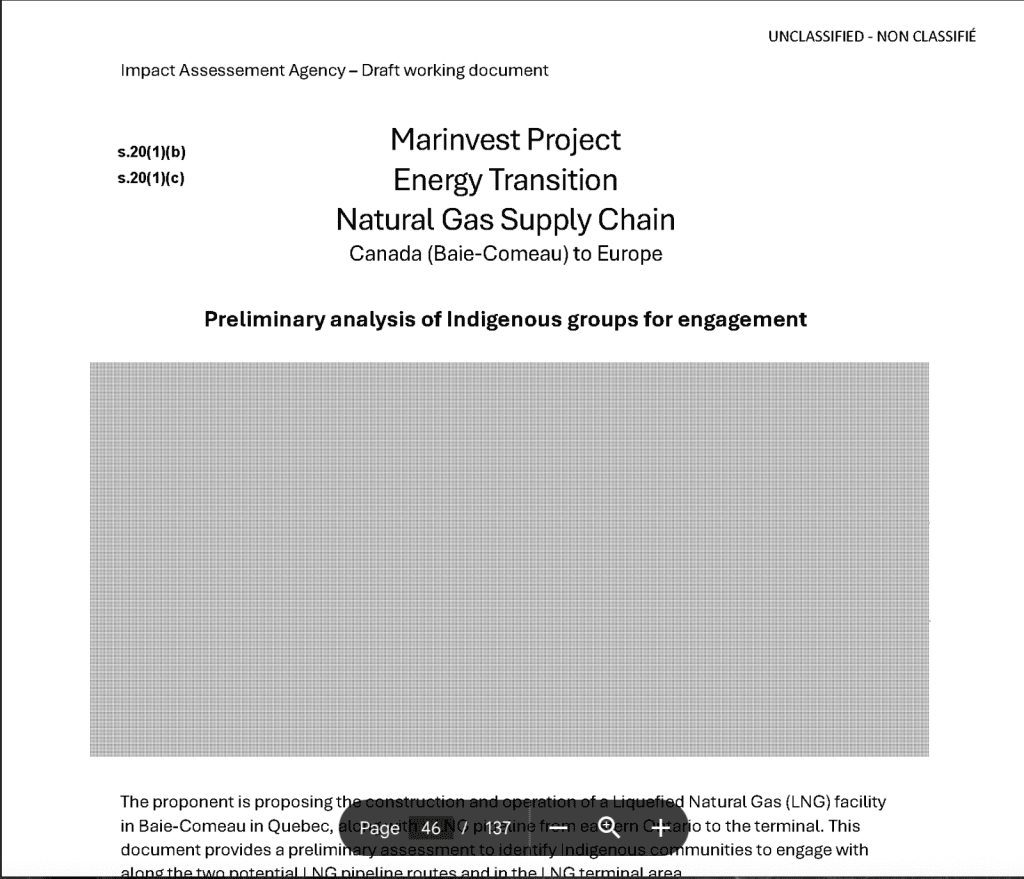
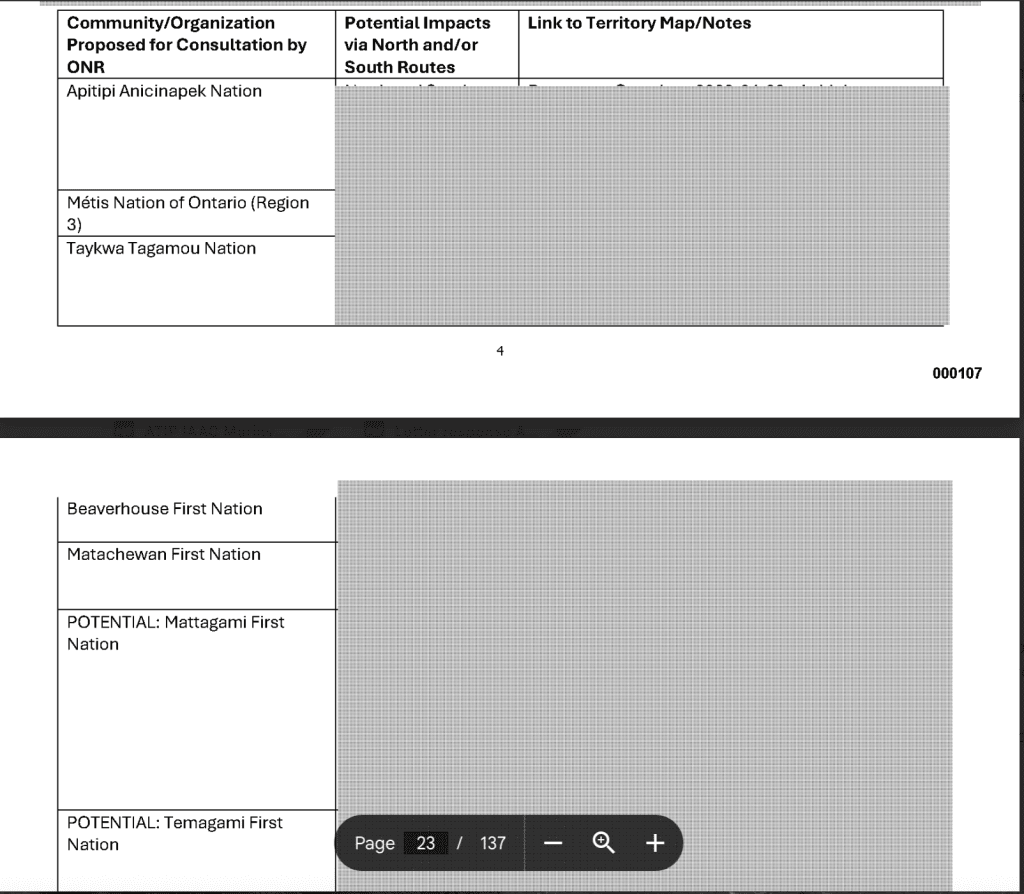
Greenpeace and other environmental groups obtained documents about the proposed LNG facility in Baie-Comeau through access to information legislation. They were heavily redacted. Screenshot: Sarah Cox / The Narwhal
Along with other Innu communities, Pessamit opposed a different LNG export project proposed for the Saguenay region of Quebec on the grounds it would pose a threat to ancestral lands and impact fish and caribou. Pessamit representatives were unable to respond to a request for comment before publication.
So what about the rejected LNG project in Quebec?
The Quebec government nixed plans for a LNG plant in the Saguenay region in 2021, saying it risked “disadvantaging the energy transition.” The province’s environmental review agency found the project’s risks outweighed its benefits. It said the proponent, GNL Québec Inc., had failed to demonstrate the project would reduce greenhouse gas emissions or accelerate the transition to clean energy.
The Saguenay LNG project would have been about the same size as the Baie-Comeau LNG project, according to Le Devoir.
The Impact Assessment Agency of Canada also found the Saguenay LNG project was likely to harm the environment, leading Ottawa to reject the project in 2022. The agency determined the project would have negative effects on nearby Innu communities, harm the beluga whale population through increased shipping traffic and cause greenhouse gas emissions to rise.
Why ship LNG from Quebec?
Quebec has a distinct advantage over LNG shipped to Europe from other places in North America: geography.
A typical shipping route between Baie-Comeau and the Dunkirk LNG terminal in northern France would take about eight days, according to the Montreal Economic Institute, a public policy think tank that receives 11 per cent of its annual budget from the oil and gas industry. (Names of individual funders are not disclosed.)
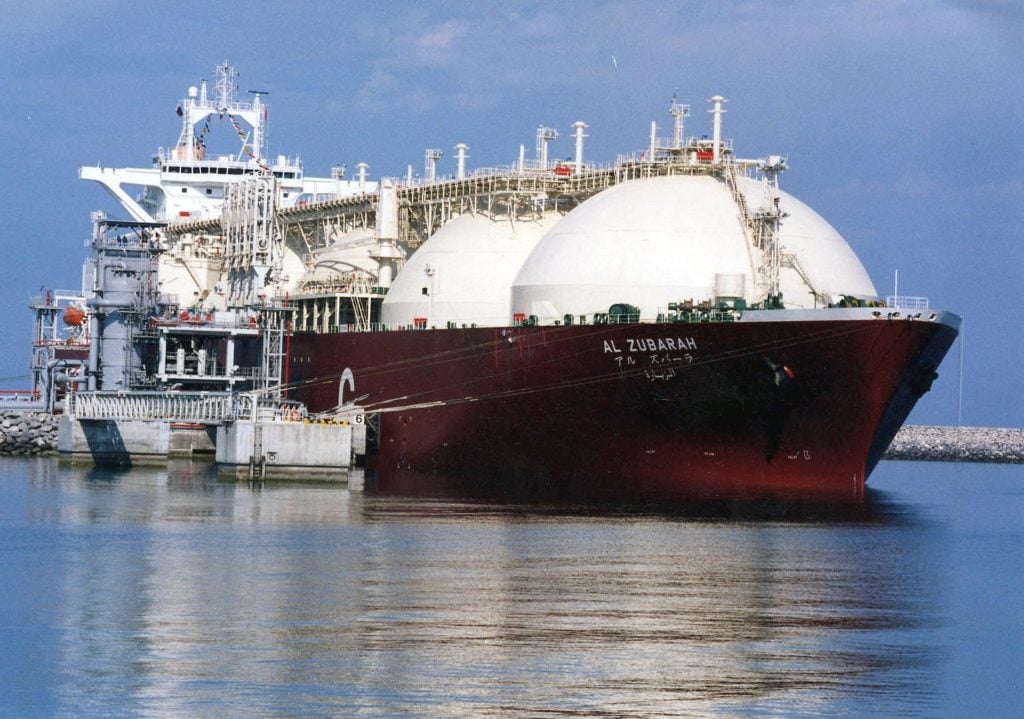 It takes half as long for a ship to travel to Europe from Quebec than from Qatar. A coming wave of global LNG projects could cause an oversupply that affects the economic viability of projects in Canada. Photo: Associated Press
It would take about 14 days at the same speed for LNG from the Gulf of Mexico’s terminals to reach Dunkirk and more than 17 days from Doha, Qatar, another big LNG export terminal.
“Geography plays in Quebec’s favour,” Gabriel Giguère, a senior policy analyst with the society, said in a February news release. “A shorter distance means shorter delivery times, and therefore lower transportation costs, compared to dealing with its main competitors.”
Will there be an environmental assessment ?
Some form of environmental assessment is likely if the Baie-Comeau LNG project proceeds, but the process could be fast-tracked.
In December, the Quebec government introduced Bill 5, which aims to accelerate authorizations for projects deemed to be priorities and of national importance.
The Quebec bill, which has not been passed by the National Assembly, follows the federal government’s Bill C-5, passed last June. The federal legislation aims to accelerate “nation-building” projects.
What about the Baie-Comeau LNG project’s economics?
The oil and gas industry is pushing for LNG expansion, pointing to Europe’s desire to replace Russian gas and Canada’s drive to diversify exports following tariffs U.S. President Donald Trump slapped on Canadian goods.
“But it’s important to remember that these are multi-billion dollar, multi-decade projects and their long-term viability is a serious concern as global markets shift towards cleaner, more reliable energy sources,” Haig, from the International Institute for Sustainable Development, said.
As importers shift towards cheaper, more reliable renewables, “An oversupply of LNG is imminent, with a massive wave of new projects coming online around the world, especially in the U.S. and Qatar,” Haig said.
He said the growing war in the Middle East won’t change that. “There’s a difference between short-term supply disruptions and long-term outlook in the market.”
Doubling down on LNG is likely to expose Canadians to “more risk and volatility, not less, by linking Canada’s domestic natural gas markets to more volatile international LNG market,” Haig said. Many countries are already investing in safe, clean energy, he pointed out.
“When it comes to backing renewables or fossil fuels, let’s pick the horse that’s already ahead.”