
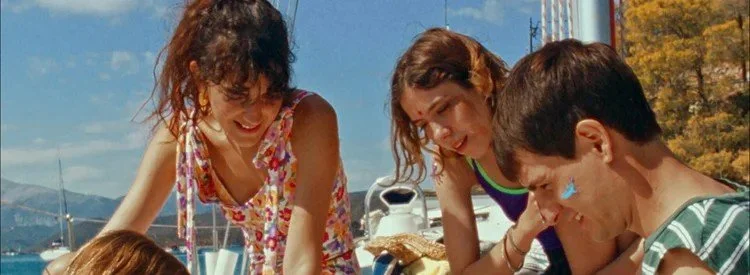
You’ll also wish you were there on Poros, male psychodrama or not, in the endearing company of Elsa and Konstantinos. Beautifully lit and framed to mimic Super 8 home movies, not to mention early avant-garde cinema, the film otherwise wins us over with its daring technical choices, climaxing in a bravura end sequence when Charamountanis cross-cuts between two bombastic monologues and the growing intensity cracks the film open as if it was bombarded with gamma rays.
The equivalent technical marvels of Harvest deserve to be seen in a theatre. Director Athina Rachel Tsangari also skewered male insecurity with her 2015 audience favourite Chevalier, but Harvest is a very different beast, being a hallucinatory medieval fable more along the lines of A Field in England or Hard to Be a God. Sean Price Williams’s cinematography daubs rural Scotland with a blazing elemental palate, but the film also benefits from a customarily uncanny performance from Caleb Landry Jones. He is often too self-conscious an actor, but here Jones is ideal as Walter Thirsk, a sort of manager-without-portfolio to a farming village in the Middle Ages. Early scenes establish Walter as a quasi-mystic in tune with nature but also a rational force inside a community governed by superstition and old ways.
The arrival of a mapmaker, Earle (Arinzé Kene), signals the end of the community’s harmonic natural routines. Gradually, we learn that Earle works for an overbearing landowner bent on industrializing his property, too long neglected to peasants and ripe for profit. The villagers live in a brutish world and are hardly strangers to cruelty: two interlopers are sentenced to a week in the stocks while their witchy companion (Thalissa Teixeira) is banished to the wilderness with a freshly shaved head. But nothing matches the pitilessness of the dandy Edmund Jordan, played with vicious glee by Frank Dillane.
So yes, here we have a bedtime story about capitalism, partly brought to the screen in part by, no surprise, Ken Loach’s Sixteen Films. It’s also a strange and absorbing visual feast—you won’t see another film this year that includes death by urine—and it’s something of a graduation for filmmaker Tsangari, making her first English-language film after a long charter membership, to quote Festival curator Harry Killas, in the Greek Weird Wave.