
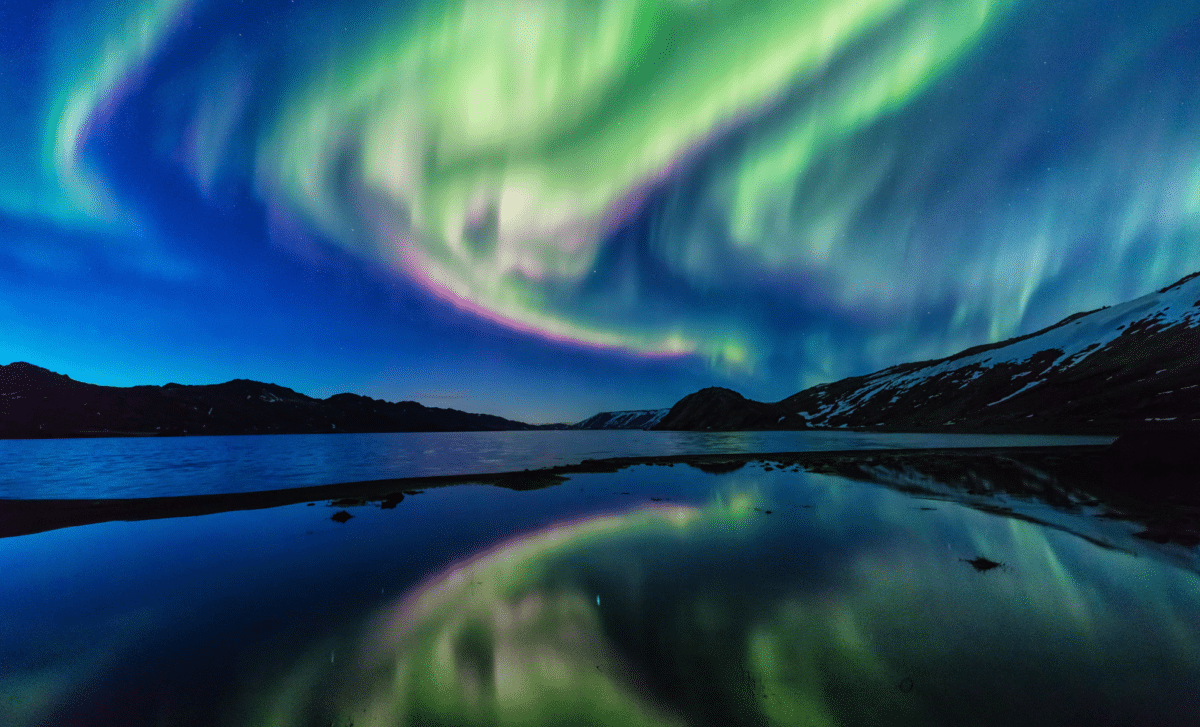
The northern lights are expected to light up the night sky across parts of the United States tonight, March 9, 2026. The dazzling auroras, caused by solar winds interacting with Earth’s magnetic field, will be visible in several northern states. According to the National Oceanic and Atmospheric Administration’s Space Weather Prediction Center (SWPC), these cosmic displays of light will be most visible in areas like Alaska, Washington, and Maine. If you’re lucky enough to be in one of these states tonight, this may be your best chance to witness the natural spectacle, but there are also additional opportunities later this month.
Understanding the Northern Lights: A Cosmic Light Show
The northern lights, also known as aurora borealis, are one of nature’s most mesmerizing phenomena. They occur when charged particles from the sun, solar winds, collide with Earth’s magnetic field. This interaction creates bursts of light in the atmosphere, often seen as glowing green, purple, and pink waves across the night sky. The lights are most commonly visible at high latitudes near the magnetic poles, but certain solar events can push the auroras farther south.
As solar winds move towards Earth, they bring charged particles that interact with the gases in our atmosphere, particularly oxygen and nitrogen. This collision results in the production of light. The varying colors of the auroras depend on the type of gas and the altitude at which the interaction occurs. Oxygen at higher altitudes produces red and green lights, while nitrogen can produce purples, blues, and pinks.
The Role of Solar Winds in Aurora Visibility
Solar winds, fast-moving streams of charged particles released by the sun, play a crucial role in the visibility of the northern lights. These winds flow outward from the sun and interact with Earth’s magnetosphere, causing disturbances. The more intense these solar winds are, the more likely it is that the auroras will be visible even at lower latitudes. The strength and timing of solar wind bursts are key to understanding when and where the aurora will appear.
The recent activity of solar winds has led to the prediction of aurora displays on March 9. According to the National Oceanic and Atmospheric Administration’s Space Weather Prediction Center (SWPC), the lingering effects of these fast solar winds will likely continue to enhance geomagnetic activity. As a result, the auroras are expected to be visible across parts of the northern United States. The SWPC uses data from satellites and ground-based sensors to predict the behavior of solar wind, helping to forecast where the auroras are most likely to appear.
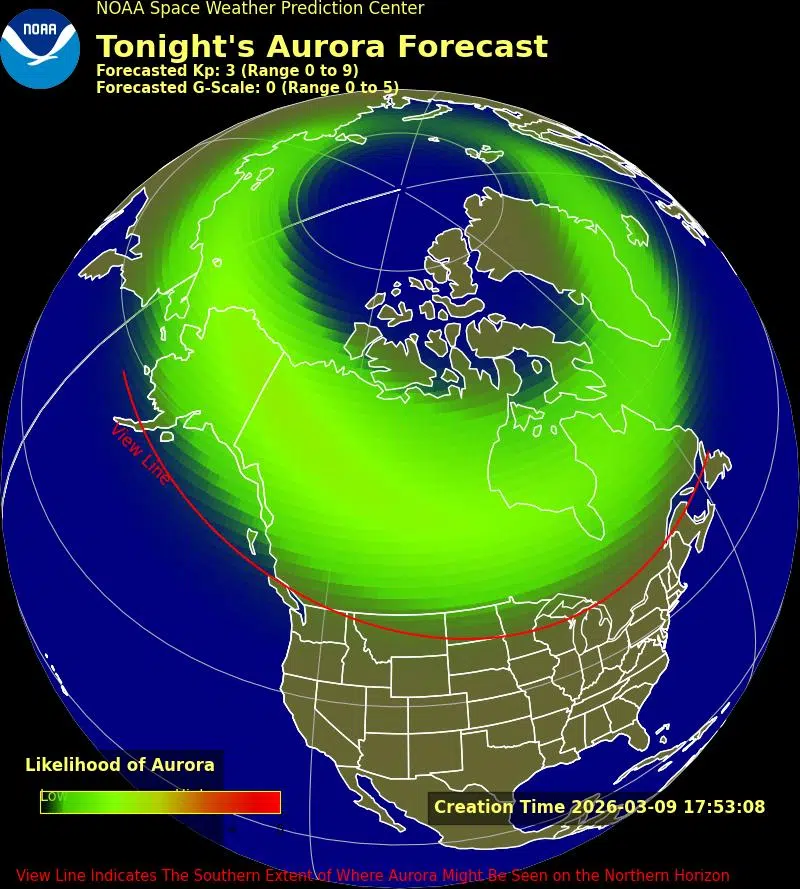 Tonight’s Aurora Forecast. Credit: NOAA
Where to See the Northern Lights Tonight
If you’re in the United States, tonight’s auroras will be visible in 10 states, mainly across the northern regions. The best chances to spot the lights will be in Alaska, Washington, Idaho, Montana, North Dakota, South Dakota, Minnesota, Wisconsin, Michigan, and Maine. These areas lie within the aurora view line, a geographic range where the northern lights are most commonly visible.
To maximize your chances of witnessing the auroras, you’ll need to find a location with a clear view of the northern horizon. Urban areas, with their light pollution, can obscure the view, so it’s best to head to rural or secluded spots. The optimal time to view the northern lights is between 10 p.m. and 2 a.m. local time, although auroras may appear earlier or later depending on the conditions. Be patient and allow your eyes to adjust to the darkness, and consider using your phone’s camera to help spot faint auroras that might not be visible to the naked eye.
The Science Behind the Solar Storm: A CME That Could Spark Aurora Activity
Along with the solar winds, a recent coronal mass ejection (CME), a massive burst of solar wind and magnetic fields, could further amplify geomagnetic activity. This CME, which launched on March 6, is expected to pass near Earth today or tonight. While it’s unlikely to directly hit our planet, it could cause a slight increase in aurora activity, possibly triggering G1-level geomagnetic storms.
Even though the CME’s impact is expected to be mild, space weather experts, including those at the SWPC, are keeping an eye on its potential to boost the auroras further. If the CME does produce a stronger than expected effect, it could bring the northern lights to even more regions, expanding their visibility beyond the northern U.S. However, even without a direct impact from the CME, the lingering solar winds will ensure that auroras are visible tonight in the regions already forecasted.
When to Expect the Best Aurora Viewing: A Window of Opportunity
Tonight, March 9, offers one of the best chances to see the northern lights in the U.S. for this solar cycle. However, those who miss out tonight may have another opportunity as the spring equinox approaches on March 20. During this time, Earth’s magnetic field aligns with the solar wind, increasing the likelihood of aurora activity. The approaching equinox, combined with solar winds, could make the next few weeks particularly exciting for skywatchers.
While tonight is a prime opportunity, it’s always worth staying alert for other solar events. Researchers at the SWPC continuously monitor solar activity and geomagnetic conditions to predict the best times for aurora viewing. As solar activity continues to ramp up over the coming years, the frequency and intensity of the auroras are expected to increase, providing more chances to witness these spectacular displays.