
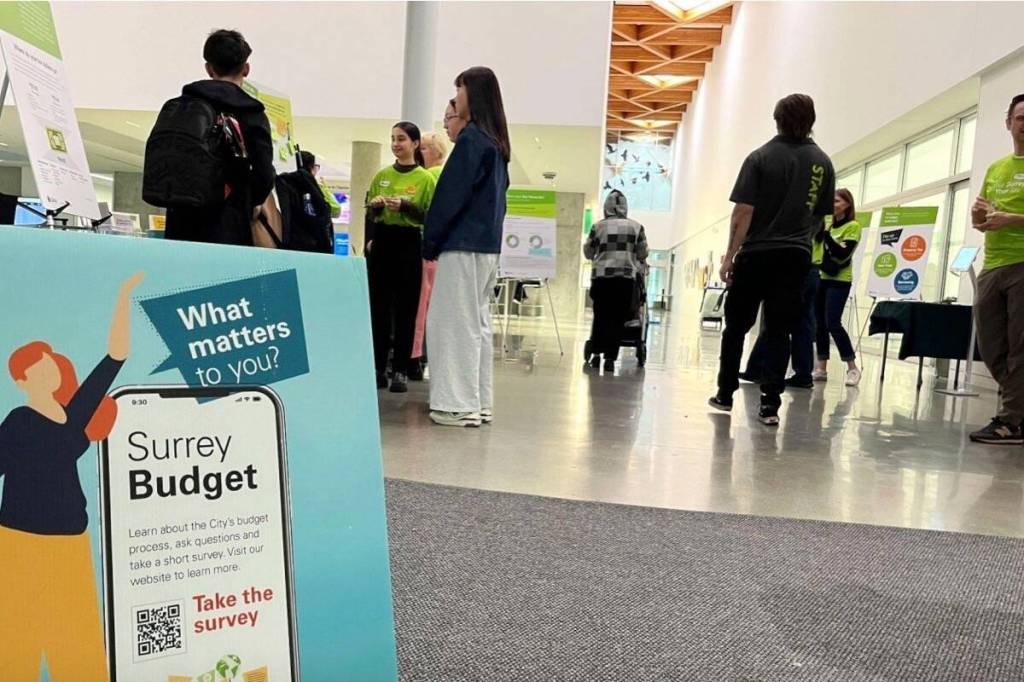
Surrey residents are getting a property tax hike of 2.6 per cent this year. It was approved by council on Monday night after related staff documents were presented to the city finance committee’s public hearing that afternoon at City Hall.
Surrey’s finance manager Kam Grewal presented the budget.
“That 2.6 per cent will generate $14.36 million in new revenue for the city, a net increase to other across-the-board corporate revenues of $8.61 million. Property tax that is driven by growth, that is $8.48 million,” he told council – sitting as the finance committee – on Monday afternoon.
“A balanced budget is proposed,” Grewal said.
A corporate report by city manager Rob Costanzo and Grewal indicates the 2.6 per cent tax increase will work out to about $75 for an average single-family home to cover “general inflationary pressures,” city operations, and “new resources” for police, the city’s public safety department, the fire department and bylaw enforcement.
“Due to additional financial contribution from TransLink to support regional transportation investments, no increase to the Roads & Traffic Safety Levy is required for 2026,” the report reads. Also, user fees will “generally” increase by up to three per cent “to predominately offset the cost increases associated with providing City services.”
The 2026 budget includes $284.5 million for the Surrey Police Service to support the ongoing transition to the Surrey Police Service from the Surrey RCMP, featuring a $45-million increase in funding over 2025 and $100 million more in budget costs since 2021.
The $779 general capital budget over five years includes, among “key” investments, a $200 million 10,000-seat arena downtown – potentially accompanied by a hotel and casino – completing the $152.4 million Centre Block development to house SFU’s school of medicine and also covers $358 million in road and other transportation improvements.
City hall received five pieces of correspondence prior to the public hearing; three in support of the budget and two expressing concerns.
The finance committee heard from two speakers. Mohkam Singh Malik spoke first.
“This budget will allow us to stop being that bedroom community and start being more of a destination,” Malik said, speaking in favour. “It’s an investment in our local economy and importantly it’s an investment in our livability. We’re creating a space where the future doesn’t just live, but where our future thrives, celebrates, and stays here in the city. Let’s keep that dream alive by building a city people actually want to be in because together we can be more than a suburb.”
Deb Jack, of Surrey Environmental Partners, argued for a park ranger program, as well as the expansion of environment-related programs and a levy to help pay for them.
Councillor Doug Elford thanked the speakers but added “to me it’s a little disappointing at the finance committee we don’t get better attendance. I mean, to me this is a very critical decision point we have to make as a council, the most important decision we make,” he said.
Following debate the finance committee passed the budget with Surrey First councillors Linda Annis and Mike Bose voting against it.
“This budget is not a referendum on the performance of council,” Elford said.
“That comes in October,” he said, alluding to the civic election. “My role is to consider a budget which I think is best for the people I represent. This is a modest tax increase which addresses the infrastructure of our growing city.”
Bose said he wouldn’t support the budget “because we did not fund the police to the level that they requested.”
Annis said she won’t support the City of Surrey funding an ice arena “where we don’t have a tenant, and to me the $200 million doesn’t seem like it’s going to fully fund it. We don’t know what the operating costs are going to be and I don’t want the taxpayers to be on the hook for that. What I would support, in terms of an entertainment centre, is doing some sort of a P-3 project (public/private) where the City gives the land and we get someone to build it and operate it.”
She also agreed with Bose that the Surrey Police Service is “being underfunded.”
Councillor Pardeep Kooner asked Grewal if the budget was not approved by the police board.
“Absolutely, it was approved by the Surrey Police Board,” Grewal replied.
“So are we in a position to argue with the police board after they’ve approved the budget?” Kooner asked.
“I don’t see an argument, to be frank,” Grewal replied. “It was a collaborative effort with the Surrey Police Board, senior executives of the SPS as well as the City side, so they’ve endorsed that budget.”
Council on March 9 granted third-reading approval to a lengthy list of bylaws related to the budget.
Council in 2025 ratified a 2.8 per cent general property tax increase that worked out to about $77 for the average assessed single-family home.
In 2024, council approved a budget that included a six per cent property tax hike, a one per cent increase in the roads and tax levy, and a secondary suite fee increase on top of increased utility rate fees.
On Jan. 26, council voted to increase water utility rates by 5.3 per cent in 2026 over 2025, hike sewer utility rates by 1.37 per cent, raise by 1.5 per cent the 2026 drainage/dyking/flood protection utility parcel tax for all property classes, and increase solid waste utility rates by 1.2 per cent and district energy utility rates by 6.4 per cent.
Annis issued a press release stating that “Locke’s tax increases have cost the average Surrey family another $1500 over her term, with more costs on the way. Under Locke, property taxes grew by 26 per cent, water rates grew by 24 per cent, and sewer rates increased by more than 70 per cent.”
She claimed Locke is “treating Surrey taxpayers like ATMs.”
Annis declared that if she is elected mayor in October there will be “an immediate core review and no city tax increases in 2027.”