
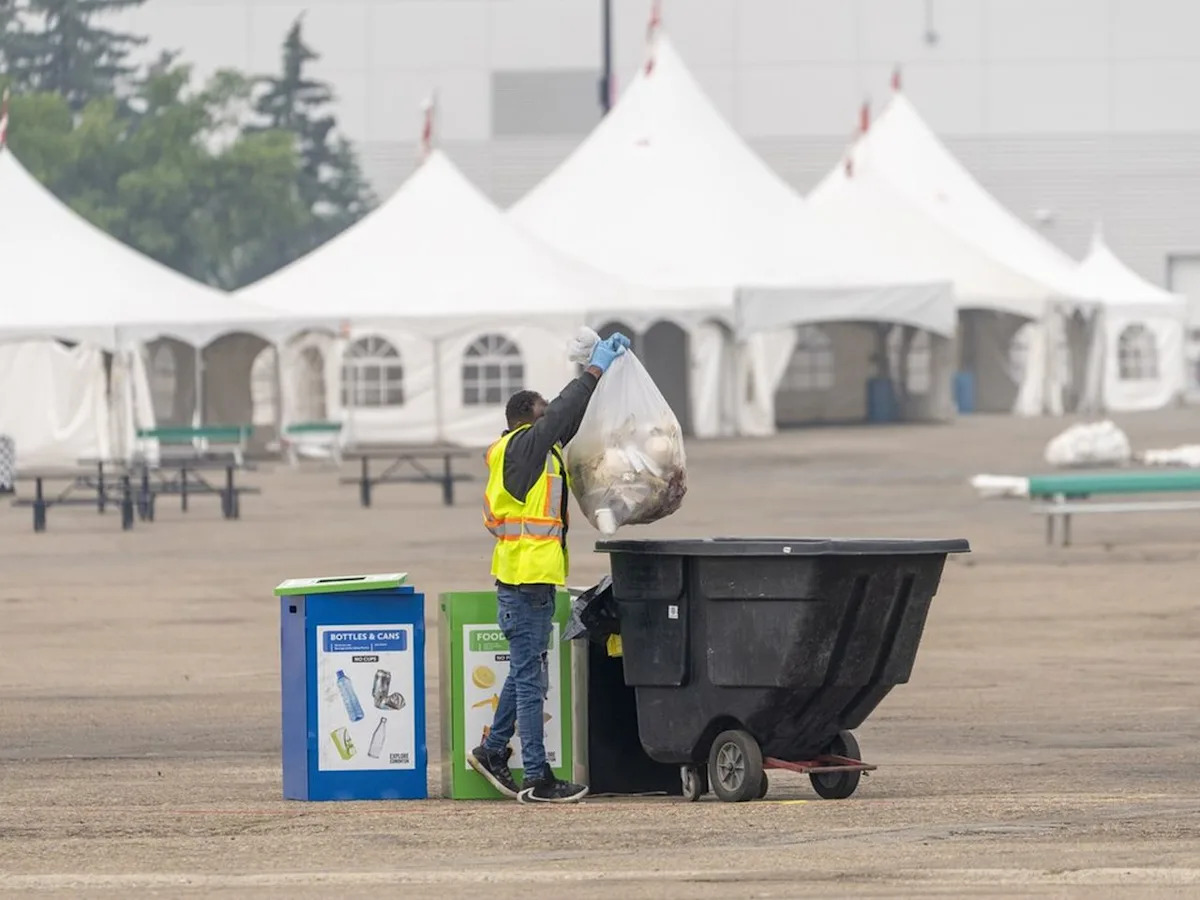
Some property-owners are asking Edmonton councillors for the city to pick up trash more often.
Representatives of multi-family home management companies aired grievances with the city’s new garbage collection system during a Monday utility committee meeting.
“Many of our buildings were built in the ’70s and ’80s, leaving limited space. Installing three bins per property has caused a bottleneck, blocking parking and creating safety concerns such as trying to get out of parking stalls with visibility issues,” said Scott Seibel of Opaque Developments. “We’re now seeing property damage by city trucks — trucks are now having to drive onto our property and are damaging concrete pads at one location.
“Despite investing heavily in surveillance cameras to catch illegal dumpers, property owners cover the clean-up, trucking and land fill fees. The fees issued by the bylaw officers go to the city.”
He and others property owners called on the city to return to weekly garbage pick-up and return to larger garbage bins to deal with the volume.
While highlighting the challenges his company is facing, Sable said he supports efforts to reduce waste.
Ward O-Day’min Coun. Anne Stevenson said 75 per cent of multi-family homes have adapted, but the city needed to figure out the issues for the remaining buildings.
“About one-quarter of properties were experiencing these challenges,” she said. “We just need to dig into where those last 25 that are causing problems.”
Two years into the 25-year waste reduction roadmap, Edmontonians are already dumping 8.8 per cent less waste per person than they were in 2021.
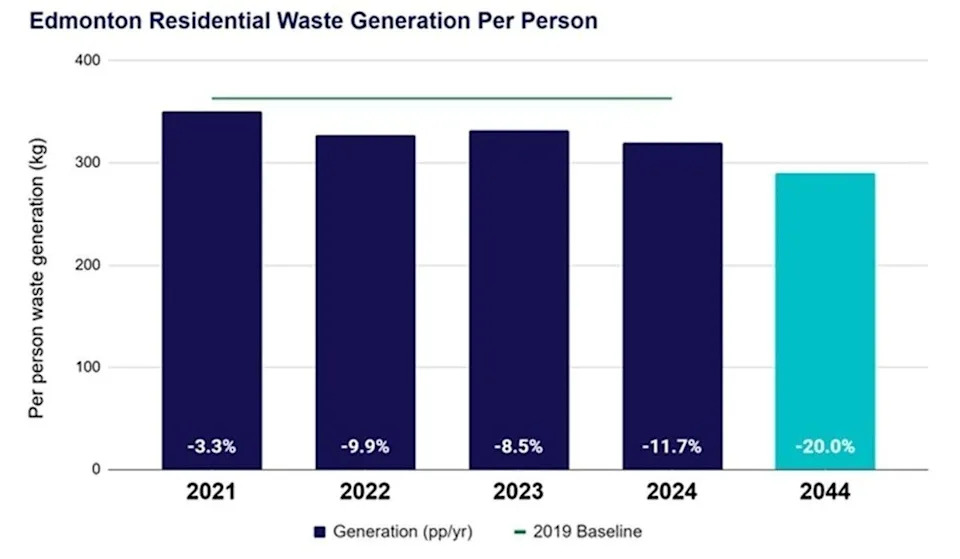
A chart showing how Edmontonians have reduced household waste over the last few years and the city’s long-term goals for waste reduction.
Data shows an 80 per cent reduction in single-use bags. Stevenson said she’s received feedback from some businesses who say not having to purchase bags for customers is reducing their bottom line, translating into lower menu prices.
Officials are hoping to build on that momentum and reduce waste per person to 14 per cent by 2030 with a goal to reduce waste per person by 20 per cent of 2019 levels by 2044.
To reach the 2030 goals, administration presented plans to encourage businesses to integrate re-usable dishes, cups and utensils into operations. A pilot project will run from 2026 to 2028.
Stevenson said it may be time to consider fees for disposable cups to discourage their use.
“Where we’re seeing the biggest success is where we’ve added a financial incentive — so where we’ve added the bag charge,” she said. “It caused challenges when it was first implemented, but we’re seeing significant success.
“The fact we’re not seeing much reduction in single-use cups suggests we need to look at another tool.”
One potential concern the report highlights is a 75 per cent increase of take-out containers as services like Skip the Dishes and DoorDash have become popular. Currently, there aren’t any regulations for take-out containers beyond banning styrofoam, which has dropped 98 per cent. However, paper and plastic take-out containers have filled that void, jumping in use by 97 per cent.
Another recommendation is expanding the city’s reuse directory — an online forum allowing residents and businesses to trade useable items they no longer need.
Reducing food waste remains a challenge. Committee heard approximately 47,000 tonnes — or more than 10 million pounds — of avoidable food waste was thrown out by Edmontonians between 2022-24. Discarded food also creates greenhouse gases — it’s estimated the food thrown out generated 26,000 tonnes of carbon dioxide and equivalents.
Committee also heard the city’s three stream communal collection program is on schedule, now servicing more than half of the 3,400 targeted properties and half of the 179,000 units within them. Officials have seen a drop in waste dropped off at Eco-Stations and the city clocked 4,771 tonnes of food scraps disposed of in proper bins. However, staff also noted an increase in recyclable materials in garbage cans.
Officials are also grappling with illegal dumping of large items like furniture.
Implementing the roadmap is budgeted at $300,000 per year. Stevenson noted reducing waste saves the city money overall.
“Our waste management strategy has an environmental goal, but primarily it’s a financial one,” she said. “The cost of landfilling is incredibly expensive, so we need to reduce that and manage our costs in the long run.”
Related
Bookmark our website and support our journalism: Don’t miss the news you need to know — add EdmontonJournal.com and EdmontonSun.com to your bookmarks and sign up for our newsletters here.
You can also support our journalism by becoming a digital subscriber. Subscribers gain unlimited access to The Edmonton Journal, Edmonton Sun, National Post and 13 other Canadian news sites. Support us by subscribing today: The Edmonton Journal | The Edmonton Sun.