
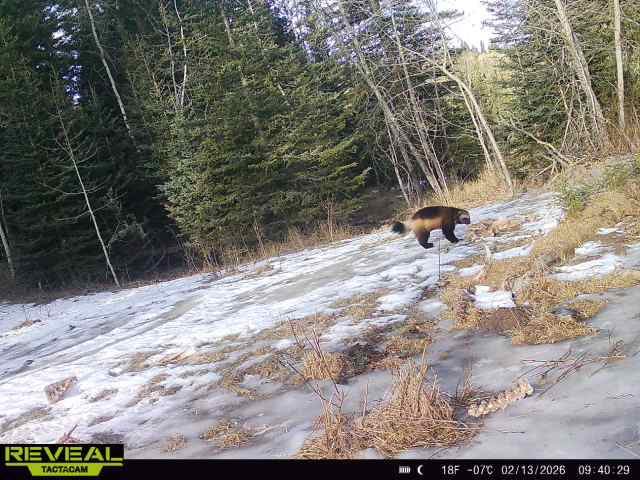
A wildlife enthusiast west of Calgary got the surprise of a lifetime earlier this year when one of his trail cameras captured something he had never seen before — a wolverine.
Joel, who operates dozens of trail cameras in the region west of the city, said the elusive animal appeared on one of his cameras on Feb. 12.
The camera had been set up overlooking a wolf-killed site along a tributary of Jumping Pound Creek to observe which animals might return to scavenge.
Instead, a wolverine wandered into frame.
“It’s like a first-in-a-lifetime opportunity,” Joel said. “I immediately started sharing it with friends and family.”
The camera uses cellular technology to send images directly to his phone, allowing him to see wildlife activity in near real time.
Joel said the sighting stood out because, despite travelling widely for work and recreation, he had never encountered the animal before.
“I put about 100,000 kilometres a year on my truck between work and play,” he said. “From as far north as Pink Mountain in B.C. down to Waterton — and I’ve never seen a wolverine.”
Joel said he runs about 13 trail cameras within a half-mile stretch of the area where the animal appeared, and roughly 40 cameras in total between Calgary and the surrounding area.
Most of the wildlife captured on those cameras is more familiar species.
He often sees wolves moving through the area and has also captured images of cougars. Coyotes and skunks appear regularly, and both grizzly and black bears are common in the region.
Originally, Joel expected the camera would capture wolves returning to the carcass.
“I wasn’t sure what else might show up,” he said.
Wolverines are solitary carnivores and the largest member of the weasel family, according to a Government of Alberta species fact sheet published in 2003. In winter, the animals often rely on carrion from large animals killed by predators or other causes.
Parks Canada says wolverines cover a “phenomenal amount of territory” in the Rocky Mountains and can travel vast distances across alpine and forested terrain.
By the time the animal reached Joel’s camera site, the wolf kill had already been stripped down.
“It was basically just skin and bone,” he said. “There wasn’t anything left to eat — it was just the smell of what had been there.”
After Joel shared the image in several wildlife groups on social media, the post quickly sparked debate among users, with one group eventually disabling comments.
“There were a lot of opinions,” he said. “Some people were saying there’s hunting seasons for wolverines. That’s not true. There’s a trapping season, but not in our area.”
According to the Government of Alberta fact sheet, the species was historically found across Alberta but is now largely restricted to the northern boreal region and the province’s mountains and foothills. The provincial population has been estimated at fewer than 1,000 breeding individuals.
In Canada, wolverines are listed as a species of “Special Concern” under the federal Species at Risk Act.
Placing trail cameras often means hiking deep into remote areas, Joel said.
“I walk with my dog everywhere I go,” he said. “I’m out just adventuring and exploring.”
For him, the excitement comes from never knowing what might appear next.
“You find somewhere that’s covered with tracks and heavily used, and you’re like — what all comes down this main track?” he said.
“I love the suspense of not knowing what’s going to show up. One day it could be a golden eagle, the next day it could be a wolverine. You just don’t know.”
Send your news tips, story ideas, pictures, and videos to news@discoverairdrie.com. You can also message and follow us on Twitter: @AIR1061FM.