
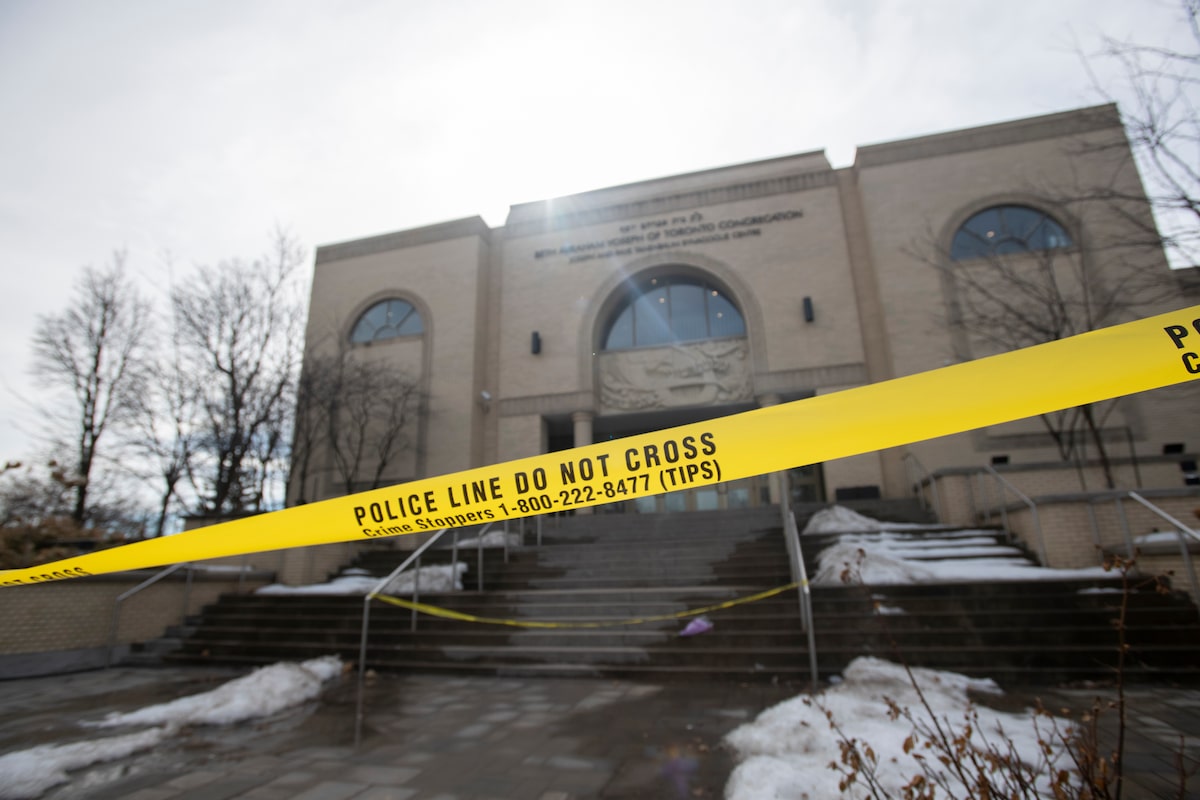
The Beth Avraham Yoseph, pictured here, and the Shaarei Shomayim synagogues in Toronto were hit with gunfire on the weekend.Fred Lum/The Globe and Mail
Michael Geist holds the Canada Research Chair in Internet and E-commerce Law at the University of Ottawa, Faculty of Law.
On a hot August day nearly 32 years ago, I was married at the Shaarei Shomayim synagogue in Toronto. I leafed through my wedding album this weekend as I grappled with the news that gunfire targeted the synagogue on Friday night, the third such attack on a synagogue in Toronto in a matter of days. The photos of my grandparents – Holocaust survivors who rebuilt their lives in Canada – looked back at me as if to warn that the risks are real.
The gun violence sparked the usual political tweets denouncing the shooting, pledging support, and unconvincingly stating that antisemitism has no place in Canada. Yet the predominant emotion that would have once greeted this news – shock – is no more. Over the past two-and-a-half years, Canadian Jewish communities from coast to coast have faced relentless antisemitic incidents: schools hit with gunfire, synagogues firebombed, community centres and old-age homes vandalized, hospitals protested, summer camps threatened, Jewish students and campus groups vilified, and Jewish-owned businesses boycotted.
These repeated incidents have become as much a part of life of being Jewish in Canada in 2026 as the police presence outside synagogues and the enhanced security for community events. The unmistakable message, echoing that dark era in Europe in the 1930s, is that Jews are not welcome here.
Ottawa pledges faster security funding, stronger hate laws after Toronto-area synagogues shot at
So what is to be done?
The calls for leadership grow tiresome, having taken on a performative air of outrage without action. There can be no more bland pledges to oppose all forms of hate, or statements that disguise antisemitism as anti-Zionism. Real conviction is needed. It starts with political, police, business and religious leaders speaking loudly in a single voice, without equivocation, that antisemitism is wrong and will not be tolerated in our communities.
As the violence escalates, we have seen that weak messaging signals an antisemitism exception that would rightly be viewed as unacceptable if any other group was the target. Yet too often politicians have lacked courage on this issue, seemingly afraid to “take a side.” On the issue of antisemitism there is only one side on which to stand, and leaders unable to say so disgrace their offices of power.
But words – even words that leave no room for doubt about the evils of antisemitism – must be accompanied by action. End the dithering and pass anti-hate and bubble-zone legislation to better protect vulnerable communities. Provide law enforcement with the tools necessary to ensure there are consequences to the actions that can lead to violence. And give community groups the resources they need to establish effective security measures to deter future incidents and assist in police investigations.
This will also require organizational accountability that has, to date, been sorely lacking. Antisemitism has been permitted to fester for too long within unions, school boards, professional associations, university campuses, and workplaces. Leaders must take a hard look within, ensure that antisemitism is well understood within their organizations, and implement real consequences for those that violate those norms.
These efforts will also need regular reporting, since you can’t manage what you don’t measure. The Ontario government has made some small steps in this direction with Bill 166, which requires universities to establish policies and rules that describe how their institution will address and combat racism and hate and to issue annual reports on their implementation and effectiveness. The reports can be hard to find, but point to a potential model that would entrench greater accountability into organizations of all kinds.
The December massacre at Bondi Beach in Australia and the murders last year in Colorado and Washington, D.C., tell us where this is headed. With too many of our leaders looking the other way on antisemitic threats and excusing vandalism, it shouldn’t surprise us that things have escalated here in Canada. It is long past time to back unequivocal condemnation of antisemitism with real action.