
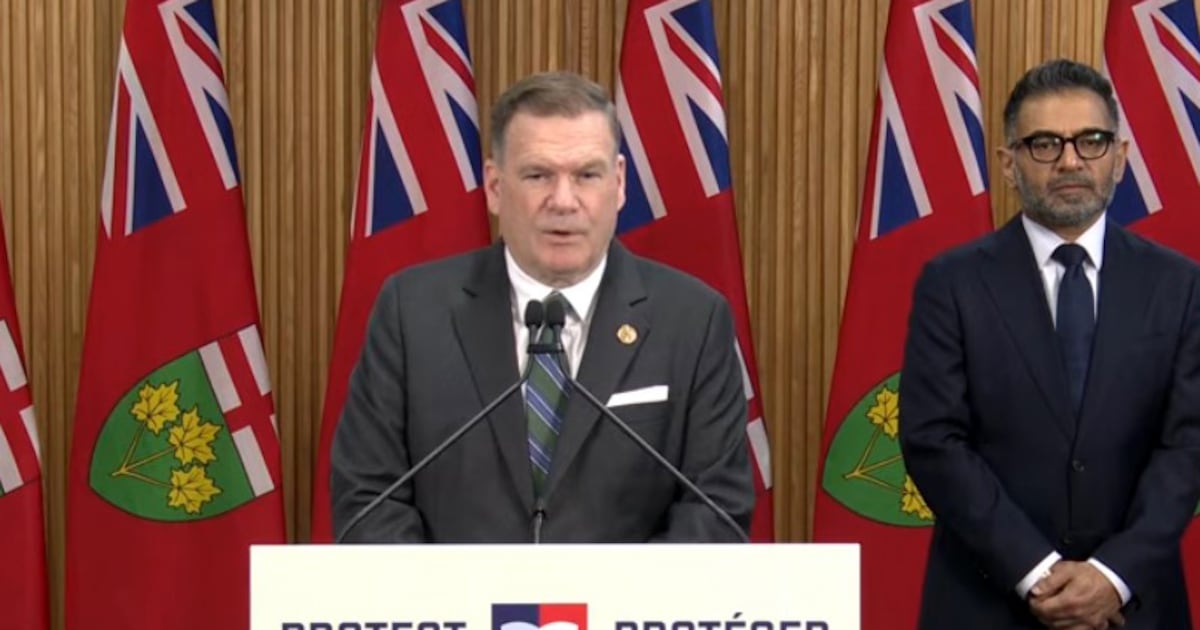
The Ontario government is revealing more details about its plan to shrink the number of conservation authorities in the province, including a decision to boil the 36 existing ones down to nine rather than seven.
Environment Minister Todd McCarthy said in the fall that the province would move to reduce the number of individual conservation authorities to seven.
He said Monday that the province is moving forward with its plan, with some adjustments after a feedback period.
“Today, I am pleased to announce that our Ontario government is moving forward with plans for a new regional model for conservation authorities, one that would strengthen watershed management, improve service delivery, and continue to protect local knowledge and decision making,” McCarthy said.
Conservation authorities in the province are responsible for the conservation and management of natural resources and play a key role in watershed management. They also issue permits for housing development and the installation of sewage systems in areas affected by risks of natural hazards such as flooding.
McCarthy said Tuesday the current system includes a patchwork of different standards, administrative duplication, outdated and fragmented data systems and a lack of accountability.
The government says it needs to streamline the conservation authority system in order to make sure that housing approvals move along more quickly. It also says it can do so without reducing environmental standards.
However critics have raised concerns that standards could be compromised, that the move is being made too quickly and that the administrative areas of the new conservation authorities will be too large.
McCarthy promised Tuesday that there will be no reduction in staffing levels and that local expertise “will remain central to conservation work.”
The Ford government passed legislation in the fall to create a new centralized agency – the Ontario Provincial Conservation Agency (OPCA) – to lead the regional conservation authorities.
A consultation period that followed included feedback from 500 people, the province says.
McCarthy said the province will be providing OPCA $3 million annually in addition to $20 million provided in the fall to set up the new centralized agency.
The nine proposed regional conservation authorities to replace the current system in Southern Ontario will include (from west to east): Western Lake Erie, Lake Huron, Eastern Lake Erie, Western Lake Ontario, Central Lake Ontario, Eastern Lake Ontario, and St. Lawrence River.
The Northwestern Regional Conservation Authority would serve the Thunder Bay Area, while the Northeastern Regional Conservation Authority would serve Timmins, Sault Ste. Marie, Sudbury, and North Bay.
In terms of the proposed governance structure, upper and single-tier municipalities would still play a role in appointing members to conservation authority boards, but lower-tier municipalities (e.g., towns and townships) would not.
In a statement, NDP Environment critic Peter Tabuns called the government’s plan “an attack on the environment” and claimed it would pave the way for sprawl and environmental disasters.
“Our watersheds are unique, and each one has varying needs that will fall by the wayside when haphazardly lumped together,” Tabuns said. “Drawing these arbitrary lines on a map undermines local control and the ability to respond to local problems.”
Consolidation of the various conservation authorities is set to begin in May and will be complete by early 2027.