
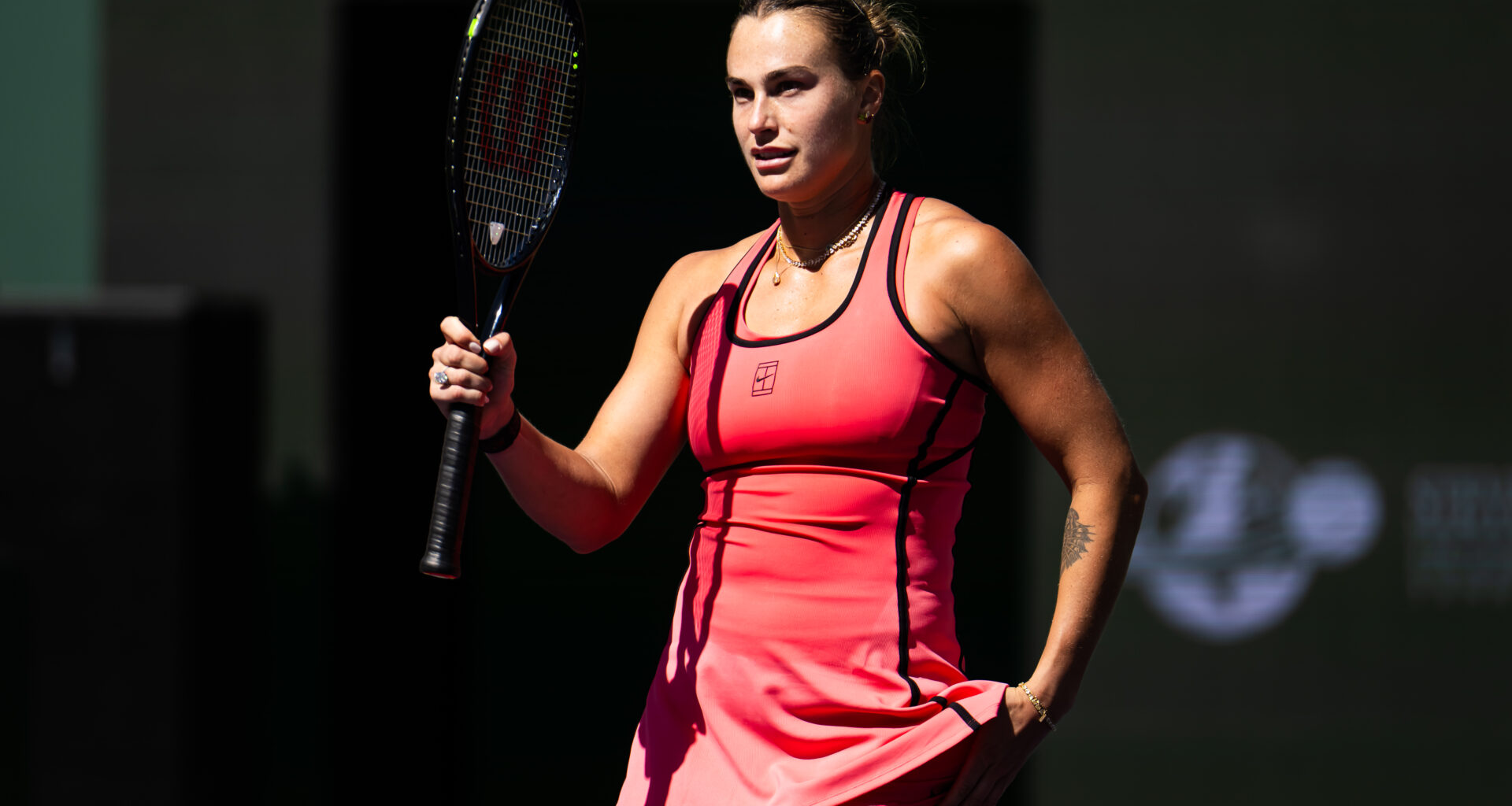
INDIAN WELLS — It was billed as a battle between four-time Grand Slam champions. In retrospect, maybe it wasn’t surprising that the current World No. 1 prevailed over the former No. 1.
Serving with precision and power on Tuesday, Aryna Sabalenka was a 6-2, 6-4 winner over Naomi Osaka at the BNP Paribas Open. She advances to what should be a smashing Thursday quarterfinal against the winner of the later match between No. 6 seed Amanda Anisimova and No. 10 Victoria Mboko.
Sabalenka avenged her loss from their only previous WTA Tour Driven by Mercedes-Benz meeting, at the 2018 US Open.
“I’m super happy with the performance today, the way I brought variety on court, that I made her guess most of the time,” Sabalenka told reporters afterward. “I was trying to change the rhythm and make sure that the ball comes back on her side [at] different heights and speeds. So I think that was the key of the match.”
How about this for an eye-opener, at 11 a.m. local time? Between them, Sabalenka and Osaka have won four of the past eight Australian Opens and four of the past eight US Opens. And while they are separated by only seven months (Osaka is older), their championship timeframes have been far different. Osaka won Grand Slam titles for four straight years from 2018-2021, while Sabalenka won hers in a span of three years from 2023-2025.
Osaka’s last title — her triumph at the WTA 125 L’Open 35 de Saint Malo notwithstanding — was the 2021 Australian Open. Since coming back after childbirth in 2024, she has reached finals in Auckland and Montreal, and the semifinals of the US Open.
In her post-match press conference, Sabalenka was asked if she felt an extra dose of intensity before playing Osaka.
“Not really,” she said. “I don’t think about this kind of stuff going [into] the match. I just focus on myself, focus on the game plan that I have. This is what I learn with experience, that you better leave this stuff outside of the tennis court, and you go out there and you do your best.”
Opening the match with an emphatic 118 mile-per-hour ace, Osaka survived a break point and held serve. Sabalenka went on to win the next three games, helped enormously by a trio of double faults by Osaka in the third game.
Just when it looked like Osaka was creeping back into the set, Sabalenka cranked up her serve. It happened again and again.
Sabalenka won 39 of her 56 service points — good (very good) for 70 percent – and was not broken. She finished with eight aces, two of them in the last game, and zero double faults.
Osaka was broken three times.
Enjoying a clear advantage in mobility, Sabalenka moved Osaka from side to side, opening up the court for an array of winners. Drop shots were also effective.
In the seventh game of the second set, tied at 3, Sabalenka took the racquet out of Osaka’s hand with a massive forehand winner. The 4-3 lead would prove to be insurmountable.
Sabalenka, who has been at No. 1 in the PIF WTA Rankings for 73 consecutive weeks, is in the midst of a marvelous streak of high-end consistency. She’s the first player to reach the quarterfinals in 14 consecutive WTA events (excluding the WTA Finals) since Justine Henin appeared in 25 consecutive quarterfinals between Charleston 2006 and Miami 2008. Since 2025, Sabalenka and Swiatek (who’s still alive in this draw) have reached a WTA-high 16 quarterfinals, leading all women.
“Overall, I’m happy that I put so much pressure on her,” Sabalenka said. “I think she was a little bit confused today in the key moments. Happy to see that. Happy that my serve worked well. Return was really great tennis. Happy with the performance, for sure.”