
Breadcrumb Trail Links
As Calgary’s population grows, so does both diversity and sprawl. Our weekly Countdown to 2 Million special series continues.
Published Mar 11, 2026 • Last updated 1 hour ago • 11 minute read
You can save this article by registering for free here. Or sign-in if you have an account.
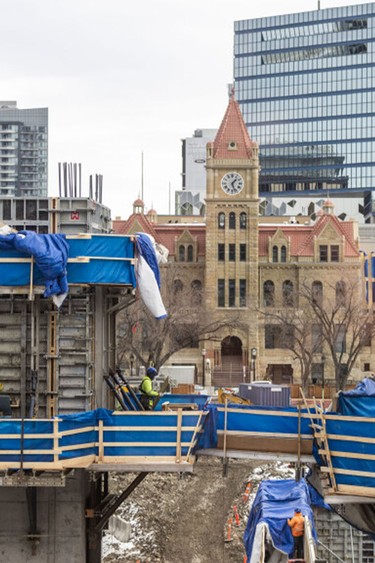 The construction site for the Werklund Centre (Arts Commons) expansion is shown near Calgary’s Old City Hall on Wednesday, Jan. 28, 2026. Photo by Brent Calver/PostmediaArticle content
In early February, the Exposure Photography Festival opened at Contemporary Calgary.
Logistically, Exposure is a unique event that spreads out across Calgary and into other cities across the province. What it offers is a succinct glimpse of a growing city’s interconnected ecosystem that links venues with audiences, artists and organizations.
Article content
Article content
Featuring hundreds of local artists and international photographers, the festival partners with 30 venues of all sizes, from major institutions such as Contemporary Calgary to small galleries, coffee shops and artist-run collectives. The art runs the gamut from traditional wildlife photography to edgy and surreal experimental work.
Advertisement 2
This advertisement has not loaded yet, but your article continues below.

THIS CONTENT IS RESERVED FOR SUBSCRIBERS ONLY
Subscribe now to read the latest news in your city and across Canada.
Unlimited online access to articles from across Canada with one account.Get exclusive access to the Calgary Herald ePaper, an electronic replica of the print edition that you can share, download and comment on.Enjoy insights and behind-the-scenes analysis from our award-winning journalists.Support local journalists and the next generation of journalists.Daily puzzles including the New York Times Crossword.
SUBSCRIBE TO UNLOCK MORE ARTICLES
Subscribe now to read the latest news in your city and across Canada.
Unlimited online access to articles from across Canada with one account.Get exclusive access to the Calgary Herald ePaper, an electronic replica of the print edition that you can share, download and comment on.Enjoy insights and behind-the-scenes analysis from our award-winning journalists.Support local journalists and the next generation of journalists.Daily puzzles including the New York Times Crossword.
REGISTER / SIGN IN TO UNLOCK MORE ARTICLES
Create an account or sign in to continue with your reading experience.
Access articles from across Canada with one account.Share your thoughts and join the conversation in the comments.Enjoy additional articles per month.Get email updates from your favourite authors.
THIS ARTICLE IS FREE TO READ REGISTER TO UNLOCK.
Create an account or sign in to continue with your reading experience.
Access articles from across Canada with one accountShare your thoughts and join the conversation in the commentsEnjoy additional articles per monthGet email updates from your favourite authorsSign In or Create an Account
or
Article content
On Feb. 5, Contemporary Calgary opened its doors as a partner and host of the festival’s four central exhibitions with a big-city gala that suggested the city had come of age as one of Canada’s artistic hubs.

Noon News Roundup
Thanks for signing up!
Article content
“It actually broke our single-evening record,” says Contemporary Calgary CEO David Leinster. “Between 5 o’clock and 9 o’clock we had almost 1,300 people through the building. When you look at some other cities and communities in this country and others, they are shocked: Getting 1,300 people to an opening in an evening is not common.”
It’s a recurring theme when talking to leaders of Calgary’s major cultural institutions. The city has become the envy of others, particularly when it comes to investment in the redevelopment of a number of major arts organizations in and around the downtown core.
This rise began to take shape 10 years ago, when the $191-million National Music Centre opened in East Village. Two years later, the $245-million, five-level Central Library opened a few blocks away.
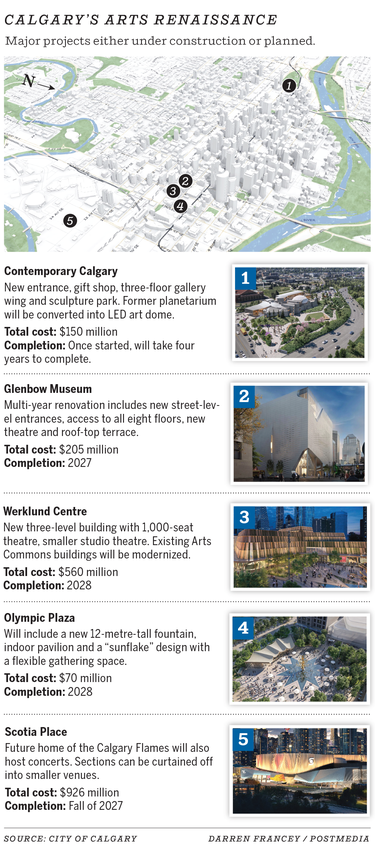
By 2029, when Calgary is estimated to approach a population of two million people, the final stages of renovations will be complete at the Werklund Centre (formerly Arts Commons), Contemporary Calgary, The Glenbow Museum and Olympic Plaza, representing a total investment of nearly $990 million from all three levels of government, philanthropists and fundraising campaigns.
Scotia Place, the $926-million future home of the Calgary Flames, is scheduled to open in 2027. The centrepiece of the developing Culture and Entertainment District is expected to host concerts that can seat up to 20,000 people, which should mean major artists that have skipped Calgary in the past — given the limitations of the Saddledome — will bring their tours here.
Article content
Article content
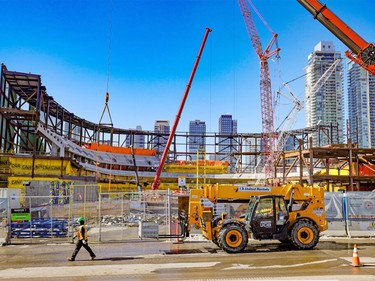 Work continued on the new Scotia Place project in Calgary on March 2, 2026. Photo by Gavin Young/Postmedia
It all makes for an unprecedented investment in infrastructure that certainly gives the appearance Calgary’s cultural scene — at least in terms of the brick, mortar and concrete of our major downtown institutions — will look significantly different by the time the city welcomes its two-millionth resident.
Of course, venues are only one aspect of maintaining and nourishing an arts scene for a growing population. Changes to programming and the need to support a foundational base of artists are also critical.
As Calgary’s population grows, so does both diversity and sprawl.
While world-class galleries may attract tourists, programming needs to reflect the tastes of the city’s population. That requires organizations to reach out to cultural communities and offer them a say in their programming.
Glenbow, for one, is undergoing a philosophical shift in what it will present.
While it undergoes a $205-million physical transformation, the new space will house up to 36 exhibits at a time that will be constantly renewed. Some will be travelling exhibits, but many will be fed by the museum’s sprawling collection of artifacts.
The shift should end what outgoing CEO Nicholas Bell calls “generational visiting” by large swaths of the city’s population.
Glenbow has traditionally featured permanent exhibits dedicated to everything from the history of Alberta to minerals. They didn’t change, so while city residents may have attended once a decade or so, many didn’t feel compelled to make it a regular stop.
Article content
Glenbow is addressing other barriers that have prevented certain segments of the population from visiting, including affordability. A $35-million donation from the family of Calgary philanthropist and businessman JR Shaw will allow the museum to offer free admission. Staff at Glenbow will also consult and partner with members of various cultural groups to develop exhibits and programs, rather than rely solely on in-house expertise.
Article content
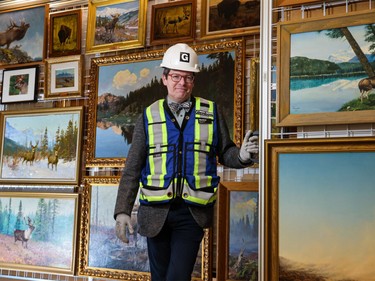 Glenbow president and CEO Nicholas R. Bell shows off one of the new collection storage areas at the museum on April 15, 2025. Photo by Gavin Young/Postmedia
Still, Calgary is already one of Canada’s most diverse cities and healthy arts institutions began addressing this years ago. Hitting two million people won’t suddenly bring major change to savvy organizations.
“If there were organizations that were irrelevant in a city of 1.2 million, they will continue to be irrelevant in a city of two million people,” said Alex Sarian, president and chief executive of the Werklund Centre. “The idea around programming and this idea of exploring the question ‘who are we in service to, and who are we doing this work for?’ is a question that transcends city size and the scalability.”
Sarian wrote about the need for arts organizations to better tailor programming to the populations they serve in the 2024 book The Audacity of Relevance. He uses the metaphor of hardware and software. The former is the building and infrastructure needed to house the latter, which is made up of artists, smaller arts organizations and audiences.
“My biggest fear is that people spend too much time and resources and energy on the hardware and the infrastructure without giving proper attention to the software: the actual programming and the people that are meant to be filling it,” he said.
Article content
“My biggest fear is that 20, 30 years from now, Canada will have these beautiful facilities that nobody knows what to do with because we spent too much time investing in the hardware and not the software. So I’m excited about Calgary, because we have the right business case to invest in the hardware: The city is growing and hopefully still taking care of the people of Calgary, including the artist community.
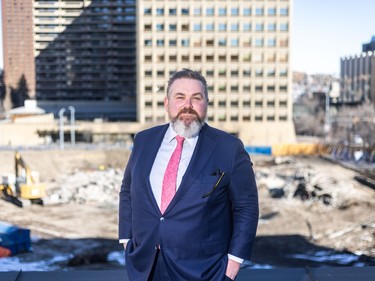 Arts Commons President and CEO Alex Sarian poses with the construction site around Olympic Plaza in Calgary on March 11, 2025. Photo by Brent Calver/Postmedia
“I want to make sure that 20 years from now, 30 years from now, Werklund Centre is thriving not because it’s a beautiful facility but because Calgarians feel like they want to breathe life into it.”
Key to this is a thriving local community of artists who feel they are contributing to the city’s culture.
While the new event centre may mean major acts such as Taylor Swift will no longer skip Calgary and Tate McRae might include a hometown show on her next stadium tour, our culture can’t be defined by popular visiting artists.
Calgary needs to be a place where local artists can live and, in the best case scenario, make some sort of living through their art.
“This is not an arts thing, but the biggest variable is ensuring that Calgary remains competitive related to other major cities,” said Sarian.
“It doesn’t matter how beautiful the Werklund Centre is, if Calgary becomes too unaffordable for the artist community then we have lost because all our venues become just places where touring artists will perform as they helicopter through town as opposed to being local hubs where people are creating with and for each other.”
Article content
One strategy aimed at strengthening Calgary’s arts scene is to have it branded a “music city,” not unlike Nashville or Austin, Texas.
In 2024, a report from the advocacy group West Anthem suggested ideas to improve the lives of musicians and health of music venues. They included repurposing city or provincially owned spaces for arts activities, increasing funding for artists and organizations, addressing housing issues for musicians, creating mentoring opportunities between new and established musicians and promoting diversity within the music industry.
Article content
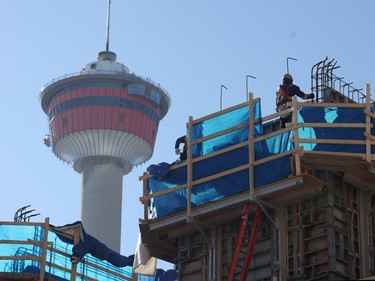 Framed with the Calgary Tower, construction workers install rebar while working on the Werklund Centre project on Feb. 24, 2026. Photo by Gavin Young/Postmedia
There have been some significant challenges when it comes to supporting live venues.
In 2010, there were 67 multi-purpose venues programming music, and 75 bars, cafes or restaurants with live music performances in 2010, the report found. In 2023, the numbers were 58 and 53, respectively.
In England, a registered charity called Music Venue Trust is designed to prevent grassroots venues from closing, something that has been a concern in Calgary as development forced venues such as The Blues Can and Mikey’s on 12th to relocate.
Mikey’s closed just over a year after opening a new location in Bowness. Currently there is anxiety over the future of the Ship and Anchor due to a proposed development that would include residential units above the bar.
Despite these struggles, there is a growing awareness that creating spaces and opportunities for musicians is long overdue.
Article content
“We’ve seen more conversations around being a music-friendly city than we’ve ever had in the history of this province,” said Andrew Mosker, co-founder and chair of West Anthem and president and CEO of the National Music Centre.
“It’s been friendly to film and television. Music has not been at the table for those conversations and it is now.
“To be prepared for a city of two million people, there’s opportunity there, so let’s get ready. I always think we are preparing and we can be ready and we can deliver with the right partners and supporters and advocacy and funding.”
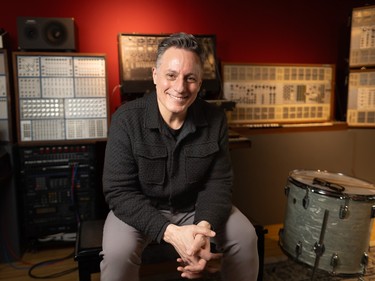 Andrew Mosker, founding President and CEO of the National Music Centre, was photographed in the Calgary building’s Synth Lab on March 5, 2026. Photo by Brent Calver/Postmedia
Determining the type of artists and how many contribute to the scene in Calgary is a bit of a challenge.
A 2025 report by Hill Strategies, using census data, determined there were 33,300 workers in arts, culture, and heritage occupations in Calgary, as of 2021. That figure included 7,020 professional artists and 1,420 people who work in five occupation groups classified as arts leaders.
It acknowledged those estimates might be low, due to so-called gig work and the uneven workflow of certain artists. A 2023 Arts Professional Survey by Calgary Arts Development found only nine per cent of professional artists in the city relied on their artistic practice for 100 per cent of their income, meaning many would not be counted in national data because it would not be considered their primary source of income.
Eighty-three per cent of those who identified as artists in the Calgary Arts Development Survey were self-employed and just seven per cent were employed full-time as an artist, meaning many do not receive benefits provided by traditional full-time employment.
Article content
Patti Pon, president and CEO of Calgary Arts Development, said the artist’s role in a growing city is to be “our storytellers, meaning-makers and our sense-makers” who reflect on a changing population in a way “that can make us all feel we are a part of that change.”
It’s a role she sees as more important than ever in the past decade “when nothing appears to make sense. When it’s really hard to find meaning. When the rates of loneliness and depression have gone through the roof and skyrocketed.”
Pon said the city’s arts community needs to be included in broader discussions about income and affordability moving forward.
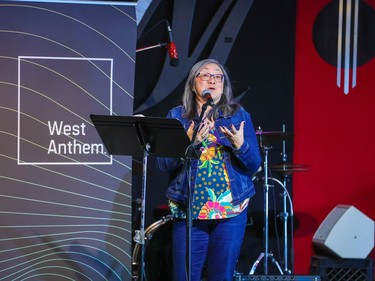 Calgary Arts Development president and CEO Patti Pon speaks on May 28, 2024. Photo by Gavin Young/Postmedia
“In the bigger conversation about affordability and jobs, artists are right there in it. They feel it,” she said.
“As we make our way to two million, there’s the 35,000-foot level where the role for artists to play is quite significant and very much needed. That’s more on the philosophical side: Why arts are a must-have, not a nice-to-have, in my opinion.
“Then there’s the practicality part, which is about affordability when you are talking about (artists and organizations) outside of these large institutions that are receiving record-breaking donations and recognition.”
In 2024, Calgary Arts Development invested or supported 41,000 arts experiences that attracted 5.3 million attendees.
“There’s no point building those big institutions if there is nothing underneath to support it. I’m very conscious of that right now,” Pon said.
Article content
Calgary visual artists Caitlind r.c. Brown and Wayne Garrett are renting a house in Ramsay in a neighbourhood full of artists. They have found a landlord who is flexible about rent. But not all are as understanding. When they applied for the house eight years ago, it was the first time the couple didn’t have to lie about their full-time profession when looking for housing.
“Every other time we had to lie and say, ‘Oh I’m a teacher,’” said Brown. “Wayne is a Red Seal machinist and can say, ‘Oh, I’m a machinist,’ which is not technically a lie, but it’s not what he does for a living.
“I think we are sort of successful artists in our own way, so to have to lie to every landlord in the city except for these ones I think says a lot about how people see artists.”
She said they’ll stay where they are as long as they can but there is always some anxiety as their neighbourhood goes through “a second or third wave of gentrification.”
“Sometimes boom time means rent goes up and everything gets really expensive,” Brown said. “I think it can be a fairly difficult city for artists. The flipside of this is that boom-time means there is more opportunities for arts and culture.
“Calgary can be pretty tough. With the boom-bust cycle, artists are really good at adapting to quick change. But it can be exhausting.”
Brown and Garrett are known for immersive art installations that have been shown around the world. They are behind some of the city’s unique public art installations, including Fisher Ladder at the gateway to Elbow Island Park and Delta Garden + City Unseen, which is made up of 12,000 survey monuments embedded in the concrete near the Peace Bridge.
Article content
Each one contained messages from Calgarians who were asked through a survey to answer questions “Where are you going?” and “Where do you want to be?” Calgary’s hopes and dreams were literally embedded in a piece of public art.
The couple was also behind the multi-artist project Idle Worship last May, which featured a convoy of 11 mobile exhibits housed in cars, trucks and minivans that arrived unannounced in parking lots and other public spaces in all four of the city’s quadrants.
It was meant to be commentary on Calgary sprawl, its car-centric nature and its role as the hub of Canada’s oil and gas economy. It’s a timely topic for a city that continues to grow and spread, even if it’s not necessarily what everyone wants to hear.
Article content
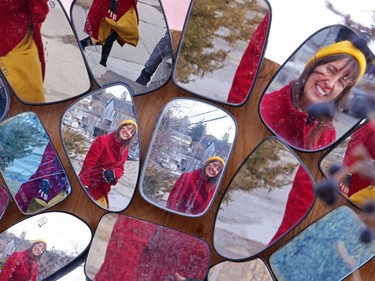 Calgary artist Caitlind Brown was photographed with one of her creations that uses discarded eyeglass lenses on March 7, 2026. Photo by Gavin Young/Postmedia
“One of the most wonderful things of being able to be an artist is that you get to be a storyteller that tells a story that no one is charged with looking at or acknowledging,” Brown said.
“Sometimes it can be really critical. I think it’s easy for people to think of public art as being municipally funded and an expensive object. Sometimes that’s true and you need that within the ecology of art in a public space. (Idle Worship) did the same thing. It reflects the city back on itself and critiques the way that we think about and develop our shared amenities.
“You really need artists to do that, because who else is going to?”
 ADDITIONAL COVERAGE
• Already strained health-care system hard-pressed to meet growing population demands
• Varcoe: Calgary building more diverse economy to support population boom
• Making their move: Population boom builds Calgary business
• Answering Calgary’s call: Newcomers find their way to feeling at home in city
• Doing the math: Why the counting of Calgarians doesn’t always add up
• Humble Calgarian holds one-in-a-million place in city’s history
• Calgary is fast approaching a population of two million people — will the city be ready?
Go to calgaryherald.com/countdown-to-2-million to see more.
Bookmark this website and support our journalism: Subscribe now so you don’t miss the news you need to know and sign up for our free newsletters.
Article content
Share this article in your social network