
Market updateAt 9:31 a.m. ET, the S&P/TSX composite index was down 0.3 per cent at 33,212.91 points. The Dow Jones Industrial Average fell 15.7 points, or 0.03 per cent, to 47690.76. The S&P 500 rose 8.6 points, or 0.13 per cent, to 6790.09, while the Nasdaq Composite rose 74.2 points, or 0.33 per cent, to 22771.267.The Canadian dollar was trading 0.1 per cent lower at $1.3591 to the greenback, or 73.58 U.S. cents, after trading in a range of $1.3556 to $1.3593. Canadian government 10-year bond yields rose 2.1 basis points to 3.431 per cent.Brent futures traded up US$3.31, or 3.8 per cent, at US$91.11 a barrel. U.S. West Texas Intermediate (WTI) traded US$3.13 higher, also 3.8 per cent, at US$86.58 a barrel.Spot gold was down 0.3 per cent at US$5,177.50 per ounce. U.S. gold futures for April delivery fell 1.1 per cent to US$5,185.20.03/11/26 09:36TSX opens slightly lower as investors await IEA decision on crude release
– Reuters
Canada’s main stock index opened slightly down on Wednesday as investors awaited a pivotal announcement from the International Energy Agency on a potential release of crude oil reserves, while assessing the latest U.S. inflation data.
At 9:31 a.m. ET, the S&P/TSX composite index was down 0.3 per cent at 33,212.91 points.
Group of Seven energy ministers met Tuesday at IEA headquarters in Paris. IEA executive director Fatih Birol said afterwards they had discussed all available options, including making IEA emergency oil stocks available to the market.
The largest-ever previous collective release of emergency stocks by IEA member countries was 182.7 million barrels, in the wake of the energy shock prompted by Russia’s full-scale invasion of Ukraine in 2022.
IEA members currently hold over 1.2 billion barrels of public emergency oil stocks, with a further 600 million barrels of industry stocks held under government obligation.
Wall Street’s main indexes opened mixed on Wednesday as investors assessed a key inflation report.
The Dow Jones Industrial Average fell 15.7 points, or 0.03 per cent, to 47690.76. The S&P 500 rose 8.6 points, or 0.13 per cent, to 6790.09, while the Nasdaq Composite rose 74.2 points, or 0.33 per cent, to 22771.267
Inflation stayed stubbornly elevated last month as gas prices rose in a snapshot of what consumer prices looked like before the U.S.-Israeli attack on Iran sent energy costs soaring.
Consumer prices rose 2.4 per cent in February compared with a year earlier, the Labor Department said Wednesday, matching January’s 2.4-per-cent increase. Excluding the volatile food and energy categories, core prices climbed 2.5 per cent from a year ago, also matching January’s level, which was the lowest in five years. Both figures are above the Federal Reserve’s 2-per-cent target.
– Reuters and The Associated Press
03/11/26 08:36U.S. consumer prices increase as expected in February
U.S. consumer prices picked up in February as the cost of gasoline increased in anticipation of an escalating war in the Middle East, and with the conflict driving up oil prices, a further rise in inflation is expected in March.
The Consumer Price Index rose 0.3 per cent last month after gaining 0.2 per cent in January, the Labor Department’s Bureau of Labor Statistics said on Wednesday. Economists polled by Reuters had forecast the CPI climbing 0.3 per cent. Gasoline prices in the CPI report had declined for two straight months.
Prices at the pump have jumped by more than 18 per cent to US$3.54 per gallon since the U.S.-Israeli war on Iran started at the end of February, data from motorist advocacy group AAA showed.
Oil prices shot up well above US$100 per barrel, before pulling back on Tuesday after President Donald Trump stated the war could end soon. The CPI also rose amid the continued, but staggered pass-through from Trump’s sweeping tariffs, which he pursued under a law meant for use in national emergencies that have since been struck down by the U.S. Supreme Court.
In the 12 months through February, the CPI advanced 2.4 per cent matching January’s increase, and reflecting last year’s high readings dropping out of the calculation.
The Federal Reserve tracks the Personal Consumption Expenditures price indexes for its 2-per-cent inflation target, and is expected to keep interest rates unchanged next week.
– Reuters
03/11/26 08:06Conflicting signs in the rental market leaves one recommended apartment REIT at Scotiabank
– Scott Barlow
Scotiabank REIT analyst Mario Saric is dealing with contradictory data in the apartment sector,
“OUR TAKE: Hard to Say. Yesterday’s Rentals.ca February asking rent data fell 1.3 per cent month-over-month, double 3-month avg. and worse than negative 0.9 per cent last year; National 1-and-2 BR each fell 0.6 per cent. That said, specific REIT markets (which we estimate = 65 per cent of Canada) show an avg. 0.8 per cent positive asking rent growth, ranging from BEI (0.6 per cent) to MI (1.0 per cent), well above the 0-per-cent 3-month avg, with Toronto, Halifax, & Montreal at 2-per-cent growth. The avg. 0.8-per-cent growth is contrary to the 10 basis points higher implied cap rate vs. last month, though spreads to 10-year remain mostly tighter-than-avg. We’re left scratching our heads a bit and feeling like an Economist. The individual market data looks encouraging (i.e., for a Spring rent inflection) and consistent with BEI new lease spreads getting better through Q1, but the aggregate national data is getting worse; we’ve reached out to Rentals.ca to help bridge the gap (could be new construction rents, data can be volatile m/m, methodology change). We’re still preaching patience. Our odds to a concrete trough Spring asking rent had fallen YTD, and we still see the Apartment REITs as a 2H/26+ story. KMP [Killam Apartment REIT, KMP-UN-T] is our only SO [’sector outperform’], but even there, we think you have time.”
03/11/26 07:59Rising energy prices roil global bonds as traders tear up rate cut bets
Global bond markets were under renewed selling pressure on Wednesday, as the U.S.-Iran war drove up oil prices and traders increased their bets that central banks would have to abandon rate cuts this year and instead consider hiking.
Short-dated bond yields – which are sensitive to interest-rate expectations – shot higher as bond prices tumbled in the euro zone and Britain. Yields also rose in the United States.
“What the rates markets is saying is that this war leads to a prolonged rise in oil, and the path that central banks are on will have to shift to a more hawkish one,” said Seema Shah, chief global strategist at Principal Asset Management.
Energy prices have risen dramatically this week as flows through the vital Strait of Hormuz have slowed to a halt and Iran has hit its neighbors’ exporting infrastructure.
U.S. President Donald Trump’s statement that the war was “very complete” helped cool prices on Tuesday, but they were volatile on Wednesday and last up around 2% following reports that vessels were struck by projectiles in the key Strait of Hormuz.
Prices neared US$120 a barrel on Monday and last traded at around US$90, up roughly 25 per cent since the start of the war.
Germany’s 2-year bond yield rose as much as 8 basis points, Britain’s and Italy’s jumped more than 12 bps, while those in the United States climbed 3 bps. Longer-dated bond yields also rose.
– Reuters
03/11/26 07:56Morgan Stanley offers free research for DIY investors
– Scott Barlow
I don’t want this to sound like an advertisement for a global financial giant that doesn’t need any help, but DIY investors might find useful information at the newly opened Morgan Stanley Institute (even if they need to watch for bias towards Morgan Stanley clients and capital markets activity),
“Today marks the launch of The Morgan Stanley Institute—a new platform that draws expertise from across the firm and transforms it into integrated thought leadership, providing actionable solutions for financial decision makers. As clients and investors face increasingly complex challenges, The Institute is designed to meet those needs, leveraging Morgan Stanley’s intellectual capital to deliver premium, cross-divisional insights through a differentiated, content-rich platform. Each perspective we offer is rooted in long-term, thematic discussions that go beyond short-term market noise, helping shape smarter investment decisions.”
03/11/26 07:49Hedge funds pour hopes into tech even as AI jitters rattle
Global hedge funds’ most crowded long trades in February centered on technology stocks, data from securities lending provider Hazeltree showed on Wednesday.
The S&P info tech index, which tracks some of the biggest global technology firms, has fallen around 4 per cent so far this year. The broader S&P index is down almost 1 per cent.
Here are some details about hedge fund positioning in tech:
* Global tech companies such as Tencent, Nvidia and Microsoft attracted high amounts of hedge fund buying in February, said the Hazeltree report.
* Hazeltree’s report is based on data from 600 asset managers tracking 16,000 global stocks.
* Hedge funds have continued to buy technology stocks through the beginning of this month to March 6, separate data from a Goldman Sachs client note also showed.
* U.S. tech was the most bought region in the sector, said Goldman’s note.
* Hedge fund buying in software companies mainly comprised of short covering, when traders must exit losing bets that wagered the asset prices would fall, said Goldman.
* Hedge funds held crowded short tech stocks in February including in payments firm, Wise, file storage company Dropbox and AI scaler, Oracle, showed the Hazeltree data. The firms did not immediately respond to requests for contact.
– Reuters
03/11/26 07:46Biggest stock winners from PM Carney’s trip to India
– Scott Barlow
Prime Minister Mark Carney and Indian Prime Minister Narendra Modi shake hands following the presentation of agreements and joint statements in New Delhi, India on Monday, March 2.Adrian Wyld/The Canadian Press
RBC Capital Markets analyst Walter Spracklin identified the biggest domestic stock winners from Prime Minister Mark Carney’s trip to India,
“Our view: We believe the recent trip by Prime Minister Carney, his team and Canadian business leaders to meet with officials in India delivered tangible agreements that positively impact our coverage, along with the framework for potential future agreements that could impact several companies in our coverage universe. With the sheer size of the Indian market, we believe the groundwork for a meaningful improvement in what had been a frosty relationship between Canada and India is a positive for Canadian companies. This report provides the Canadian Research Department’s views on stocks that could be impacted and in particular, we highlight Cameco (CCO), AltaGas (ALA), Brookfield Infrastructure (BIP), CN Railway (CNR), and Bombardier … Lots of opportunities on the energy front, including uranium, oil, LNG and LPGs. With India currently being the third largest consumer of oil and fourth largest importer of liquefied natural gas (LNG), the countries see “significant potential” to expand bilateral energy trade. On top of oil and LNG, Canada could increase its exports of uranium and liquefied petroleum gas (LPG) to India, with Canada potentially importing refined petroleum products from India”
03/11/26 06:32Wednesday’s analyst upgrades and downgrades
– David Leeder
An office building for Goeasy Ltd, a personal lender for subprime borrowers, in Mississauga, Ontario, on Tuesday.Nick Iwanyshyn/The Globe and Mail
A group of equity analysts on the Street downgraded shares of lender Goeasy Ltd. (GSY-T) and others made significant reductions to their target prices on Wednesday.
The moves come in the wake of the Mississauga-based company plummeting almost 57 per cent on Tuesday after it revealed it will book an incremental $178-million charge for bad loans when it reports fourth-quarter earnings for 2025 at the end of the month, as well as a $55-million writedown for loan interest and fees.
“While the update resets expectations, there remains significant risks to the story,” said National Bank Financial’s Jaeme Gloyn. “Management pulled guidance and provided limited detail which leaves investors (and us) with impaired visibility on the outlook and future earnings power of the business.
“Beyond earnings power we see other sources of uncertainty, including: a) whether current allowances (approximately 10 per cent) are sufficient versus management’s expectation for mid-teens net charge-offs, b) stability of loan terms (e.g., cost, collateral) given negotiations with the lending syndicate, and c) risk of shareholder dilution if an equity raise is required to satisfy liquidity or leverage constraints.”
Mr. Gloyn lowered his recommendation to a “sector perform” rating from “outperform” previously, citing “reduced earnings visibility and elevated uncertainty.”
Read more: Here
Other companies mentioned include: CES Energy Solutions; Flagship Communities REIT; Logan Energy; Pan American Silver
03/11/26 06:18Oracle rallies as strong revenue forecast eases concerns over massive AI bets
Oracle (ORCL-N) shares surged about 10 per cent before the bell on Wednesday after the software giant’s upbeat revenue forecast calmed worries over faster returns from its hefty spending on artificial intelligence infrastructure.
The company has poured billions of dollars toward building data centers for partners like OpenAI and Meta (META-Q), while trimming staff and using smaller, AI-assisted teams and tools to develop software for its traditional customer base and businesses.
Oracle raised its revenue forecast for fiscal 2027 to US$90-billion, above analysts’ estimates of US$86.6 -billion.
Remaining performance obligations (RPO), a key indicator of future contracted revenue, jumped 325 per cent from a year earlier to US$553-billion in the third quarter, compared with US$523-billion in the prior quarter and beating market estimates.
Oracle looks “like one of the more direct ways for investors to tap into the ongoing buildout of AI infrastructure. It’s a higher-risk, higher-reward stock, and effectively a leveraged play on the AI theme, which means it’s the first in line to take some punishment should the AI story lose steam,” said Matt Britzman, senior equity analyst at Hargreaves Lansdown.
For its current fiscal fourth quarter, the company projected adjusted profit between US$1.96 and US$2.00, above analysts’ estimates of US$1.94.
Oracle’s stock is trading at over 19.17 times its 12-month forward earnings estimates, compared with Microsoft’s 22.05.
– Reuters
03/11/26 06:01IEA to recommend huge release of strategic oil stocks because of Iran war: reports
The International Energy Agency (IEA) is recommending a large-scale release of oil from strategic reserves that would exceed 100 million barrels over the first month, two sources with knowledge of IEA discussions said on Wednesday, to help restrain soaring crude prices amid the U.S.-Israel war with Iran.
Spain’s Energy Minister Sara Aagesen said the proposed release would be the largest in IEA history, more than double the level from the start of the Ukraine war four years ago.
The IEA did not immediately respond to a request for comment.
In 2022, IEA member countries released 182.7 million barrels in two waves, which was the largest in IEA history, when Russia launched its full-scale invasion of Ukraine.
The Wall Street Journal had earlier reported that the IEA had proposed the largest release of oil reserves in its history.
Western economies coordinate their strategic oil stockpiles through the Paris-based IEA, which was formed after the 1970s oil crisis.
– Reuters
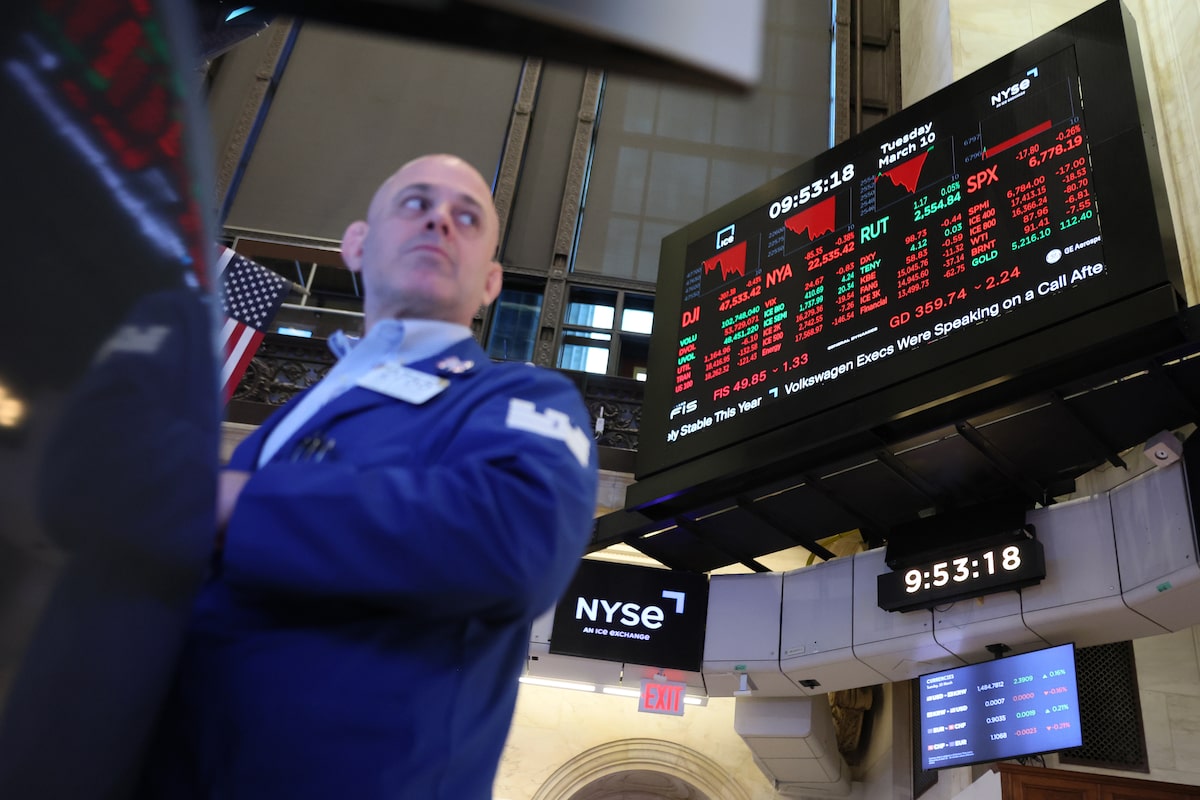
03/11/26 05:45Wall Street futures subdued as investors eye crude prices, inflation reportOpen this photo in gallery:
Traders work on the floor of the New York Stock Exchange (NYSE) on Tuesday.Spencer Platt/Getty Images
U.S. stock index futures were subdued in choppy trading on Wednesday as investors assessed the outlook for crude prices and looked ahead to a key inflation report, while tensions in the Middle East continued to escalate.
At 4:57 a.m. ET, Dow E-minis were down 131 points, or 0.27 per cent, and S&P 500 E-minis were down 9.75 points, or 0.14 per cent. Nasdaq 100 E-minis were down 38.5 points, or 0.15 per cent.
Energy prices whipsawed as traders weighed a report that the International Energy Agency was looking at releasing oil reserves to stabilize supply, in the face of intensifying air strikes in the Middle East that are likely to ground shipping through the strategic Strait of Hormuz for a while.
Still, remarks from President Donald Trump earlier this week offered markets some reassurance that the war might not be drawn out for months. Oil prices have fallen to under $90 a barrel from nearly US$120 earlier in the week.
Later in the day, a report is expected to show consumer prices likely picked up in February as tariffs were passed through to individuals, which could add to worries of rising gasoline costs in the months ahead. The levies were deemed unconstitutional late last month.
Worries that higher energy costs could fan price pressures pushed back expectations for a 25-basis-point interest rate cut by the Federal Reserve to September from July, according to LSEG-compiled data.
Signs of a softening jobs market are likely to further complicate the central bank’s monetary policymaking.
“The big concern for the markets is to what extent this supply shock leads to higher inflation, weaker growth, interest rates that are higher than they would otherwise have been, and lower profitability,” said Kyle Rodda, senior financial market analyst at Capital.com.
Wall Street’s fear gauge, the CBOE volatility index, edged higher 0.72 points to 25.65.
Meanwhile, Oracle (ORCL-N) predicted that the AI data centre boom will power its revenue above estimates well into 2027, sending its shares up 10 per cent in premarket trading.
Semiconductor stocks such as Nvidia, Broadcom and Advanced Micro Devices were marginally higher.
– Reuters
03/11/26 05:24Stocks sink as volatile oil prices, Middle East conflict weigh on trading
Global shares edged lower on Wednesday as oil prices fluctuated and mixed signals about the U.S.-Israeli stance on Iran heightened investor anxiety over inflationary pressures and risks to economic growth.
Beyond the Middle East, investors were reminded of the vulnerabilities within private credit after the Financial Times, citing people familiar with the matter, reported JPMorgan Chase JPM.N had marked down the value of some loans held by private-credit groups and was tightening its lending to the sector.
Oil had another volatile day, although price movement was relatively muted compared to the record price swings of Monday’s session.
The Wall Street Journal reported the International Energy Agency has proposed the largest release of reserves in its history to bring down crude prices, while energy ministers from the G7 nations said they supported the principle of using stockpiles to deal with the situation.
Brent crude futures were last up around 2 per cent at US$89.47 a barrel, having traded as low as US$86.24 overnight.
The MSCI All-World index eased a touch on the day as losses in European shares mounted, leaving the STOXX 600 down 0.7 per cent, shrugging off gains in Asia, where the Nikkei rose 1.7 per cent and South Korea’s Kospi gained 1.75 per cent.
U.S. stock futures were virtually flat on the day .
– Reuters
03/11/26 05:21Before the Bell: What every Canadian investor needs to know today
– S.R. Slobodian
Global markets slid as contradictory signals from the U.S.-Israeli war on Iran kept investors anxious over the risks to inflation and global growth.
Wall Street futures were in the red ahead of a key U.S. inflation report for February – before escalating tensions in the Middle East boosted energy prices.
TSX futures pointed lower after Canada’s major stock market closed marginally higher yesterday.
In Canada, investors are getting results from Descartes Systems Group Inc. and Bird Construction Inc.
On Wall Street, markets are watching earnings from Campbell’s Co.
“If the war ends and the worst – in terms of an energy price spike – is behind us, investors could return to a more constructive mode,” Ipek Ozkardeskaya, senior analyst at Swissquote, wrote in a note. “But uncertainties loom, and there is a chance that the Iran war will not be done and dusted quickly.”
Read more: Here
03/11/26 05:01Oil prices seesaw as markets weigh IEA reserves release, persistent supply concerns
Oil prices rebounded on Wednesday as markets doubted whether the International Energy Agency’s reported plan for a record release of oil reserves could offset potential supply shocks from the U.S.-Israeli conflict with Iran.
Brent futures traded up 59 US cents, or 0.7 per cent, at US$88.39 a barrel. U.S. West Texas Intermediate (WTI) traded 98 US cents higher, or 1.2 per cent, at US$84.43 a barrel.
Both contracts extended losses in early Asian trade, after plunging more than 11 per cent on Tuesday, despite U.S. crude prices leaping 5 per cent at the market’s opening.
The IEA’s proposed drawdown would exceed the 182 million barrels of oil that IEA member countries put onto the market in two releases in 2022 when Russia launched its full-scale invasion of Ukraine, the WSJ said, citing officials familiar with the matter.
In a note to clients, Goldman Sachs analysts said that a stockpile release of that size would offset 12 days of the investment bank’s estimated 15.4 million barrel-per-day Gulf exports disruption.
– Reuters
03/11/26 05:00Tuesday markets recap: TSX gains back ground as fears lessen of prolonged war in Middle EastOpen this photo in gallery:
Israeli tanks and armoured personnel carriers near the Israel-Lebanon border on Tuesday.
The U.S.-Israeli war with Iran has sparked a jump in crude prices, which has fuelled worries over inflation.Amir Cohen/Reuters
Canada’s main stock index edged higher on Tuesday as fears lessened of a prolonged Middle East war, with gains for financial and metal mining shares offsetting declines for energy after oil prices pulled back.
The S&P/TSX Composite Index ended up 81.33 points, or 0.3 per cent, at 33,270.65. On Monday, the index touched its lowest intraday level since Feb. 6 before ending higher.
“Prices have recovered somewhat after the initial fears of a prolonged conflict,” said Michael Sprung, president at Sprung Investment Management.
“Going forward we’re going to see high volatility as long as this war continues. Perhaps the best thing investors can do is just be confident in the companies they own in terms of their financial integrity and their management integrity.”
The materials index, which includes precious metal miners, added 1.2 per cent. The price of gold was up 1.2 per cent as the safe-haven U.S. dollar gave back some recent gains.
Heavily weighted financials were up 0.8 per cent despite a near 57-per-cent plunge in the shares of Goeasy Ltd. GSY-T The lender forecast a fourth-quarter incremental charge-off of $178-million and suspended its quarterly dividend as well as share repurchases.
Meanwhile, U.S. stocks lost steam, with the S&P 500 giving up early gains to skid into negative territory as investors weighed the U.S.-Israeli war on Iran against continuing worries of economic stagflation.
The Dow joined the S&P 500 in negative territory, while the Nasdaq eked out a nominal gain.
“The market was showing some strength and it has given all that back,” said Tim Ghriskey, senior portfolio strategist at Ingalls & Snyder in New York. “There’s a lot of confusion among investors.”
“You see these headlines coming out of the White House that give the market hope, and then clearer heads prevail and markets realize this is nowhere near over,” Mr. Ghriskey added. The indexes wavered through early-session trepidation as U.S. Defence Secretary Pete Hegseth warned that Tuesday would be the most intense day thus far of strikes against Iran.
The conflict has sparked a jump in crude prices, which has fuelled worries over inflation against a backdrop of a weakening labour market – a toxic combination of rising costs and a softening economy called stagflation.
U.S. and Brent front-month crude futures settled down over 11 per cent.
The Dow Jones Industrial Average fell 34.29 points, or 0.07 per cent, to 47,706.51, the S&P 500 lost 14.51 points, or 0.21 per cent, to 6,781.48 and the Nasdaq Composite gained 1.16 points, or 0.01 per cent, to 22,697.10.
Moves in Treasury yields were mixed and modest.
– Globe staff and wires