
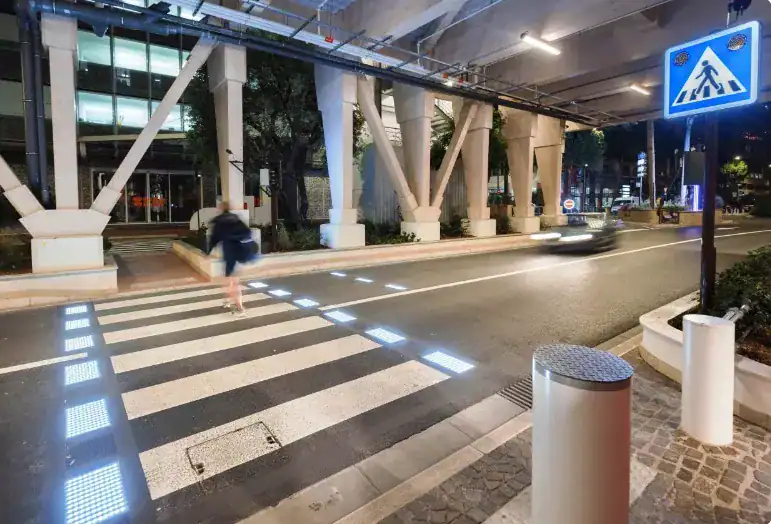
Brampton is considering bringing light-up crosswalks to the city, like this one by Canadian company SmartCrossing. (Photo: SmartCrossing)
Some Brampton neighbourhoods could get new, high-visibility crosswalks to help fill a gap in the city’s road safety network left by Ontario’s speed camera ban, councillors say.
“The reality is, that now that the speed cameras are no longer in palace, we are struggling to find other tools and methods to deal with speeding,” Coin. Rowena Santos said during a Brampton City Council meeting on Wednesday.
Santos and other councillors say they’ve seen an increase in speeding drivers following Premier Doug Ford’s ban on automated speed enforcement (ASE) cameras across Ontario.
And while the city is repurposing the expensive cameras for other uses, a new pilot project aims at slowing drivers down in community safety zones with added road safety tech, including light-up crosswalks.
The high-visibility, light-up LED crosswalks are already being used in Quebec and European countries like Finland and Spain, and the technology is available through a Canadian company called SmartCrossing.
READ MORE: Cameras still online show over 70K cases of speeding following ban in Brampton, councillor says
City staff have been instructed to explore bringing in-ground, light-up crosswalks to Brampton, and early estimates put the cost of each new crosswalk between $60,000 and $160,000.
The pilot project could lead to one high-visibility crosswalk in each of Brampton’s ward pairings, if requested by area councillors.
Santos said she would want to bring a smart crosswalk to Wards 1 and 5, while Councillors Martin Martin Medeiros and Denis Keenan also expressed interest in Wards 2 and 4.
A report to council later this year will reveal the costs of the program, and other technology the city can use to improve road safety. The province has also made funds available to municipalities to pay for enhanced road safety measures following the ASE ban.
Before they were removed, ASE cameras caught drivers speeding up to four times over the limit in 50 km/h and 40 km/h zones in Brampton, according to the city. Data shows the cameras led to an average speed reduction of 9.33 km/h at locations where cameras have been placed in the city.
The fastest driver recorded by an ASE camera in Brampton was at McVean Drive north of Tappet Drive, clocked at 200 km/h in a 50 km/h zone – a speed that could come with stunting and speeding charges, as well as a vehicle impound and a licence suspension.
Ontario launched its ASE camera program in 2019, and Brampton began up-scaling its automated speed enforcement (ASE) camera program in 2023 by approving more than 100 new cameras. The city also purchased an ASE ticket processing facility that promised to generate around $30 million in revenue every year with annual expenses of some $13 million.
The last 35 of the city’s nearly 200 ASE cameras went live on Sept. 1, just two months before the ban. Santos and other councillors called on Ford to spare ASE cameras in school zones, but no exceptions were granted.
“Now, we ‘re just struggling to find ways to slow (cars) down with other methods,” Santos said.
INsauga’s Editorial Standards and Policies
Last 30 Days: 32,087 Votes
All Time: 1,255,163 Votes
896 VOTES
Are high gas prices changing your travel routines?
WIN A $100 GIFT CARD
Subscribe to INsauga’s daily email newsletter for a chance to win a $100 Amazon gift card.