
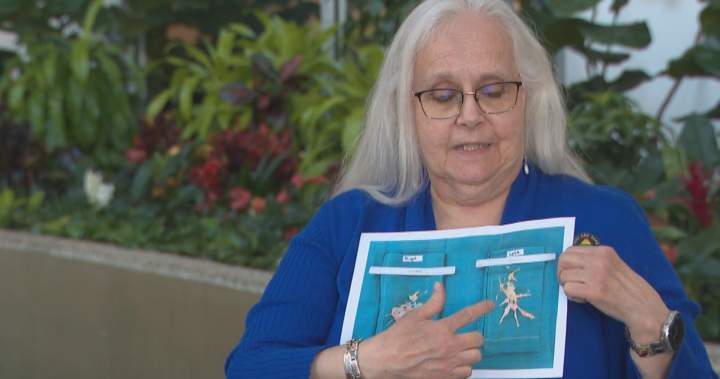
When Deborah Hoekstra was having trouble climbing stairs in 2020, doctors thought she had contracted COVID-19, but after a CT scan they found her lungs were full of blood clots.

The United Church minister knew something was wrong when she spoke to a member of her congregation who was a former nurse.
“She’d say, ‘You know, Deborah, you could have died,’” Hoekstra said. “I had no idea how serious she was, but she’d look at me saying, ‘You’re a miracle.’”
After days in hospital and years of monitoring, things weren’t getting better.
“The blood clots were not disappearing” Hoekstra said. “I started sitting for more things and I was out of breath more and I had no energy and I was starting to look ill and tired and wasn’t sleeping well.”
Story continues below advertisement
In 2024, she was referred to the Pulmonary Hypertension Clinic at the Mazankowski Alberta Heart Institute.
“That’s where I met Dr. Varghese who got all excited and said, ‘I think you have CTEPH,’” she said.
Chronic thromboembolic pulmonary hypertension (CTEPH) is a rare form of pulmonary hypertension caused by chronic blood clots and scarring in the lungs’ arteries. If not treated, it can be fatal. However, the team at the Mazankowski Heart Institute had recently brought a rare surgery to the hospital months before her diagnosis.
Thanks to support from the University Hospital Foundation, Dr. Steven Meyer and a team of doctors had been sent to the United States to learn the procedure. An entire team — from radiologists to anesthesiologists to ICU doctors — all play a role in helping patients through it.

Get weekly health news
Receive the latest medical news and health information delivered to you every Sunday.
Doctors then perform a pulmonary thromboendarterectomy (PTE), in which a patient is taken to the operating room, put under anesthesia and into a state of hypothermia and the blood is drained from the lungs. A special instrument reaches down inside the lungs to remove the built-up scar tissue.
“What we do is we open up the arteries to the lungs, and we peel this very thin layer of scar tissue out of the lining of the blood vessels in the lungs in the pulmonary arteries,” Dr. Meyer explained. “We remove the obstruction of blood flow through the lungs.
Story continues below advertisement
“Patients feel much better, and they live a lot longer after these treatments.”
The University Hospital Foundation also helped fund the specialized equipment needed to perform the surgery and to attract the top talent to the hospital.
“We’re able to attract these incredible specialists, to build this incredible team, to support these patients from pre-op, inter-op and post-op,” Meyer added.
“This is just another legacy of the Mazankowski Heart Institute.”
Dr. Meyers said five people have undergone the surgery in the last 16 months. Hoekstra was number three.
The team in Edmonton is the first in Western Canada to provide the procedure. Prior to that, most patients from Alberta were sent to Toronto.
“That comes at a great cost to the province, also at a cost to patients, and there was patients that said I just can’t or won’t,” Dr. Meyer said.
Doctors also said many practitioners didn’t know where to turn if they believed their patient may have CTEPH.
“They now have a home,” said Dr. Rhea Varghese, who is a respirologist with the Pulmonary Hypertension Clinic and the doctor who diagnosed Hoekstra.
“Now they know that sending them to the Pulmonary Hypertension Clinic can at least help them, if not surgically, medically.”
Story continues below advertisement
Hoekstra said she had heard the wait list was up to a year to get in for surgery in Ontario, and she was afraid she may not make it that long. Instead, she said she was able to stay close to home, where she could have her support nearby.
“When he (Dr. Meyer) told me that they believed I was eligible for the surgery, I actually fist-pumped,” she said. “There’s a solution to this!
“He made it very clear that it was a very risky surgery. There was a chance I might not make it.”
To prepare, she watched videos of the surgery to see exactly what was going to happen. Hoekstra had her surgery in June 2025 and said by September she was able to go back to work part-time in September, and full-time in January 2026.
She now shows off the scar on her chest.
“I see life,” she said when she was asked about what she thinks when she sees it.
The Full House Lottery supports the world-class cardiac care through the Royal Alexandra Hospital Foundation and the University Hospital Foundation.
© 2026 Global News, a division of Corus Entertainment Inc.