
Oil prices top $100 a barrel again Callum Jones
Oil prices are on the rise again, with the international benchmark Brent crude back above $100 per barrel, as concern over the US-Israel war with Iran intensifies. Asian stock markets are back under pressure, too.
In a bid to calm concerns over oil supplies, the International Energy Agency (IEA) ordered the largest release of government reserves in its history on Wednesday. But the announcement was overshadowed by widespread Iranian attacks on energy facilities across the Middle East.
Several merchant ships were struck in and around the strait of Hormuz, one of the most important arteries in global trade. Iraq halted all operations at its oil ports after an attack on two nearby oil tankers. Bahrain told residents to stay home after an Iranian attack on fuel tanks in the Muharraq Governorate.
Oman has meanwhile shifted all vessels out of its main oil export terminal at Mina Al Fahal after drone strikes at another of its ports, Bloomberg reported, citing sources who received a notice from a port agent.
The disruption continues.
Updated at 01.32 EDT
Key events
Show key events only
Please turn on JavaScript to use this feature
Earlier today, Iran appeared to set ablaze two tankers in Iraqi waters.
Here are some images of the aftermath:
A foreign tanker carrying Iraqi fuel oil was damaged after an attack caused it to catch fire in Iraq’s territorial waters on 12 March 2026. Photograph: Mohammed Aty/ReutersA foreign tanker carrying Iraqi fuel oil was damaged after an attack caused it to catch fire in Iraq’s territorial waters on 12 March 2026. Photograph: Mohammed Aty/ReutersA foreign tanker carrying Iraqi fuel oil was damaged after an attack caused it to catch fire in Iraq’s territorial waters on 12 March 2026. Photograph: Mohammed Aty/ReutersShare
The Guardian has published a video showing the tankers in Iraqi waters bursting into flames.
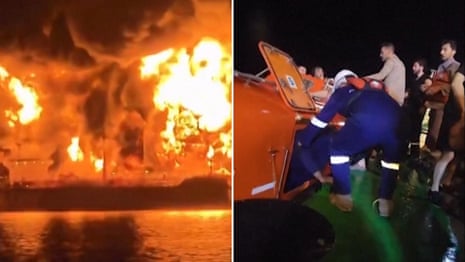 Fuel tankers burst into flames in Iraqi waters after suspected Iranian boat attacks – videoShareIsraeli drone strikes area in Beirut where displaced people had been sheltering
 William Christou
The aftermath of Israel’s drone strike last night on the central Beirut neighbourhood of Ramlet al-Baydaa was still evident on Thursday morning. Two bombs from a drone had fallen in quick succession on the beachfront corniche where displaced people had been sleeping for the past week, killing eight people and injuring 21.
It was the third time that Israel bombed central Beirut in recent days, striking areas previously thought as safe. The strike came a few hours after Hezbollah launched its most intense bombing of Israel yet, launching waves of rockets and drones in tandem with Iran.
The sand had turned red where bodies had lay just a few hours ago, and the wreckage of a motorcycle leaned against two bombed out cars. The bombs had bore two deep holes into the sidewalk, and Lebanese soldiers peered inside with a flashlight, seeing if any of the explosives remained.
“It was terrifying. We heard them hit once and then once again almost immediately. We didn’t think they would hit here. What’s here? It’s just the sea,” said Riyadh al-Lattah, a 57-year-old woodworker from the southern suburbs of Beirut who was camped out with his wife and five children across the street from the impact site.
Al-Lattah was one of hundreds of residents who turned to the city’s beachfront when Israel ordered Beirut’s southern suburbs to be evacuated last week. With nowhere else to go, al-Lattah set up two tents along the beach, joining the growing tent encampment in front of the usual upscale neighbourhood.
He did not expect, however, that Israel would strike without warning.
“This war is harder. At least last time they would warn you. They’d tell you before they hit; now it’s just random bombings,” said al-Lattah. Another man who was camped out, 18-year-old Hussein al-Atrash, said that he would soon leave Beirut, afraid of more strikes to come.
“We came here because we thought we would be safe. Wherever we go, they bomb,” said al-Atrash, a displaced resident of Dahiyeh.
As he spoke, the army began to yell for crowds to stand back – they had found an unexploded bomb in one of the holes in the sidewalk.
The Israeli military announced that it has begun another widescale wave of attacks on Iran.
Israeli forces earlier today launched a wave of strikes on Lebanon, killing at least seven people on central Beirut’s seafront.
ShareDrones strike Kuwait airport, causing material damage
Kuwait international airport was struck by several drones on Thursday, according to Kuwait News Agency.
The drones caused some material damage, but no injuries. It is still unclear who was responsible for the strike.
On Wednesday, four people were injured after air defences intercepted two drones near Dubai airport in the United Arab Emirates. Soon after the attack, the Dutch carrier KLM canceled all flights to Dubai up to and including 28 March.
Updated at 04.54 EDT
The Israeli military issued an urgent warning on Thursday to the residents of Qasr Naba, a town in Lebanon about 64 kilometres (40 miles) east of Beirut.
Israeli forces will be attacking at least one building in the village believed to be Hezbollah military infrastructure, IDF spokesman Avichay Adraee said on X.
The warning came shortly after an Israeli strike on central Beirut’s seafront killed at least seven people.
ShareOil prices top $100 before dropping back slightly
Oil prices topped $100 a barrel on Thursday before falling back as Iran stepped up its attacks on energy infrastructure around the Middle East.
The Guardian’s Callum Jones reports that the price of Brent crude – the international benchmark – show up by 9% to $100.29 per barrel on Thursday, despite efforts by governments across the world to allay fears of a sustained supply crunch.
That price has since dropped to $98 a barrel, according to the Associated Press.
On Wednesday. the International Energy Agency ordered the largest release of government oil reserves in its history in an effort to calm the oil price shock triggered by the conflict.
ShareItalian base in Kurdish region of Iraq attacked, says Italian foreign minister
An Italian military base in the Kurdish region of Iraq was attacked, Italian foreign minister Antonio Tajani said in a post on X.
Tajani said he strongly condemned the attack in Erbil, but didn’t say if authorities knew who was responsible for it. He said all soldiers on the base were safe.
ShareSummary
In case you’re just tuning in to our live coverage of the US-Israel war on Iran, here’s a snapshot of the latest key developments. It’s now 10.30am in Tehran, 9am in Beirut and Tel Aviv and 3am in Washington DC.
Iran appeared to have set two tankers ablaze on fire in Iraqi waters, killing one crew member, as it stepped up strikes on oil and transport facilities around the Middle East.
About 2,000 people have reportedly been killed in the war launched almost two weeks ago, while Unicef said more than 1,100 children had been killed or injured.
Donald Trump said at a rally in Kentucky that the US had won the war but didn’t want to have to go back every two years. “We don’t want to leave early do we? We’ve got to finish the job.”
Oil prices, which shot up earlier in the week to nearly $120 a barrel before retreating, jumped almost 10% back above $100 a barrel in Asian trade on Thursday amid renewed fears about supply disruption.
A spokesperson for Iran’s military command warning in remarks directed at the US: “Get ready for oil to be $200 a barrel, because the oil price depends on regional security, which you have destabilised.”
British prime minister Keir Starmer said the government would “step in” if companies exploited rising heating oil prices amid the Middle East conflict.
US intelligence indicates that Iran’s leadership is still largely intact and is not at risk of collapse any time soon, the Reuters news agency reported, citing three sources. A “multitude” of intelligence reports provide “consistent analysis that the regime is not in danger” of collapse and “retains control of the Iranian public”, one of the sources said.
Lebanon said an Israeli strike on central Beirut’s seafront killed at least seven people early on Thursday – another attack in the heart of the capital as Hezbollah launched more missiles at Israel. The Israeli military earlier said it launched a “large-scale wave of strikes” on Beirut’s densely populated suburbs after the Iran-backed militant group fired what the IDF said were “dozens” of rockets.
The International Energy Agency ordered the largest release of government oil reserves in its history – 400m barrels – in a bid to calm concerns over supplies and dampen one of the worst fuel shocks since the 1970s. The US said it would release 172m barrels of oil from its strategic petroleum reserve.
An attack on Iraq’s Basra port early on Thursday killed at least one person and forced authorities to halt operations at all the country’s oil terminals, officials said.
Other reports of Iranian attacks included the targeting of fuel tanks at a facility in Bahrain’s Muharraq and drones striking oil storage facilities at Salalah port, while another container vessel reported being struck near the United Arab Emirates, Kuwait reported a drone hitting a building, injuring two, and Dubai authorities responded to a drone that fell on a building.
With news agencies
Updated at 03.26 EDT
Foreign ministers from the Association of Southeast Asian Nations (Asean) will hold a special meeting on the situation in the Middle East on Friday, a Philippine foreign ministry official has been quoted as saying.
Donald Trump has been at pains in recent days to reassure the world that the economic impact of his war on Iran can be contained, but across Asia – the world’s top crude oil importing region – the rhetoric around the ramifications of this conflict is less important than the reality.
Asian countries from Pakistan to South Korea have been forced to confront a brewing energy supply crisis.
You can read more in this analysis from Callum Jones here: