
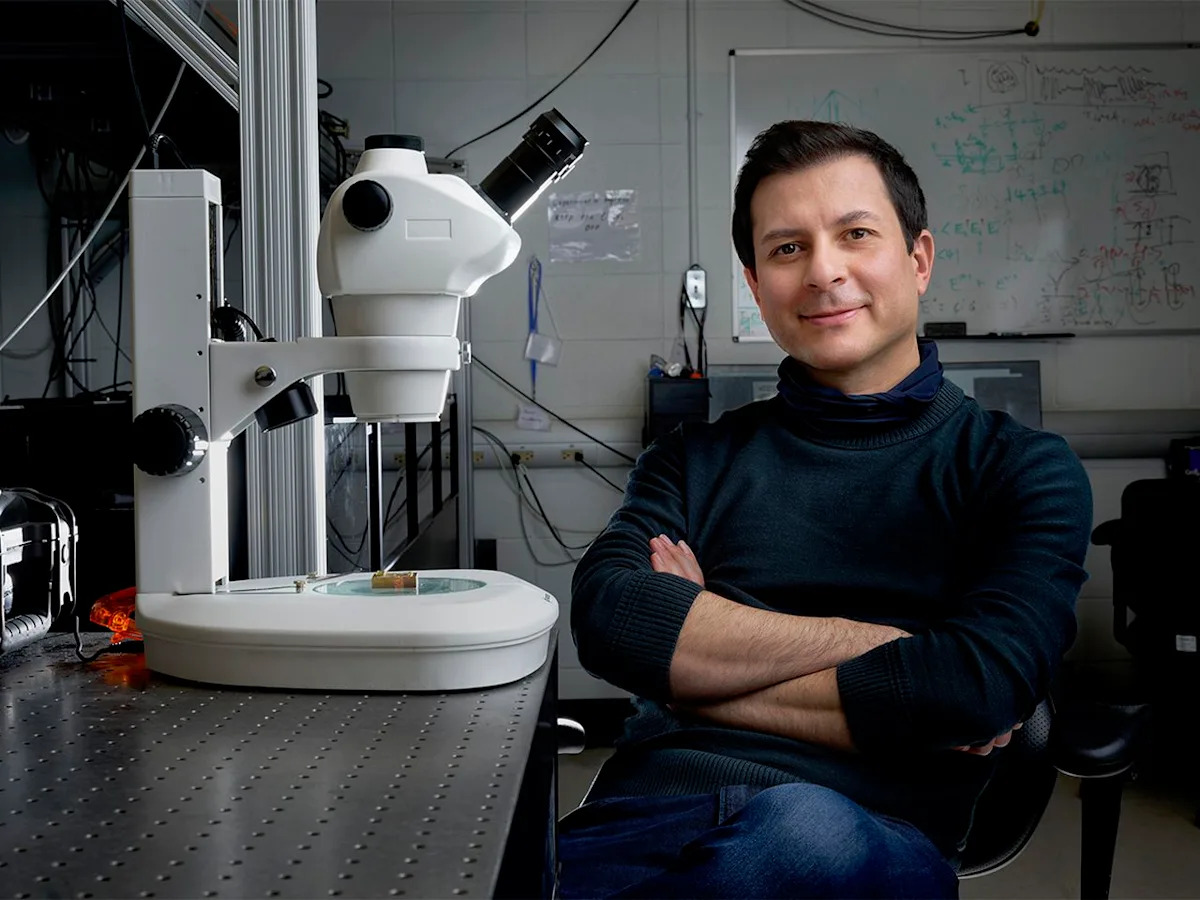
Two Calgary scientists are recipients of Canada’s top research prizes, and will receive $100,000 each to further their work in bioengineering and quantum mechanics.
Dr. Nigel Shrive and Dr. Shabir Barzanjeh, who both work with the University of Calgary, joined an exclusive roster of Canadian researchers bestowed with Killam Trust prizes in January.
Ten minutes before he found out he had won the award, Barzanjeh had completed a meeting with Paul Corkum, a renowned Canadian physicist and leader in atomic physics at the University of Ottawa.
Barzanjeh was awarded the money as part of the Killam NRC Paul Corkum Fellowship.
“It felt amazing,” he said. “It gives me a lot of freedom to do my own research.”
Focus on quantum computers for Dr. Barzanjeh
With the funding, Barzanjeh plans to take a year off from his job at the university to focus on his work with the National Research Council, aiming to create technology that makes it easier to build quantum computers — whether that means travelling to Ottawa or Europe to build rapport with researchers at an international level.
Alongside his partner, Sergei Studenikin, at the council’s Quantum and Nanotechnologies Research Centre, Barzanjeh has been developing a system that would combine semiconductor spin qubits with quantum-limited amplifiers.
The qubits contain information that can be accessed through the semiconductor systems to be controlled and read more efficiently.
“The main effort is to make quantum hardware more efficient and, hopefully, in the future, we can build them in collaboration with other partners,” he said.
The team is also pursuing the first Canadian demonstration of entanglement between semiconductor qubits with the use of microwave quantum signals. If successful, the approach could scale the build of quantum processors, networked quantum systems and secure communications, and make Canada a leader in global quantum innovation.
It’s a line of work that has kept Barzanjeh occupied for more than 15 years, since his interest was first spiked during his time as a PhD student.
“I’ve just been attracted to the mysteries of quantum worlds,” he said. “It’s not easy to understand.”
Varied interests started for Dr. Shrive as a young student
Shrive, on the other hand, is unsure of what to do with his winnings. “It’s too early to say,” he said.
The researcher has a plethora of projects to choose from — including refocusing on an already successful artificial knee design he created more than a decade ago to be used by those suffering from arthritis, to advancements in biomechanics and working on advancements in eco-focused masonry.
His varied interests started when he was a young student trying to decide between engineering and medicine.
“After a year engineering, I went and worked as a summer student on a construction site. And that made me think, do I really want to be doing this? And I went back to my tutor and I said I think I should be reading medicine rather than engineering,” he recalled.
His tutor suggested he do both. “Why not biomedical engineering?” he recalled him suggesting, before putting Shrive in contact with researchers working in the field. “That got me interested and fascinated,” he said.
He likened the skeleton to an “engineering load-bearing system with motion.”
“The muscles are like motors, the skeleton is like a structure . . . everything in that musculoskeletal system from bones and joints is basically carrying load, like a building carries load,” he said.
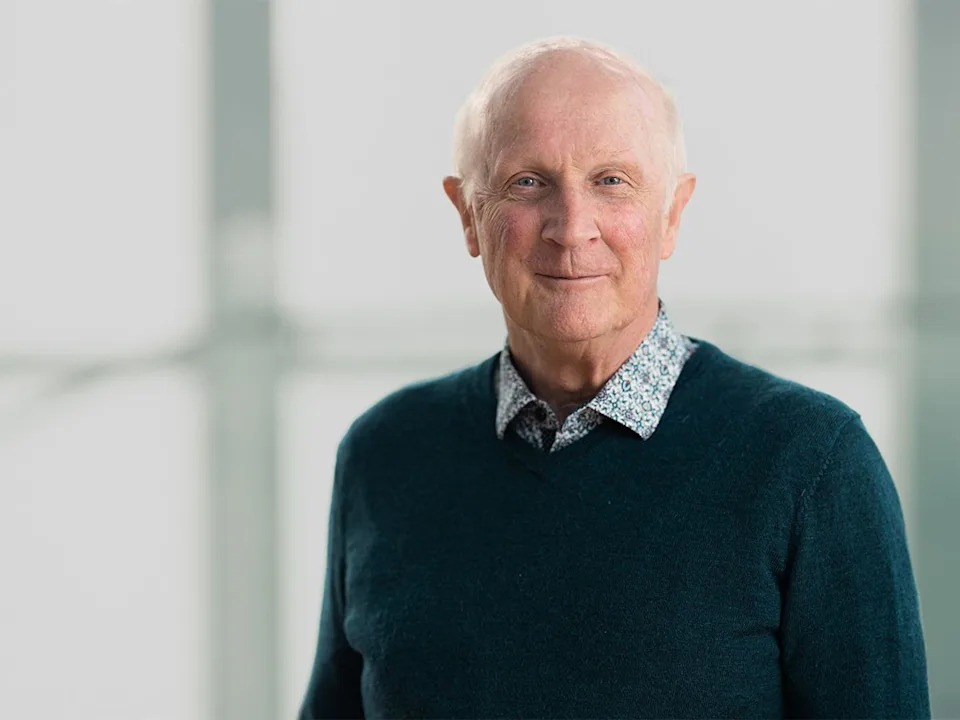
Nigel Shrive has been awarded the Killam Trust Research Prize. It is considered of Canada’s most prestigious scholarly award, recognizing Canadians whose groundbreaking research are shaping the future of science, technology, policy, health, and more — work that is not only internationally recognized, but transformative for Canada’s global standing.
Shrive and his team are also experimenting with a natural mineral additive that could reduce Portland cement in concrete, cutting down on the global greenhouse emissions of cement production by approximately two per cent.
His career and research interests see-saw regularly between working with living cells and decidedly non-living cement.
“Masonry is inert,” he said with a chuckle, which drastically changes the research approach.
“With masonry, if you do an experiment to (prove a hypothesis), often you can be correct because nothing changes. It’s a place where you can reassure yourself that your logic and your thinking and your basic fundamentals are correct.”
Biomechanics prove its own scientific challenge due to the changing nature of the living body.
“The cells are alive and they change,” he said. “What you might think is a way that the structure is functioning and changing behaviour, you’ll suddenly find that that’s not where it is at all because it’s alive and it changes all the time.”