
As the U.S. federal government under Donald Trump moves to cut funding for active transportation programs and doubles down on policies favouring expanded fossil fuel development, cycling advocates say the political shift may now be reaching the streets—literally.
In Washington, D.C., rumours that federal agencies could soon remove a key protected bike lane near the National Mallare raising alarm among cyclists and urban mobility advocates across North America. The corridor in question, along 15th Street NW, is one of the city’s most heavily used cycling routes and a critical connection between the capital and Northern Virginia.
According to the advocacy group Washington Area Bicyclist Association, an anonymous source recently warned that federal agencies may be preparing to remove protected bike lanes along 15th Street NW/SW and East Basin Drive between Constitution Avenue and the 14th Street Bridge—a stretch that sits largely on land managed by the National Park Service.
The rumour suggests the effort could involve the Federal Highway Administration, which partners with the Park Service to manage transportation infrastructure on federal lands. Even more troubling to advocates is the suggestion that the lanes could be removed quickly, without formal announcement or public consultation.
“We heard from a source that the U.S. Department of Transportation is targeting the removal of the protected bike lanes on 15th Street and East Basin Drive,” said Kalli Krumpos of WABA. “We were told that it was unlikely there would be any public comment opportunity and that there would not be any announcement in writing before removal began—likely in the next few weeks.”
For cycling advocates across North America, the issue resonates because the corridor represents a textbook example of modern protected cycling infrastructure—and a rare one that crosses multiple jurisdictions and federal land.
A critical regional link
The threatened segment forms a vital connection between central Washington and Northern Virginia via the 14th Street Bridge, creating what advocates describe as the only fully “low-stress” bike route between the core of the capital and the suburbs across the Potomac River.
The corridor is also one of the city’s busiest for cyclists.
“The 15th Street bike lanes are one of the District’s highest ridership bike lanes,” Krumpos said. “This route is a key connection for commuters, tourists, and residents.”
Portions of the project were completed as recently as 2023 through a partnership between the District Department of Transportation and the National Park Service, linking the 14th Street Bridge directly into downtown cycling routes and the broader regional network.
But the corridor also carries historical significance in the evolution of urban cycling infrastructure in the United States. The segment between Pennsylvania Avenue and V Street NW was home to the first protected bike lane ever installed in Washington, built in 2010 as the city began shifting toward separated cycling infrastructure.
Safety gains backed by data
Advocates argue the possible removal of the lanes is particularly perplexing given the project’s documented safety improvements.
A before-and-after evaluation conducted by the District Department of Transportation found the redesign dramatically improved conditions along the corridor. According to the agency’s analysis, total roadway crashes declined by 46 percent, while bicycle injury crashes dropped by 91 percent. Bicycle traffic along the corridor increased modestly by about 3 percent.
At the same time, the redesign did not slow drivers—an often-cited criticism of protected bike lanes. In fact, travel times improved slightly, with peak-hour northbound trips dropping by 36 seconds and southbound trips by 40 seconds.
Capital Bikeshare usage along the corridor has also been substantial. A station near the Jefferson Memorial alone has recorded more than 232,000 trips since 2022.
“Though there were increases in the number of cyclists who use the corridor, that wasn’t the primary goal,” Krumpos said. “The goal of the protected bike lane project was to improve safety for cyclists and pedestrians on an already popular stretch.”
A missing link with major consequences
Urban cycling networks depend heavily on continuity. Remove a single link and the entire system can become less usable—especially for less confident riders.
If the lanes disappear, advocates say the effects would ripple far beyond the few kilometres involved.
“This bike lane is a critical part of the region’s bike network,” Krumpos said. “It’s the only entirely low-stress connection between Virginia and the core of D.C., and it serves commuters, tourists, and recreational riders.”
She added that removing the protected infrastructure would likely reverse many of the gains the project created.
“There have been safety improvements for everyone who travels through the corridor,” she said. “If the lanes are removed, everyone would be less safe. There would also be confusion as people on bikes and scooters might try to ride on the sidewalk.”
Those concerns are particularly acute during major tourism periods along the National Mall, including the annual National Cherry Blossom Festival, which draws roughly 1.5 million visitors each year to the same corridor.
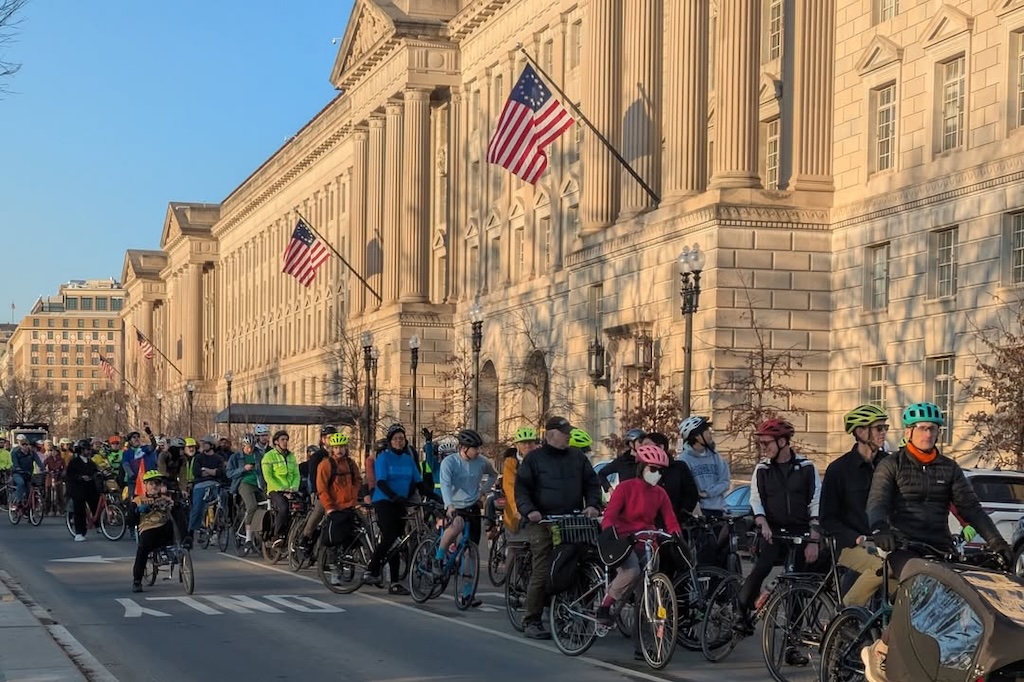
Washington Area Bicyclist Association protest ride
Riders mobilize
After hearing about the potential removal, WABA quickly began organizing. The group contacted legal counsel to explore possible challenges, mobilized volunteers to monitor the corridor, and hosted a protest ride and rally to bring attention to the issue.
“Our goal was to call attention to the many transportation safety threats facing D.C. and the people who live, work, and recreate here,” Krumpos said. “We also wanted to provide community members an opportunity to stand together and use our voices to call for safer streets.”
The rally also highlighted broader transportation concerns facing the city, including federal legislative proposals that advocates say could weaken traffic safety measures.
A broader fight over transportation priorities
The situation underscores a longstanding tension between federal control of land around the National Mall and the city’s efforts to build safer streets.
Large sections of the corridor fall on federal property managed by the National Park Service, meaning city infrastructure projects often require coordination with federal agencies.
Krumpos said the issue ultimately comes down to priorities.
“Faster, wider roadways are more dangerous for everyone and don’t support the needs of all road users—especially people who walk, bike, and take transit,” she said.
For cycling advocates across North America, the controversy is being watched closely. Washington, D.C., has often been cited as a model for protected bike infrastructure in the United States. If one of its most prominent cycling corridors can be removed despite strong safety results, advocates say it could set a troubling precedent.
“D.C. is a testing ground because we don’t have the same ability to protect ourselves from federal threats,” Krumpos said. “If changes are implemented here, they could be targeting other communities next.”