

The National Hockey League’s current playoff format, which was implemented for the 2013-14 season, has been a topic for debate since its inception.
The basis of the league’s current division-based bracket is to guarantee four divisional matchups in the 16-team tournament, with each divisional No. 2 seed playing each divisional No. 3 seed. The two division winners per conference then end up drawing against a wild-card team, based on their finish in the standings.
This can create some heavyweight tilts in round one, and this season is no different, as three of the top four teams in the league – the Colorado Avalanche, Dallas Stars, and Minnesota Wild – all reside in the Central Division. As it stands, only one of the three can advance to the conference final out of the Central bracket.
Wild general manager Bill Guerin would like to see something different.
“It’s funny, we talk about it a lot. Personally, I would like to see it change, but I understand why we don’t,” Guerin said on First Up with Aaron Korolnek and Carlo Colaiacovo Thursday.
“It goes year to year. I think this year is just really unique in that you have these three really strong teams all in one division. You don’t see that a ton.”
.@mnwild General Manager Bill Guerin on on his crazy year with the Wild and Team USA, Auston Matthews’ exemplary leadership & playing in a tough central division https://t.co/dZoluhfFvd
— First Up (@FirstUp1050) March 12, 2026
Like most sports leagues, talent imbalances shifting from one conference to another is going to happen, but by segmenting the teams a second time through the divisions, the risk that those imbalances create unfair seeding increases further.
The pushback argument? To be the best, you’re going to have to beat the best anyway.
“You have to be careful what you wish for, too,” said Guerin.
“There’s a scenario that doesn’t really matter because you are going to play a good team no matter what. The parity in the league is so strong that you’re going to play somebody good.”
Having failed to advance past the first round in any of their eight trips to the playoffs since 2015, the Wild, though, would take any breaks they could get.
The current format also opens the door for lesser teams to be rewarded. Take the Pacific-leading Anaheim Ducks, for example, who are well below the Avalanche, Stars, and Wild in points, but would have home-ice advantage until the conference final while also playing lesser competition along the way than those three Central Division teams.
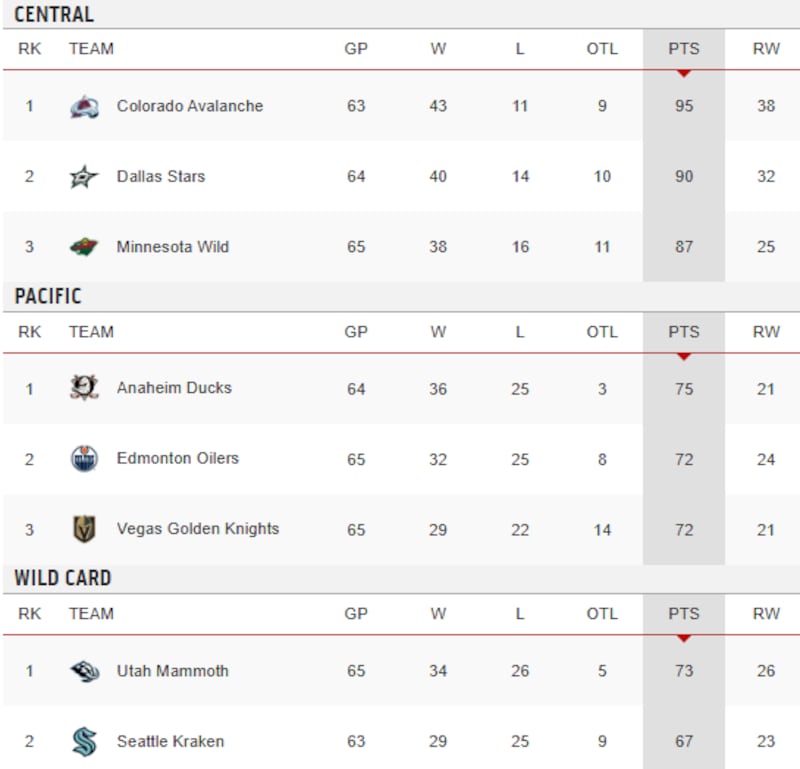 West Playoff Picture – March 12
“On the other side of it, the teams that work so hard to get to the top, maybe deserve to at least play one of the teams that haven’t gotten there,” said Guerin.
“So, I see both sides of it, to be quite honest with you. That’s really the crappy part of it, somebody’s going home. I guess competitively, if you look at it, you’re gonna play a good team anyway. But I do agree that one of the top three teams should not be going home [in the first round].”
The Avalanche, Stars and Wild appear locked in to to the top three spots in the Central Division, with the third-place Wild sitting 14 points ahead of the fourth-place Utah Mammoth. Colorado holds the Division lead, three points up on Dallas and eight points up on Minnesota.