
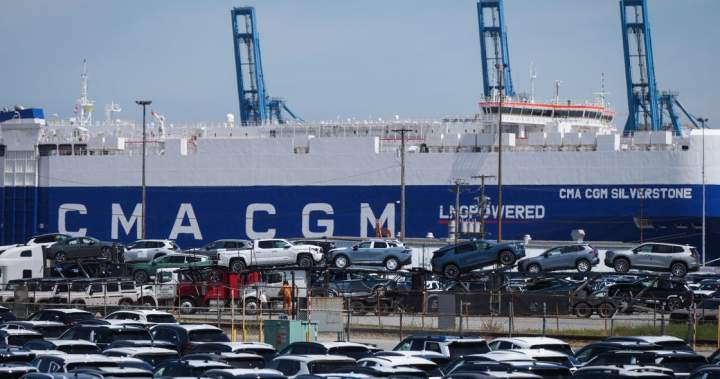
Canada’s trade deficit with the world increased in January as the number of vehicles exported to international markets dropped more than 20 per cent, according to the latest data.

Statistics Canada says total exports in January fell 4.7 per cent from December 2025, which was the largest monthly decline since April 2025. At the same time, Canada’s imports fell 1.1 per cent, which ballooned the trade deficit to $3.6 billion compared to $1.3 billion a month earlier.
A trade deficit happens when an economy imports more than it exports, while the reverse is a trade surplus, as was seen in September.
Motor vehicle exports dropped by 21.2 per cent, which was one of the biggest declines among product categories. Six out of 11 sectors saw exports fall in January.
Exports of passenger cars and light trucks specifically fell 32.5 per cent in the month to $5.4 billion, which Statistics Canada says was the lowest level since September 2021, and due to lower motor vehicle production in Canada.
Story continues below advertisement
“Canada’s trade started the year on a weak note,” said economist Jasleen Kaur Trehan at the Canadian Chamber of Commerce in a statement.
“Sectors that drove momentum in December — including autos and gold exports — saw sharp pullbacks, with motor vehicle and parts exports plunging more than 21 per cent amid production shutdowns.”

Get daily National news
Get daily Canada news delivered to your inbox so you’ll never miss the day’s top stories.
Trehan also says if export volumes continue to stay low, then Canada’s GDP could get dragged down with it.
This comes after 2025 saw the Canadian economy expand a modest 1.7 per cent, according to GDP data for the year, which is below the two-year average of about two per cent.

2:07
Ontario workers impacted by tariffs to receive nearly $230M in added funding
U.S. President Donald Trump’s administration has imposed a 25 per cent tariff on all Canadian-made vehicles and parts, in addition to sweeping tariffs on virtually all countries.
More on Economy
More videos
Story continues below advertisement
These tariffs have increased costs for some customers in the U.S., which is where the vast majority of Canadian-made vehicles and parts are shipped.
In January, General Motors laid off hundreds of workers in Ontario.
Manufacturing job losses totalled 28,000 in January, according to a separate report from Statistics Canada, and the unemployment rate hit 6.5 per cent across all job sectors.
Canada’s exports to the U.S. fell 3.8 per cent, and so did imports from the U.S. by 3.4 per cent. This means although Canada currently has a trade surplus with the U.S. amid the trade war, it shrank slightly to $5.4 billion from $5.7 billion the month before.
Exports to countries other than the U.S. also fell by 6.5 per cent in January, which Statistics Canada says was mostly because of lower shipments of of unwrought gold to the U.K. Meanwhile, imports from countries other than the U.S. increased by 2.1 per cent, led by imports of industrial machinery from China.
In the midst of the trade war, Prime Minister Mark Carney said he aims to double Canada’s exports to non-U.S. countries over the next decade.
Metal and non-metallic mineral product exports fell eight per cent in January, which includes unwrought gold, silver and platinum group metals and alloys, after rising nearly 18 per cent in December.
Story continues below advertisement
Aircraft and other transportation equipment parts saw exports fall 16 per cent after posting much stronger numbers in previous months. Much of the aircraft exports had been Canadian-made private jets from companies like Bombardier.
© 2026 Global News, a division of Corus Entertainment Inc.