

“Japanese knotweed’s story follows an innocent plant which was forcefully pulled from its native habitat and placed into new territories, causing it to turn into an alien monster infecting the world globally,” The Knotweed Lab, a project that aims to slow the spread of invasive knotweed in B.C., says on its website.
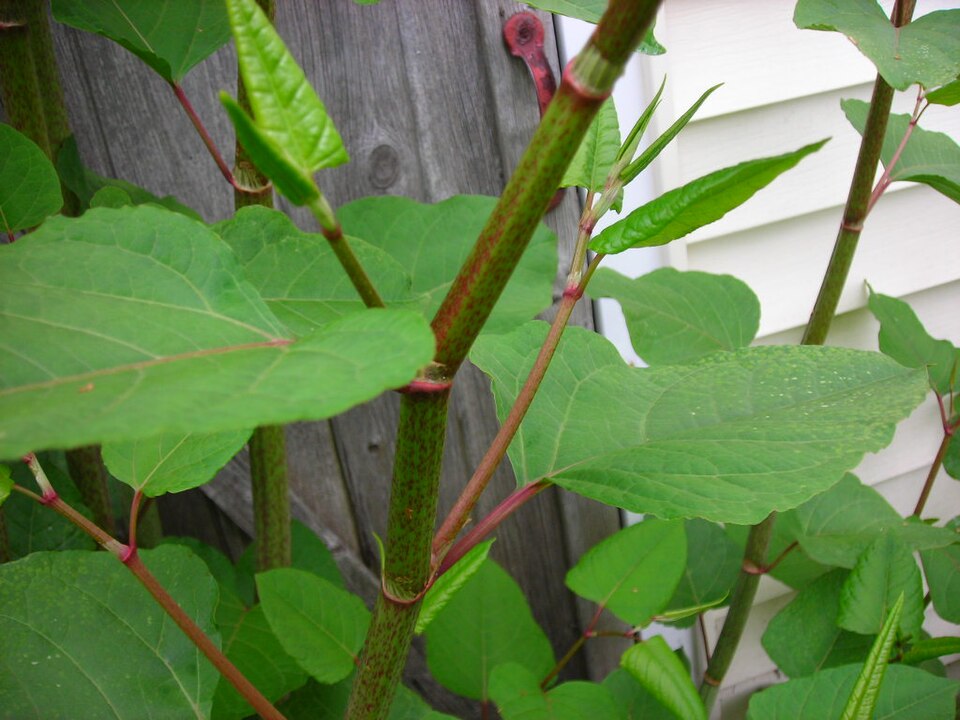
Japanese knotweed stems are reddish-purple. ( Ancatdubh43/Wikipedia) Public domain.
Japanese knotweed is considered more widespread and damaging in the UK, but the Knotweed Lab says if mitigation efforts don’t step up, Canada could be peering into its future.
“If this problem is left unchanged, Canada might face the same consequences as Britain,” the lab writes.
Japanese knotweed was introduced to North America in the 1800s as an ornamental plant and to help control erosion. Today, it is established in B.C. and from Ontario to Newfoundland.
The ‘worst’
The structural damage, fast spread, and difficulty to eradicate are just some of the reasons the Knotweed Lab called this the “world’s worst plant”.
In addition to the UK, mainland Europe, and North America, Japanese knotweed has also infiltrated Australia. In 1999, the International Union for Conservation of Nature (IUCN) added it to its list of 100 worst invasive plants.