
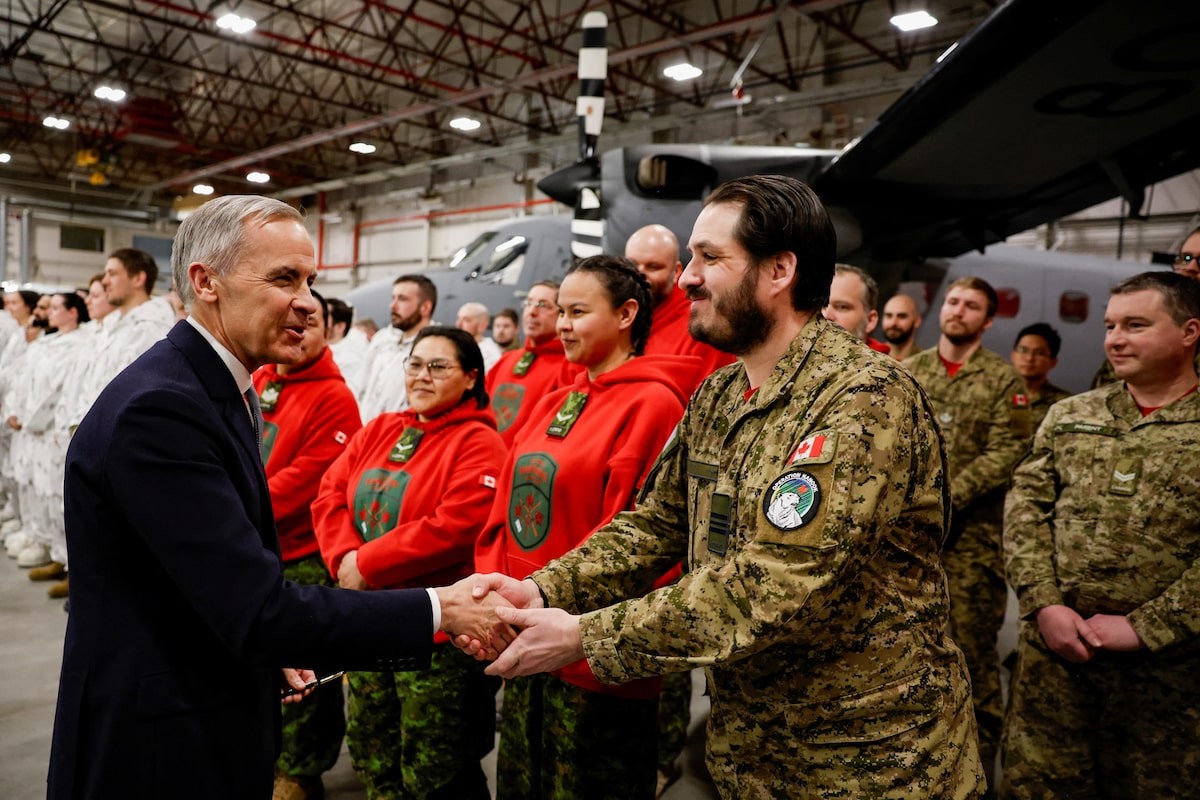
Prime Minister Mark Carney greets members of the Canadian Armed Forces as he visits the Royal Canadian Air Force 440 Transport Squadron in Yellowknife, on Thursday.Carlos Osorio/Reuters
The latest tranche of developments referred to Ottawa’s Major Projects Office for fast-track approval is centred on the Far North, a focus of efforts to improve national security and trade.
The infrastructure seeking the government’s go-ahead and funding represents efforts to bring new transport and energy options to Nunavut and the Northwest Territories.
Canada spending nearly $35-billion to fortify North, assert sovereignty
Here are the details:
The Grays Bay Road and Port project represents the Nunavut side of the proposed Arctic Economic and Security Corridor. It is a $1.2-billion plan to connect a new shipping gateway in the northernmost reaches of Canada’s mainland to southern population centres in a bid to bolster resource development and strengthen Arctic sovereignty.
The proposal, which has been under consideration for decades, includes a deep-water port with two large-vessel wharves, a medium-vessel wharf and a barge landing area.
Nunavut road project could transform the territory, but at what cost?
The port would be linked to a 230-kilometre all-season road to Jericho near the Nunavut-Northwest Territories boundary. From there, the backers plan a winter-only road to near Yellowknife, at least initially (see below). The corridor would pass through a number of as-yet undeveloped gold, zinc, silver, lead and copper deposits in the Kitikmeot Region.
The project’s proponent, Inuit-owned West Kitikmeot Resources Corp., says western Arctic transport infrastructure will strengthen supply chains by creating a new route for essential supplies. The port, located halfway between the ports of Nome, Alaska, and Nuuk, Greenland, on the Northwest Passage, would have strategic importance by creating a year-round presence.
A path in the ice is left in the wake of an icebreaker as it traverses the Northwest Passage through the Franklin Strait in the Canadian Arctic Archipelago.David Goldman/The Associated Press
The company says the development could increase annual GDP by $750-million, and it could create 670 construction and 390 operations and maintenance jobs. Construction is targeted to start in 2029 and take about five years.
West Kitikmeot Resources has said it wants Ottawa to cover 75 per cent of its costs. The federal government has already contributed $21-million, and the project’s backers are applying for a further $50-million in federal critical minerals infrastructure funding. Nearly $20-million in additional private investment will be needed merely to complete the engineering and permitting work.
– Jeffrey Jones
The NWT portion of the Arctic Economic and Security Corridor is a proposed all-weather road from Yellowknife that would link up with the Grays Bay Road at Jericho. The Tłı̨chǫ Government, Yellowknives Dene First Nation and the Government of the Northwest Territories have formed a partnership to decide on a governance and ownership framework for the project. The route is still under consideration.
The winter road over the Lac de Gras, NWT. The road runs from Yellowknife to the Ekati Mine.Pat Kane/The Globe and Mail
The partners say the full corridor will boost trade between Alberta, NWT and Nunavut – resources could be shipped to Arctic tidewater or south to Alberta processing facilities. A year-round route would help unlock copper, zinc and lithium deposits in NWT’s Slave Geological Province and create new employment and business opportunities for Indigenous and Northern people, they say.
Under the current timetable, the partners are planning for regulatory reviews and seeking construction funding through 2028. They are currently designing the project and nailing down the business case and cost estimate as they seek federal funding.
– Jeffrey Jones
The Mackenzie Valley Highway is a long-sought-after 800-kilometre transportation corridor into Canada’s Arctic that will connect to remote and Indigenous communities along the Mackenzie River.
It is expected to cost more than $1.5-billion.
Most of the communities along the Mackenzie River rely on a winter road for transportation and barge deliveries for supplies. However climate change is shortening the time window for the winter road, and low water levels have disrupted barge deliveries, costing a collective $14-million between 2022 and 2024, according to documents published by the NWT Legislative Assembly in 2024.
A view of the Mackenzie Mountains from the shores of the Mackenzie River in Tulita, NWT.Tate Juniper/The Globe and Mail
Proponents of a year-round two-lane gravel highway promise it will incentivize resource exploration and the development of rich petroleum reserves. A preliminary 2015 business case estimated construction of the road would create more than 14,000 jobs within NWT, while long-term operation and maintenance would create 161 jobs. By improving transportation to the Arctic Ocean, the project has also been cast as a bid to bolster NWT and Canadian Arctic sovereignty.
In 2018, the project received $140-million in funding from the federal government and the territory for environmental assessment and planning studies. Ottawa and NWT have also sponsored significant improvements to the winter road, including the construction of 38 permanent bridges. The environmental assessment is expected to be completed either this year or in 2027. A final construction decision is expected for 2028.
A 6.7-kilometre stretch of the proposed highway was finished in 2024. It took two years to construct, employed 95 people and cost $25.5-million, according to reporting from Yellowknife’s Cabin Radio. The original plan for this stretch was for a 13-kilometre highway that would cost $20-million.
– Kate Helmore
The Taltson Hydro Expansion Project will add 60 megawatts to the existing NWT hydro system, doubling capacity and creating a unified Northern electricity grid that will serve 70 per cent of residents.
The project will expand the 18-megawatt Taltson generating station located 56 kilometres northeast of the Alberta-NWT boundary and fed by the Taltson River System. It will connect the dam to another system in the Yellowknife area via a 270-kilometre transmission line. This first stage will deliver reliable power at stable rates to 11 communities. A second stage plans to connect the grid to the mineral-rich Slave Geological Province.
The additional 60 megawatts will reduce community dependency on diesel when water levels are low, and help industry transition from fossil fuels, thereby removing up to 240,000 tonnes of greenhouse-gas emissions annually, said a document from the NWT government.
The project is in the preconstruction and consultation stage. In mid-2025, the project was forecast to cost between $2-billion and $3-billion.
After decades of stalling, projects in Canada’s North gain momentum as part of defence push
Proponents of the project have long argued it would support critical mineral development in the region by substantially reducing operating costs.
Last week at the 2026 national mining convention, the government of the Northwest Territories released an updated assessment of the region, claiming vast reserves of gold, diamonds and critical minerals, including lithium, cobalt, copper and zinc.
The federal government has committed $20-million to the project since 2018. In 2021 a Memorandum of Understanding was signed between the Government of Northwest Territories and all the First Nations and Métis governments in the area.
The project has faced pushback from local environmental groups which claim the expansion is the most expensive way to reduce greenhouse-gas emissions in NWT, and that the project is a government subsidy for mining companies.
A proposed expansion of the Taltson River dam was cut off in 2010 when the owners of the three large diamond mines in the area – Ekati, Diavik and Snap Lake – refused to invest in the project.
– Kate Helmore