

Why is it so hard to do business in Canada? New international data from the World Bank helps explain how regulations get in the way.
In two recent EconMinutes, we highlighted findings from the World Bank’s new Business Ready (B-READY) initiative, which compares business environments across countries. B-READY evaluates how well different countries support business activity across 10 categories, from starting a business to paying taxes.
Each category is evaluated across three dimensions: the quality of regulations, government services that support businesses, and the speed and efficiency of the system. These can then be broken down further to pinpoint where and how Canada underperforms.
In the first EconMinute in this series, we showed that Canada’s biggest weakness across all categories is the regulations themselves. The second looked at where system performance, including government support and time and cost of processes, makes it harder to do business.

This EconMinute, the third in the series, focuses on where exactly regulations are a major drag on Canada’s competitiveness. This is especially important: no amount of government support can compensate for rules that are poorly designed in the first place.
Across the 10 categories, Canada earns only a C grade for its regulatory framework, but performance varies widely within them. Canada does fairly well in two areas where it earns a B (utilities and labour), moderately in four where it earns a C (dispute resolution, financial services, business insolvency, and business entry), poorly in three where it earns a D (taxation, international trade, and business location), and receives a failing grade in market competition. It received no As.
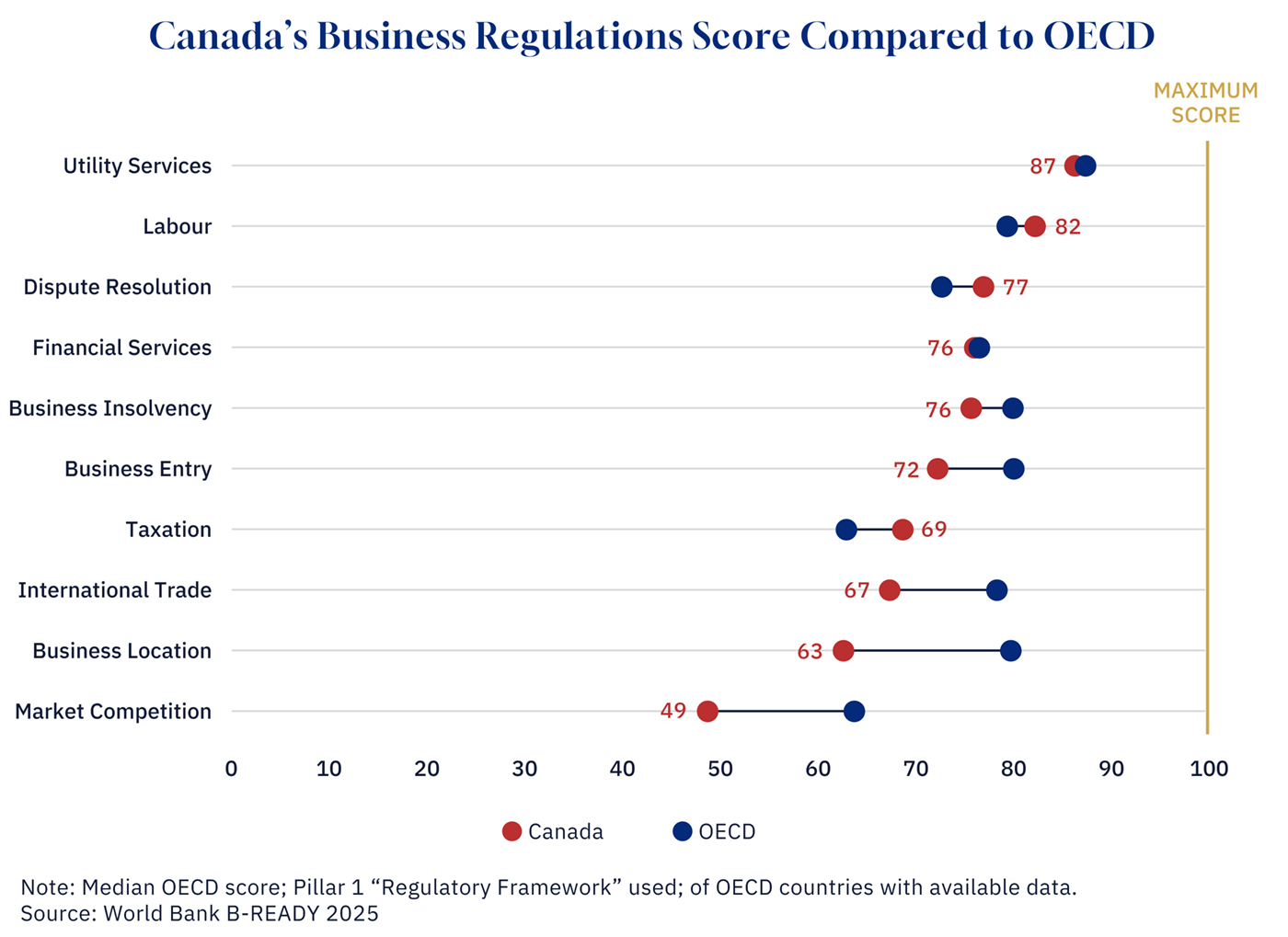
Graphic Credit: Janice Nelson.
International trade
International trade is particularly important for Canada, accounting for roughly 65 percent of GDP. Yet Canada scores just 67 out of 100 on regulations related to trade, placing it 24th out of 25 OECD countries for which data is available, ahead of only Türkiye. In other words, despite extensive trade deals and recent trips by the prime minister to grow trade and diversify exports, Canada’s regulatory framework continues to limit its trade potential.
B-READY looks at two categories of regulation related to trade: the presence (or absence) of regulations that enable trade, and the presence (or absence) of those which restrict it. Canada does pretty well in the former category. The problem is in the latter. On this measure, Canada earns a D grade, trailing many other rich economies.
Compared with its peers, Canada has more rules that limit competition in trade-related areas. One example is restrictions on foreign transportation and logistics companies, which limit providers and increase the cost of services to exporters who rely on them to reach global markets.
Other rules restrict trade more directly. For example, import restrictions tied to supply management in sectors like dairy limit foreign competition, while the oil tanker ban on B.C.’s northwest coast restricts large-scale crude oil exports.
For a trading nation like Canada, these self-imposed barriers will continue to undermine efforts to expand exports and compete in global markets.

Business location
Another area where Canada’s regulatory framework performs poorly is setting up or expanding operations, or what B-READY calls “business location.” This category includes the rules related to buying land, transferring property, and acquiring building and environmental permits. With a score of just 63 out of 100, Canada ranks 25th out of 25 in this category, making it the least attractive choice among rich countries for businesses and entrepreneurs to set up or expand operations. The gap with Canada’s southern neighbour is particularly stark: the U.S. earned a score of 94 out of 100.
The biggest issue comes early in the process when businesses go to buy land or property—often the first step in building a new facility, opening a location, or developing a project. On this measure, Canada earns just 21 out of 40 points, largely because land and property records are fragmented and difficult to access. Businesses need clear data on ownership, property values, and parcel boundaries. But in Canada, these records are often scattered across different systems and hard to obtain.
Fragmented systems increase legal risk, paperwork, and costs while slowing projects, making investment decisions more expensive and less predictable.

Taxation
Taxation is another area where B-READY results show opportunity for improvement. Overall, Canada earns 69 out of 100 in this category, ranking 10th out of 25 and slightly above the 25-country average. But that overall score hides a few specific rules and processes that pull Canada down.
For example, while Canada does fairly well in notifying businesses about upcoming tax changes and publishing guidance, it performs poorly on the administrative side. Included here is how easy it is for businesses to register for taxes: whether they have access to clear and available information on the process, and whether smaller businesses can keep records or file reports in a simplified way. In this area, Canada earns just 25 out of 40 points.
View reader comments (0)
Another area where Canada performs poorly is in terms of how clearly and predictably environmental taxes, such as carbon pricing and fuel taxes, are introduced or changed. Here, Canada’s ranking drops to 16th place, largely because Canada receives no points for meeting the World Bank’s criteria for consulting private sector stakeholders before introducing environmental taxes, and only partial points for clearly communicating transition periods for the implementation of new environmental taxes. Given the economic value generated by Canada’s energy sector, this is an area that requires urgent attention.
Uncertainty about how and when environmental taxes will be introduced or changed can discourage long-term investment in one of Canada’s most important sectors. As a share of GDP, Canada is typically the second-most reliant country on oil and gas among the 25 considered in the rankings, after Colombia. Yet its performance on environmental taxes places it alongside countries that have little or no oil and gas production.
Market competition
Finally, Canada’s weakest score is in regulations that affect market competition, where it doesn’t even earn a passing grade, scoring just 49 out of 100.
Canada performs similarly to many peer countries on traditional measures of competition policy, such as laws to prevent anticompetitive agreements and rules to allow regulators to block mergers that would create excessive market power.
Where Canada falls behind is in the rules that support innovation and the commercialization of new technologies, as well as competition for public contracts.

On innovation, Canada scores just 16 out of 33 points, ranking 21st out of 25. The issue is that Canada lacks strong policies to help turn research and intellectual property into commercial investments. For instance, there are limited incentives for university-industry collaboration and few mechanisms to support financing based on intellectual property.
Canada also performs poorly on competition for public contracts. Canada scores just 11 out of 33 possible points, barely half the score of several peer countries. Procurement rules here often focus on the upfront price rather than long-term value, and processes for resolving procurement disputes can be slow and murky. This not only increases uncertainty for businesses bidding on contracts, but it can also increase costs for taxpayers.
Conclusion
Put simply, Canada’s regulatory framework is holding businesses and investment back. The B-READY initiative helps highlight where reform is needed most, but that’s not enough. The real challenge will be committing to major and lasting reform that makes it easier to do business in Canada.
A version of this post was originally published by the Business Council of Alberta.

Alicia Planincic is the Director of Policy & Economics at the Business Council of Alberta. She regularly provides insight and analysis on…
Read more
According to the World Bank’s Business Ready (B-READY) initiative, Canada’s regulatory framework is hindering its international competitiveness. The report assesses business environments across 10 categories, revealing that Canada’s weakness lies primarily in its regulations. While government support is important, it cannot compensate for poorly designed rules. Canada receives a C grade overall, with significant variations across categories. Key areas of concern include international trade, business location, taxation, and market competition, particularly innovation. The report highlights specific issues such as trade restrictions, fragmented land records, complex tax administration, and weak support for innovation, ultimately calling for major regulatory reforms to improve Canada’s business environment.