
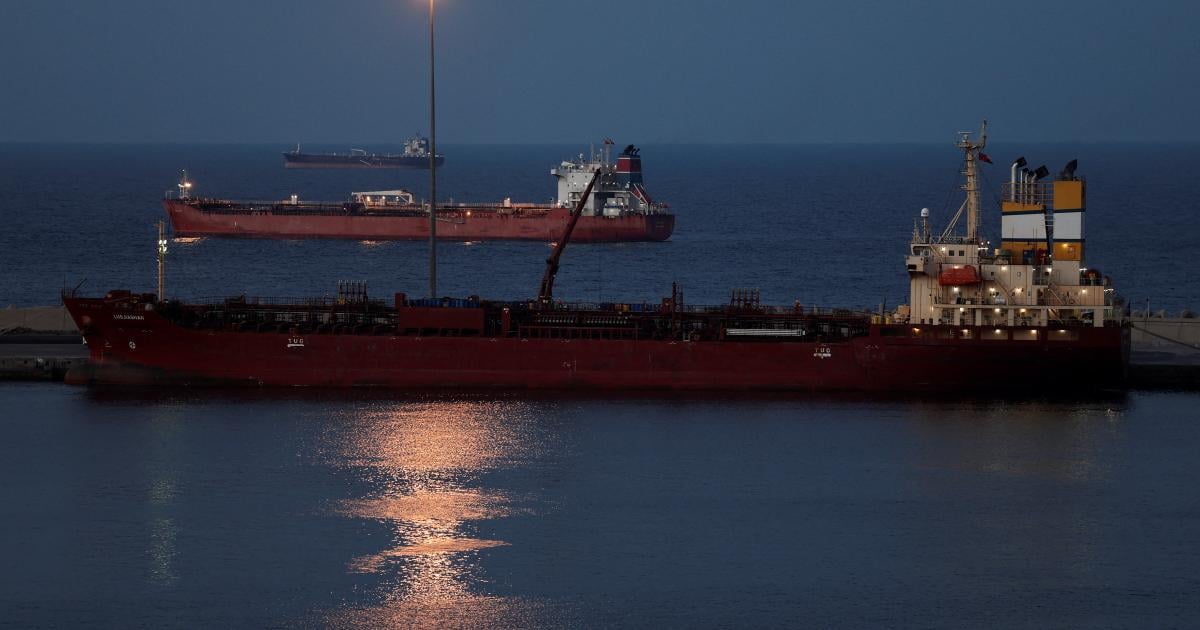
On a normal day, 20 percent of global oil supplies pass through the Strait of Hormuz, a narrow waterway opposite Iran’s southern coast. Over the past week, however, tanker traffic through the strait has plummeted in response to Iranian threats to target any vessels attempting passage, spiking the price of oil and raising global economic alarm.
Trump administration officials have seemed surprised by the chaos in world oil markets. And according to CNN, they told lawmakers in classified briefings that they did not prepare for the possibility that Iran might try to close the strait in response to strikes. After initially floating the idea of having the U.S. Navy escort tankers through the strait, President Donald Trump has now said that tankers should enter the strait on their own because most of Iran’s navy lies “at the bottom of the ocean.”
Yet even with much of the Islamic Republic of Iran Navy sunk, the danger from the separate Islamic Revolutionary Guard Corps Navy seems likely to persist. This force has long planned to threaten traffic in the strait through a combination of mines, missiles, drones, so-called midget submarines, unmanned surface vessels, and armed speed boats. Individually, these assets are already deterring most shippers from entering the Gulf and explain why the U.S. Navy has refused to provide tanker escorts. But if linked together in mutually supporting, synergistic ways, these capabilities could create an Iranian gauntlet in the strait that would be time-consuming, costly, and difficult for the United States to dismantle.
This is especially true if Iran is able to lay significant minefields. Clearing mines is always slow and difficult; doing it during a full-blown war, while facing threats from land-based antiship cruise missiles, drones, and other Iranian naval assets, would be exceedingly dangerous. Whether Iran can and will conduct this sort of campaign depends on which targets along Iran’s southern coast the United States has already destroyed as well as how extensively Iran planned for this contingency before the war began. But an Iranian campaign against tanker traffic in the Gulf would confront the United States with difficult choices and could foment further escalation.
STRAIT TALK
Iran’s Islamic Revolutionary Guard Corps has spent decades developing military capabilities aimed at traffic in the strait. It has never fully deployed them, because closing the strait would interfere with Iran’s own ability to export oil and would invite global economic backlash. But Iran has developed these capabilities as a tool for leverage against more conventionally powerful states, such as the United States and Israel, in the event of a serious crisis or war. Iran now faces exactly such a threat.
Before the war, some estimates suggested Iran had amassed an arsenal of approximately 5,000 sea mines. Some are probably crude contact mines of the type Iran used in the tanker wars of the late 1980s, when Iran and Iraq targeted each other’s ships. But some are likely seabed influence mines, which can be harder to find. These detonate in response to acoustic, magnetic, or pressure influences, and they have a timing device and ship counter that enables more control over their detonation. Before the war, Iran also had multiple means of delivering mines, including midget submarines and hundreds of other small vessels positioned along its southern coast.
It is unclear how many of Iran’s mines and mine-delivery vehicles have survived the war. Dan Caine, chairman of the Joint Chiefs of Staff, said on March 10 that the U.S. military “continues today to hunt and strike mine-laying vessels and mine storage.” It is possible, then, that Iranian mine warfare will not be much of a threat. But it is also possible that Iran dispersed its assets before the war such that some could have survived the U.S. campaign. In particular, Iran could have already distributed mines to small vessels and submersibles in many different locations along the coast. It has spent years constructing a significant network of tunnels and caves capable of hiding and protecting these boats until the moment they enter the water.
The U.S. Navy has never prioritized mine clearance.
Despite persistent U.S. surveillance, it is possible that some of these craft could reach the strait given their speed, small size, and sheer numbers. Even if each vessel laid only two to four mines, Iran has hundreds of such platforms; it is not difficult to imagine Iran being able to quietly seed hundreds of mines over a period of days or weeks.
Historically, even relatively small numbers of mines have had outsize effects. For example, in 1972, the United States stopped all traffic in and out of North Vietnam’s Haiphong harbor when it dropped just 36 mines. In 1991, the Iraqis were able to discourage a U.S. amphibious invasion by laying only 1,000 mines off the Kuwaiti coast—two of which later hit but did not sink U.S. warships. And in 1950 the North Koreans delayed the U.S. landing at Wonsan by laying only 3,000 mines across 50 square miles.
These episodes suggest that even a relatively modest Iranian mine-laying campaign could inhibit tankers from entering the strait, as Iranian missile and drone threats have already appeared to do over the past week. Mines are unlikely to actually sink tankers, which are buoyant and compartmentalized. Yet threats to the crews are real and already seem to be playing a major role inhibiting traffic in the strait—even without the placement of mines. Iran has also claimed responsibility for an attack on a tanker in Iraqi waters that appears to have employed an unmanned surface vessel—essentially a drone boat that both the Ukrainians and Houthis have used to successfully sink ships. It illustrates the extent to which Iran has prepared for the current moment.
NARROW OPTIONS
Trump has claimed that the United States has “the greatest minesweeping ability.” But the U.S. Navy has never prioritized mine clearance. Just last fall the United States removed its last dedicated mine countermeasure ship from the Persian Gulf. Only four such ships are left in the U.S. inventory—and they are stationed in Japan. The new U.S. concept for mine clearance relies on the littoral combat ship working in combination with helicopters and unmanned underwater vehicles. But this concept has never been tested in combat.
Historically, mine clearance has been slow, and it is almost impossible to do under fire. It took the United States and its allies 51 days to clear 907 mines off the Kuwaiti coast in 1991—and that was after the Gulf War was over and with the advantage of minefield maps provided by the defeated Iraqis. If Iran mines the strait and the larger war continues, the United States will face a difficult decision regarding whether to send expensive warships and helicopters close to Iran’s coast to clear the mines. The United States and Israel have degraded Iranian capabilities, but it is quite possible that they would still be able to threaten U.S. mine clearance platforms with antiship cruise missiles, drones, and small boat attacks. Indeed, bringing those platforms within reach would likely be one of Iran’s larger goals.
The U.S. Navy should never be underestimated, and hitting mobile targets is hard, so Iranian success is not guaranteed. But operating in the Gulf for days or weeks at a time while trying to conduct clearance operations would give Iran many chances to get a lucky shot. At a minimum, Iranian threats would slow clearance operations. That, too, plays to Iran’s advantage: Iran believes that time is on its side in this war, and that dragging the United States into a prolonged campaign will generate leverage for Iran.
Faced with the unappealing task of trying to defend the strait in the middle of a shooting war, the United States might try to respond to Iran’s escalation with escalation of its own. But those choices present problems, too. For example, the United States might decide that it needs to control the Iranian coast by inserting Marines or special operations forces—but the entry of ground forces would raise the risk of casualties and quagmire. Or the United States could try to escalate its bombing campaign to coerce an end to the war—but the United States and Israel may be running out of targets with which to bring about such pressure on the regime. Indeed, this is likely why the regime now seems much more willing to close the strait than ever before.
In short, if Iran effectively mines the strait, all U.S. response options are suboptimal. The United States should therefore focus aggressively on preventing Iranian mine-laying in the first place and finding an off-ramp from the larger war. If it does not, Washington should expect that ongoing harassment of traffic in the strait will be but one of a number of responses that Iran has long prepared and will now deploy.
Loading…