
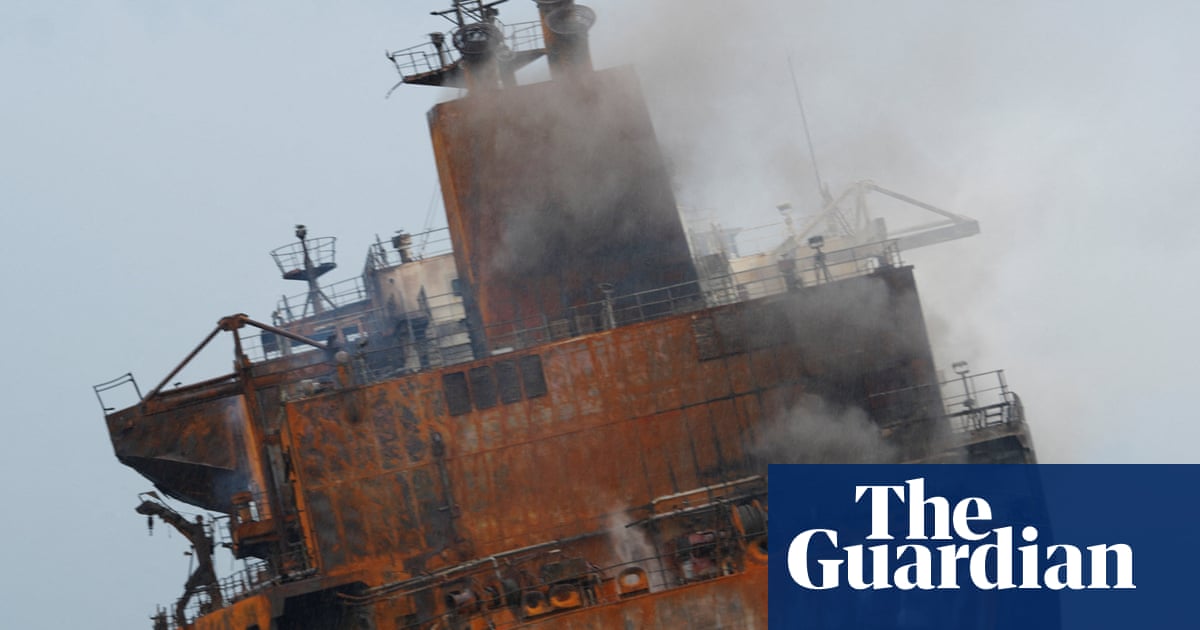
Oil markets are facing the “largest supply disruption in history” as the war in Iran continues to block tankers from shipping millions of barrels of crude each day, the world energy watchdog has warned.
The International Energy Agency (IEA) said the supply shock ignited by Iran’s effective blockade of the strait of Hormuz meant the world faced a deeper crisis than after the Yom Kippur war of 1973 and the 2022 outbreak of war in Ukraine.
The warning came as Iran issued a statement that was said to be the first from its new supreme leader, Mojtaba Khamenei, to call for the vital trade artery to “remain closed”, in a blow to hopes of a resolution to the crisis.
In response, global oil prices passed $100 (£75) a barrel on Thursday as widespread Iranian attacks on energy facilities in the Middle East overshadowed a vast release of government reserves.
In an attempt to calm concerns over oil supplies, the IEA ordered the largest release of government reserves in its history on Wednesday, when its 32 members unanimously agreed to release 400m barrels of emergency crude.
In addition, the US agreed to release 172m barrels of crude oil from its strategic petroleum reserve, in the boldest attempt yet by the White House to bring down oil prices.
Before this week, there have only been four other coordinated releases of strategic supplies since the IEA’s founding in 1974, underlining the seriousness of the current crisis.
Previous emergency releases of oil stockpiles.Oil distribution
These were in 1991, after Operation Desert Storm, President George HW Bush’s military campaign against Iraq; in 2005, when Hurricane Katrina halved US production in the Gulf of Mexico; in 2011, as Nato allies intervened in the Libyan civil war; and in 2022, after Russia’s full-scale invasion of Ukraine.
However, despite the coordinated effort to allay fears of a sustained supply crunch, the price of Brent crude rose past $100 a barrel overnight. The international benchmark later eased back to $97, but again rallied to above $100 after the Mojtaba comments.
Wall Street closed lower, with the Dow Jones and the S&P 500 falling 1.5%. In Europe, the FTSE 100 fell by less than 1% and Stoxx 600 dropped by about 1%. In Tokyo, Japan’s Nikkei 225 index fell by 1.3%, as did Australia’s S&P ASX 200.
After Donald Trump’s vow on Wednesday to “finish the job” and press ahead with the US-Israel war on Iran, the country’s regime stepped up retaliatory strikes on economic targets across the region. Several merchant ships were struck in and around the strait of Hormuz, one of the most important arteries in global trade.
Iranian and US/Israeli strikesSites of Iranian and US/Israeli strikes.
The US had signalled earlier this week it would offer a military escort to oil tankers seeking to pass through the strait, but the energy secretary, Chris Wright, said on Thursday that it was “not ready” to offer this help. He added that it was “quite likely” such escorts would be taking place by the end of the month.
The IEA said on Thursday that the war with Iran was expected to cut the region’s oil and gas production by at least 10m barrels of oil a day.
The escalating regional conflict has damaged key oil and gas infrastructure and many producers have begun shutting down production as exports via the strait of Hormuz peter out and local storage facilities fill up.
In a report, the IEA said the sharp slump in Middle East production could lead to a global oil output slump of 8m barrels a day this year – even with increased production from countries including Russia.
The fall in global oil supplies would far exceed the dent to global demand as a result of the war, it said. The watchdog has cut 1m barrels of oil a day from its global oil demand forecasts for this year because of lower refining and reduced air travel in the Middle East.
The effect of soaring energy costs is also expected to weigh on global economic growth, which could cause demand to fall further, but the IEA said it was too soon to say how great the impact might be.
A graph showing Brent crude prices per barrel since 1 January 2025A graph showing Brent crude prices per barrel since 1 January 2025
The global oil shortfall is expected to pile pressure on the market, which is already experiencing wild swings as the war unfolds.
The price of oil broke the $100 mark for the first time in four years on Monday, when it soared by as much as 29% to hit a peak of $119, before falling back sharply after Trump described the war as “very complete” in a series of conflicting remarks. The oil price had been about $60 a barrel at the start of the year.
As prices resumed their rise, Iran’s military command goaded the US. “Get ready for oil to be $200 a barrel, because the oil price depends on regional security, which you have destabilised,” a spokesperson said.
Trump later said on Truth Social that rocketing oil prices would ultimately “make a lot of money” for the US, which is one of the world’s biggest exporters. He made the claim amid growing criticism of the war as Americans face increased prices at the pump.