
His first movie in eight years is an anti-capitalist, anti–Devil Wears Prada call for global workers’ action, with demonic cunnilingus.
Photo: Neon/Everett Collection
“I’m just sucking souls out of vaginas!” LaKeith Stanfield announced as he dropped a mic on his chair mid-Q&A and pretended to walk off the stage — a moment that perfectly encapsulated the weird, wonderful, chaotic energy of the world premiere of Boots Riley’s I Love Boosters at this year’s SXSW film festival. I’ll get to Stanfield’s soul-sucking oral sex in a minute, but the crowds in Austin weren’t exactly surprised. They were primed for a Boots Riley experience, and the director delivered.
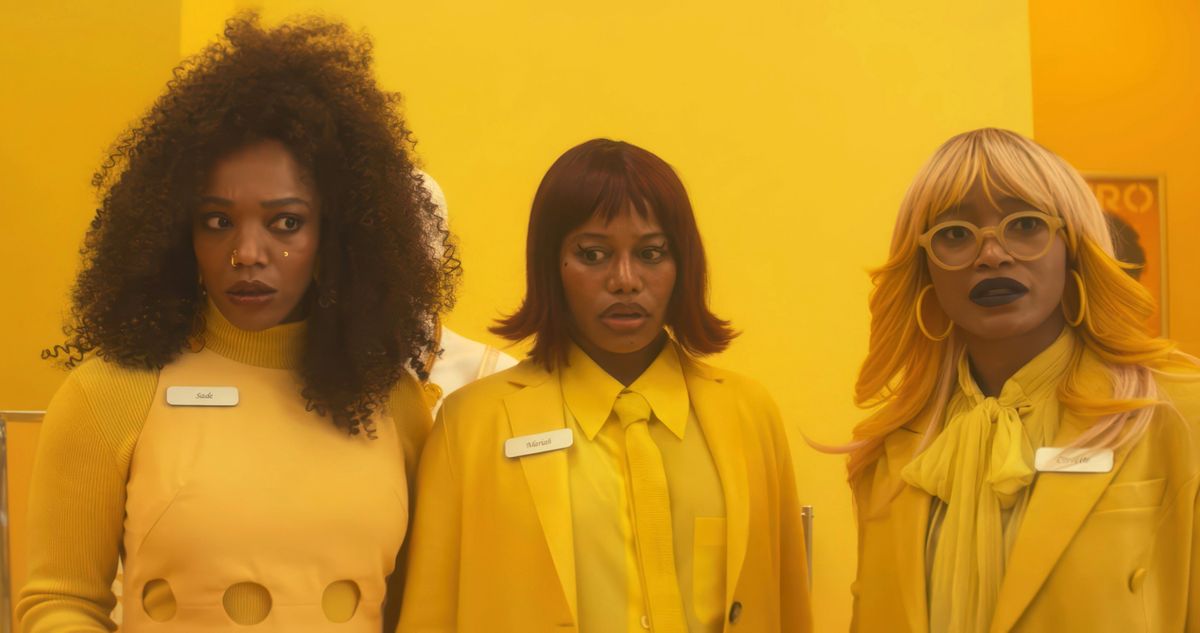
Boosters follows up Riley’s 2018 movie, Sorry to Bother You, an absurdist black comedy starring Stanfield as a code-switching telemarketer who gains success but loses his identity. The director’s latest is even more playful: a riot of neon costumes and cartoonish visuals somehow holding together a plot about a gang of female shoplifters (known as “boosters”), led by Keke Palmer, who rob from a designer-store chain run by Demi Moore in a cunty blonde bob. The boosters sell to the poor at discount prices like urban lady Robin Hoods. It accumulates into an anti-capitalist, anti–Devil Wears Prada call for global workers’ action that speaks to our collective sense of helplessness in America and beyond.
“There’s silliness in it,” said Riley, wearing his signature sky-high elongated fedora and a patterned black-and-white suit at the Q&A. “But also, I think it’s a very important movie to be out there right now, because I think we all need to figure out ways that we can change what’s happening, ways that we can fight fascism, change the structure of the world around us.”
“I’ve definitely bought a lot of stuff from boosters in my life,” Riley admitted, explaining how he came up with his mishmash of concepts. He was also thinking about fashion as an artistic endeavor, how much it costs, how many people are involved in making it, how all the people who make it can’t afford it, and how women should get it for free because they can’t be a member of society without it.
Boosters begins by following the back of Palmer’s head as she shimmies her way through an Oakland club lit up in greens and reds, looking for a good time, it seems. She spies an enticing guy, Stanfield, with seductive eyes and a Jheri curl, but goes for a cleaner-cut hunk instead and takes him back to her tiny apartment. He’s ready, and she opens the door … to a bunch of clothing racks, all in red. He’s got to be a size 12, right? It takes him a minute to comprehend that she doesn’t want to fuck. She wants to sell him shoes.
Palmer’s character, Corvette, is down on her luck and sleeping on a friend’s couch in a onetime fast-food chicken restaurant that still has the light-up menu on the wall, right next to the makeshift shower in the kitchen. The message is clear: This gang of best friends, which consists of Corvette, Sade (Naomi Ackie), and Mariah (Taylour Page), is broke — and enterprising. They’ve formed an outlaw trio of shoplifters known as the Velvet Gang, who always dress on point and are obsessed with Metro Designs, a couture label designed by Moore’s Christie Smith, a girlboss and artistic genius who treats her workers like garbage. They steal from her and sell out of the back of vans to their sharp-dressed community. Their motto: “Fashion. Forward. Philanthropy.”
Every month or so, Metro Designs changes its monochromatic color scheme, forcing the boosters to pull another heist (usually with a white girl to cause a distraction). This allows Riley and costume designer Shirley Kurata to constantly transform their set from green to yellow to aquamarine. Peppered through it all are images you’ll never get outside of a Boots Riley film, like a self-help seminar at a discount furniture store in which Palmer sits in a blue velvet massage chair that keeps smushing her face as she talks. Or a two-story-tall ball of receipts and eviction notices that comes rumbling down the street toward Corvette every once in a while, threatening to crush her unless she keeps on boosting.
The movie really kicks into another gear when a fourth booster shows up, a teleporting genius from one of Metro Design’s factories in China (Poppy Liu as Jianhu), who’s on a mission to get Christie Smith to accede to some pretty reasonable demands, like 30 percent higher wages and to stop sandblasting jeans and causing everyone to get cancer. But the joy of Riley’s “baby,” which he said took five years to get made, is how it plays like a stream of outlandish moments, the most noteworthy of which are:
Moore, in her first movie since her Substance Oscar nomination, is having a blast in a platinum haircut that carries the haughty authority of Miranda Priestly and the judging-you-while-smiling air of Leslie Bibb in The White Lotus. Her Christie Smith is an artiste, a visionary and science genius from MIT who rose to design Chanel at age 15. She is not happy about the Velvet Gang stealing all her merchandise and reducing her margins, and she says things like, “Mumblecrust whores!” and “They’re just a bunch of low-class urban bitches — with all due respect to urban bitches.”
“At first I was saying, like, ‘Wow, I didn’t didn’t know that I would be thought of as cool enough to be part of a Boots Riley film,’” Moore explained at SXSW, but she wanted to do it because she’d never had a chance to be a part of something like this.
It looks like a shining Tower of Pisa in a sea of normal skyscrapers and provides some of the movie’s funniest visual gags, like when Corvette sneaks into Christie Smith’s office by hiding in a coffee cart but can’t get out because she keeps slipping and falling on the slanted floor in her pantyhose.
Corvette and Sade boost by stuffing their clothes with clothes, but the joke is that they take SO MUCH — entire racks — resulting in a getaway waddle that makes Palmer look like the Stay Puft Marshmallow Man in Ghostbusters, dressed in powder-pink Juicy Couture and a wig.
Riley peppers his movie with news reports about rising crime rates with incredible chyrons showing an “Upstanding Community Member” (Ritter) who says workers strikes caused him trauma and a “Crying Black Mother” calling for more police. This is all a conspiracy, of course.
We learn that Metro Designs is stiffing its workers by forcing them to buy the overly priced monochromatic couture they have to wear to work in the retail shop. This information is conveyed by a hilariously avant-garde Poulter, playing the store’s manager, who dyes his hair to match each monochromatic scheme and hides his nefariousness behind a company policy that requires techno music to be played at maximum volume at all times. He even has a little speaker dial that he turns to “Low-Key” when he wants to use corporatespeak that makes no sense and to “Max Vibes” when he wants to explain how he’s screwing workers over but not let them hear him.
We get to see Jianhu plunder an entire store in seconds with a “magic bag” containing two handheld teleporting devices shaped like metal doughnuts. The devices, which she stole from the Metro Design factory in China, have “situational accelerator” and “deconstruct” modes and spew energy that looks like a stream of high-pressure water when activated.
I’ll let you figure out how those modes work, but at one point, they point it at a police car and it turns into a monster truck operated by Eric André doing his best evil-maniac laugh. At the premiere, André, in a caftan and a gondolier’s straw hat, stood up and said he’d done his part in 15 minutes and that everyone on the red carpet thought he was Boots Riley, which is how he even made it into the theater. Boots then replied that he gets mistaken for André and gets a lot of free liquor for it.
Eiza González also has a terrific, scene-stealing turn as the trio’s pot-smoking co-worker who happens to know a lot about teleporting and quantum theory.
I won’t spoil too much, but the gang does end up getting pursued by a rabid group of skinless corporate goons — all red muscle and sinew — portrayed by stop animation.
It’s been a banner year for cunnilingus in movies. In Sinners, Miles Caton’s Preacher Boy finds “the button” and licks it like ice cream as his proud cousin Stack listens from the other side of the door. In Marty Supreme, Gwyneth Paltrow’s character is so ensorcelled by Timothée Chalamet’s tongue that she finds herself on her back in the grass of Central Park and almost arrested by cops.
But neither even comes close to what might be the marquee scene of Boosters, when Stanfield’s mysterious Prince-dude, who’s been trying to go out with Corvette, takes a friend of the gang back to his home. As the trio recounts the story, we see him going down on her, and it is so good, she starts to levitate. And it just goes on and on. This is the greatest cunnilingus known in the history of man going down on woman, complete with some incredible spraying of bodily fluids. Until … the camera pulls back and we realize that this is not a man but some dinosaurlike demon.
“Too bad,” one of the Velvet Gang sighs. “He’s fine as hell.”
Stanfield told the crowd that the woman in that scene is actually his wife and then said to Riley that the next time he makes a movie, he doesn’t have to pitch it. All he has to do is call.
“Me too,” said Palmer.
“Me three,” chimed in everyone else.
Sign up for the Vulture Daily
An entertainment newsletter for the pop-culture obsessed.
Vox Media, LLC Terms and Privacy Notice