
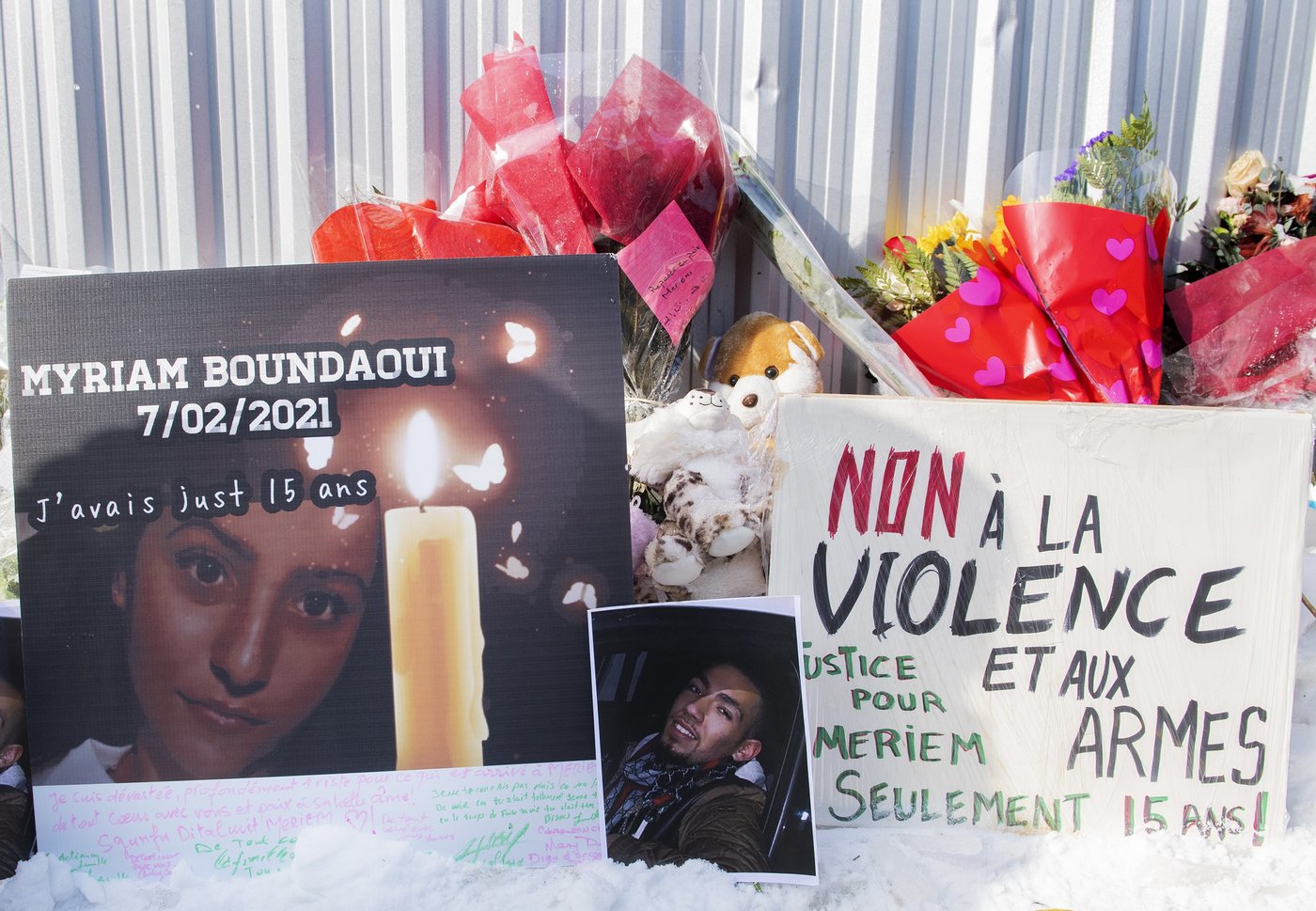
Closing arguments from the crown in the case of the two men facing first-degree murder charges in the death of 15-year-old Meriem Boundaoui concluded on Friday.
In a Montreal courtroom, crown prosecutor Simon Lapierre presented a surveillance video of the shooting from a distance that showed a vehicle pull up to a parked vehicle that had a group of people standing on the other side of it, then what appeared to be gunshots that were fired from said vehicle that approached, before driving away. The entire sequence lasted about 10 seconds.
“In this case, as in any case, video footage is extremely valuable evidence,” said Walid Hijazi, a criminal attorney in Montreal.
“The crown has its theory and might refer to the video in light of their own theory, but it can also serve for the defence. Essentially, it’s an objective piece of evidence that shows raw footage of what happened. So ultimately, it will be for the jury to determine the way it has. Does it amplify the crown’s case and will convince them beyond a reasonable doubt? Or, will it be part of the defense and raise a reasonable doubt?”
Lapierre argued that the two accused, Salim Touaibi and Aymane Bouad, were attempting to resolve a conflict when the gunshots were fired that killed Boundaoui, who the crown has said was in the wrong place at the wrong time when shot in the parked vehicle on February 7th, 2021, in Montreal’s Saint-Leonard borough.
“Even if the victim was killed by mistake, if there was a plan to kill someone, the identity of the victim does not change the situation,” said Hijazi.
“According to the law, it would still be planned and deliberate. It would still be murder in the first degree.”
The crown prosecutor also presented other evidence, such as geolocation data from a Mercedes vehicle and data from telephone calls, in an attempt to show the two accused had planned the shooting. Next week, the judge is expected to give the jury instructions before they are sequestered to reach a verdict.
“The judge will explain the elements of being an accomplice of a joint venture, common intent, etc. So it’s the moment where the judge will essentially teach to the members of the jury what are the elements of the offense in law because it’s for them to see if the story, the evidence, fits the elements of the offense and has the crown met its burden.”