
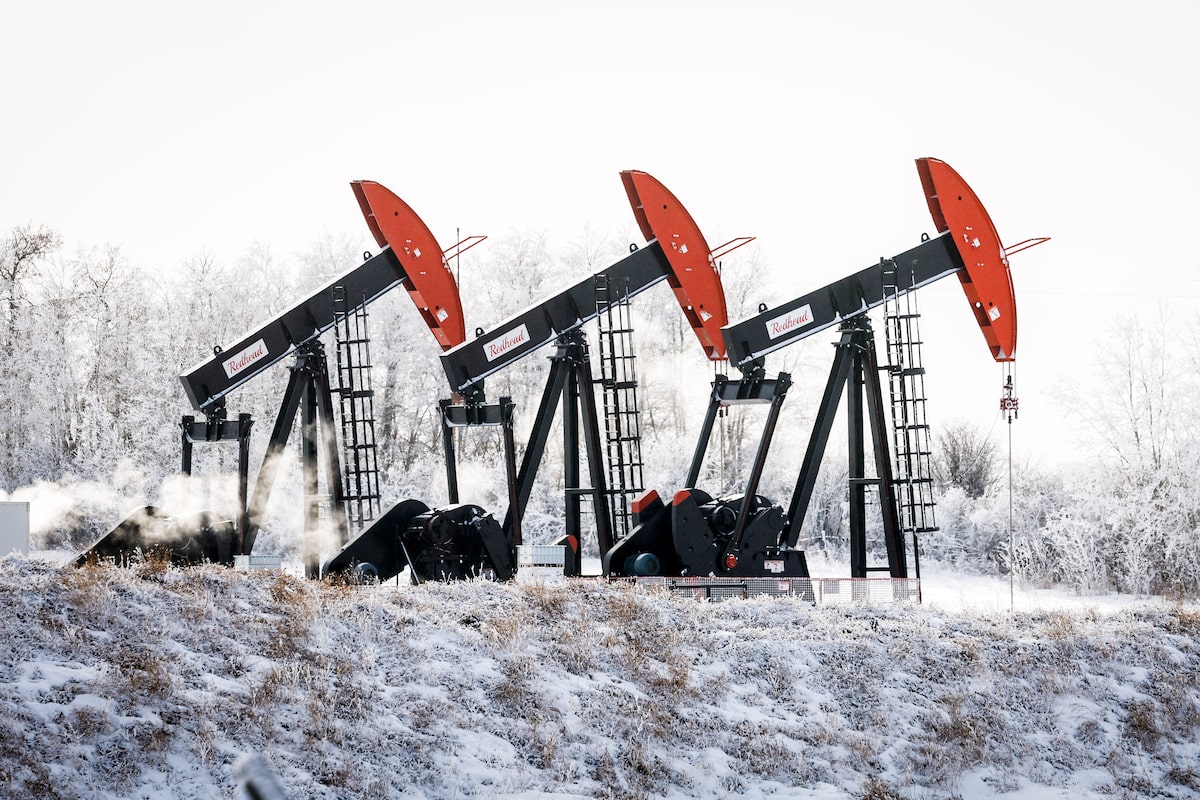
Pumpjacks draw out oil and gas from wells near Carstairs, Alta., Feb. 3, 2025.Jeff McIntosh/The Canadian Press
Canada will make 23.6 million barrels of crude oil available to world markets to meet the country’s commitment to emergency measures aimed at preventing global shortages and calming jittery markets, Energy Minister Tim Hodgson said on Friday.
The International Energy Agency’s 32 member states agreed this week to release 400 million barrels from strategic petroleum reserves to make up for some of the supply from the Persian Gulf that’s been blocked by the two-week-old Middle East war. Oil prices have surged with tankers being unable to sail through the Strait of Hormuz for fear of attacks by Iran.
Mr. Hodgson said in a statement that Canada will meet its responsibilities with crude oil produced by the country’s energy companies and co-ordinated by the federal and provincial governments. He also said natural-gas exports would increase in the coming months, providing additional fuel to trading partners.
The Paris-based IEA has said members will meet their commitments by releasing reserves over the course of 90-180 days.
Opinion: Iran is using the oil weapon
Analysis: Should Canada have a strategic oil reserve? It’s complicated
As the world’s fourth-largest producer and a net exporter, Canada is not required by the energy co-ordinating body to keep a national emergency stockpile, but Mr. Hodgson has said the industry is able to tweak production and make changes to its operations and logistics to squeeze out more supply.
Canada is expected to make its extra barrels available through its regular export points, which include the country’s West Coast and via Enbridge Inc.’s extensive pipeline network to the U.S. Gulf.
Enbridge and Trans Mountain Pipeline, whose line extends to Burnaby, B.C., from Alberta, both told The Globe and Mail this week that capacity is currently tight, but some space is available to get more barrels to tidewater.
Combined, IEA member countries hold more than 1.2 billion barrels of buffer reserves, with a further 600 million barrels of industry stocks held under government obligation. For its part, the U.S. has said it plans to release 172 million barrels from its strategic reserves over the course of about 120 days.
With the U.S. and Israeli attacks on Iran – and Tehran’s retaliatory strikes – showing no signs of abating, international benchmark Brent oil settled above US$100 a barrel for the first time since August, 2022. It rose nearly 3 per cent to US$103.14. West Texas Intermediate closed Friday’s session at US$98.71 a barrel, also up about 3 per cent.
War in Iran causes energy crisis in South Asia, disrupting life for millions
Analysts have said the release of emergency stockpiles is a welcome response as surging prices threaten a global recession. But the move is largely seen as a stopgap measure. It will not make up for the roughly 20 million barrels a day – about a fifth of global supplies – that have been removed from the market for an as-yet indeterminate length of time.
U.S. President Donald Trump and members of his administration have given contradictory signals about how long the bombardment will drag on. Mr. Trump said on Wednesday that U.S. forces had won the war, but that the United States would remain in the fight to finish the job.
Meanwhile, Iran’s new Supreme Leader, Mojtaba Khamenei, said through a news anchor on state television that the Strait of Hormuz should remain closed and that attacks on his country’s neighbours in the region will continue.
With some oil facilities damaged by strikes and storage facilities near full, Gulf oil producers have been shutting production, complicating the eventual return to more normal operations.