
Rapping with Kim Gordon
By
·
March 13, 2026
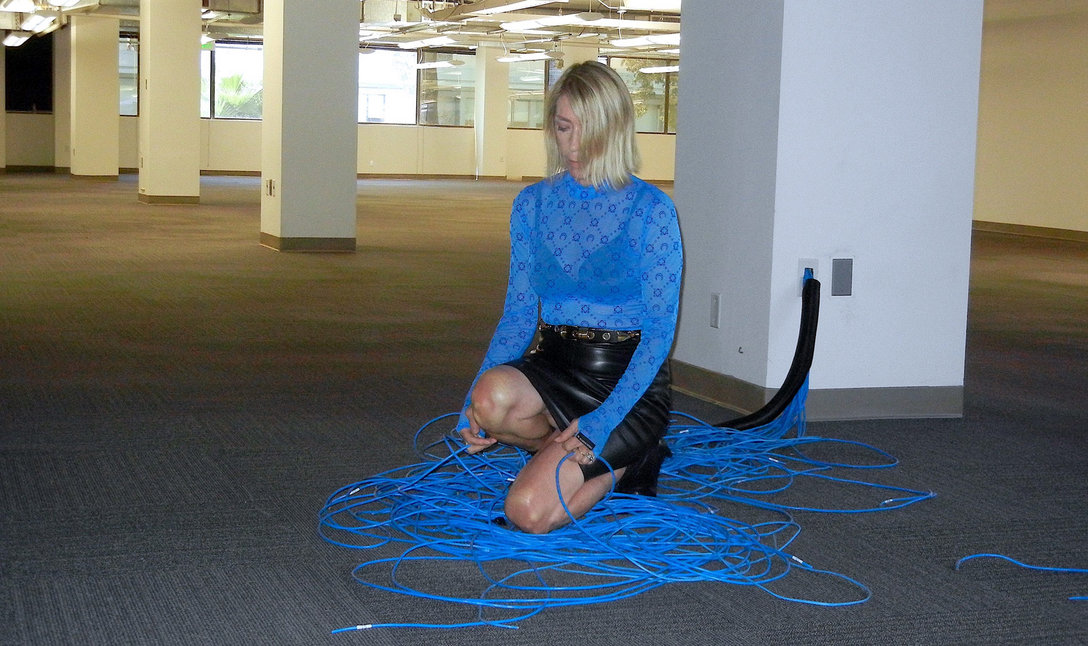
Photo by Moni Haworth
Born in the Bronx and spread across the Black and Brown neighborhoods of uptown Manhattan, it was only a matter of time before hip-hop made its way to where the cool art kids met—so when Fab 5 Freddy first brought this radical new style of music and culture downtown in the early 1980s, Kim Gordon was around.
While rap was in its early stages as an art form, Gordon found her place in the no wave scene, a loose confederation of musicians rallying against the commercialization of punk rock by making resolutely uncommercial music, soon forming the generation-defining band Sonic Youth in 1981, with whom she would play for the next three decades. Eight years after Sonic Youth’s 2011 breakup, Gordon released her full-length solo debut, No Home Record. Working with producer Justin Raisen, Gordon forged new artistic territory—no one could’ve possibly predicted one of art rock’s marquee names kicking vocals over the beat for “Paprika Pony.”
Subwoofer-cracking rap beats are the bedrock of Gordon’s third solo album, PLAY ME. Although there are other styles represented on the 12-track LP—single “NOT TODAY” is propelled by a motorik pulse, for instance—the triumphant horn sample figuring prominently on the opening/title track feels more like something that would appear on Digable Planets’s 1994 masterpiece Blowout Comb than on a record from the singer of halcyon indie rock classics like “Star Power” and “Kissability.” More than a third of Raisen’s productions here sound like they could have been outtakes from JPEGMAFIA’s cult favorite Black Ben Carson.
Gordon’s lyrics pair exquisitely with Raisen’s beat-heavy selections, as they are fractured, imagistic, and, in the case of “DIRTY TECH,” outright ironic.
We recently had the pleasure of chatting with Gordon about her relationship to hip-hop music, her collaboration process with Raisen, her approach to songwriting, and more.
One thing I’ve noticed about your, for lack of a better term, “proper” solo work is that you’ve been going in a more hip-hop-oriented direction. I was wondering if you were interested in exploring these sorts of beats before you even released No Home Record.
Yeah, I mean, I’ve always been inspired by rhythm more, and beats and melody, because it’s just the way my vocal style is. It’s not made for pop songs. I also really just like the idea of sampling, reusing sounds, and building on that.
Hip-hop, when it evolved, it came from outside the mainstream culture, which I always identified with in Sonic Youth. It was more anti-corporate.
Was there a moment where you recognized hip-hop culture and hip-hop music and said, “Oh my gosh, that’s cool?”
In the early ‘80s, we were into what the Beastie Boys were doing, but also those records Rick Rubin was producing, like LL Cool J’s first record. And also these hits like [“It Takes Two” by] Rob Base—it was just part of the sounds of Downtown New York in a way. It’s such a melting pot of sounds. Later, when we were recording Daydream Nation and the same studio as Public Enemy, that was super cool. We were really jazzed by that.
An artist that I’m a big fan of, DJ Haram, has cited you as a formative influence—and I’ve wondered if that influence goes the other way.
That’s cool. I mean, maybe not me so much, but my collaborator, Justin Raisen, he’s in that world, and he works with a lot of hip-hop artists. He sort of gets a kick out of like, ‘Is this gonna fuck with people in the hip-hop world?’ He knows what I like, and he works off of that.
You’ve been collaborating with Justin for about a decade now. Was there a moment when you felt working with Justin was working, or was it a gradual process where the more you worked, the more you realized it worked?
The first song we did together was ‘Murdered Out,’ which came about through me going into the studio and singing on somebody else’s song he was working with. And then he took these bits and pieces, and he put this trashy drumbeat [behind it]. He sent it back to me, and I was like, ‘Oh, he really gets my sensibility.’ I was very surprised, and I went back in and did more.
That was the beginning and he’ll try things on me to open up my idea of what I feel comfortable with; he also doesn’t care if I don’t like something that he presents me with. On The Collective, he used an Auto-Tuner on ‘Psychedelic Orgasm.‘ And at first I was like, ‘Dude, I fucking hate that filter. It’s on every R&B song!’ And he said, ‘Yeah, but if you do it, it’s, it’s ironic, you know?’
It was a pretty startling moment to hear your voice processed through Auto-Tune.
Yeah. I think it’s really the most musical moment on [that] record. [laughs]
There is a notion of immediacy in PLAY ME, and it’s very, very apparent. Did you and Justin go into this recording knowing that you were going to complete these songs very quickly? Was that part of the process?
We did want to make short songs and do it fairly quickly. I don’t know, it just happened that way, and I think maybe it’s just being more and more comfortable working with him. It becomes more apparent how it works together, how we work together.
Your lyrics are often a reaction to…basically every aspect of society. Do you feel like that’s your primary function as an artist? Is it a moral imperative? Or a combination of both?
I think it’s part of my instincts to be an interventionist. I mean, it’s not a moral imperative, but it’s kind of built in. [My lyrics are] observational, even in Sonic Youth, with certain lyrics like ‘Swimsuit Issue.’ Some things were sociological or observational. A lot of it is kind of reactive to what’s going on. I think my lyrics are also kind of abstract, so hopefully they don’t come off as finger-pointing in a certain way. Maybe they do, I don’t know.
How is approaching your solo work different from, say, Body/Head or Free Kitten? Is it, is it the nature of your collaboration with Justin?
Yeah, pretty much. Body/Head, that’s all unscripted, improvised music; it’s just very free music. So it’s fun. And then Free Kitten was when Julie [Cafritz] and I were inspired by what comes about in our personalities. It’s a lot of music I’ve done—even in Sonic Youth—that comes from what each person brings to the band. Julie and I were really inspired by Royal Trux. It’s like, ‘Oh, you can have a band with just two people.’ Then we added on. But when it started, it was just the two of us and we would basically just record while we were making it up and then have to learn how to play.
How does your practice as a visual artist inform your approach to making music? Do you think of music in texture or shapes or color, or is it a different process?
Music is certainly very visceral and physical in a way that, for me, is very performative. I also don’t really know anything about music, so it’s very freeing for me. Like I said, I may be more of an interventionist than a musician. The best visual work I make is when I can psych myself into a place where I don’t know what I’m doing when I’m trying to make art, so it’s similar in that way. Sometimes they overlap.
It sounds like the work dictates what you do rather than the other way around. Would that be an accurate observation?
Yeah, I guess so. My art is fairly performative as well. I guess it’s also similar in that way.
You’ve been creating art for decades now, pretty much half a century. Are there any styles of art that you’ve encountered that you haven’t tried that make you say, “I think I wanna attempt something in this style”?
I don’t know. Every now and then, I think about trying to do a fucked up jazz record or something, or something with, like, Brazilian beats.