
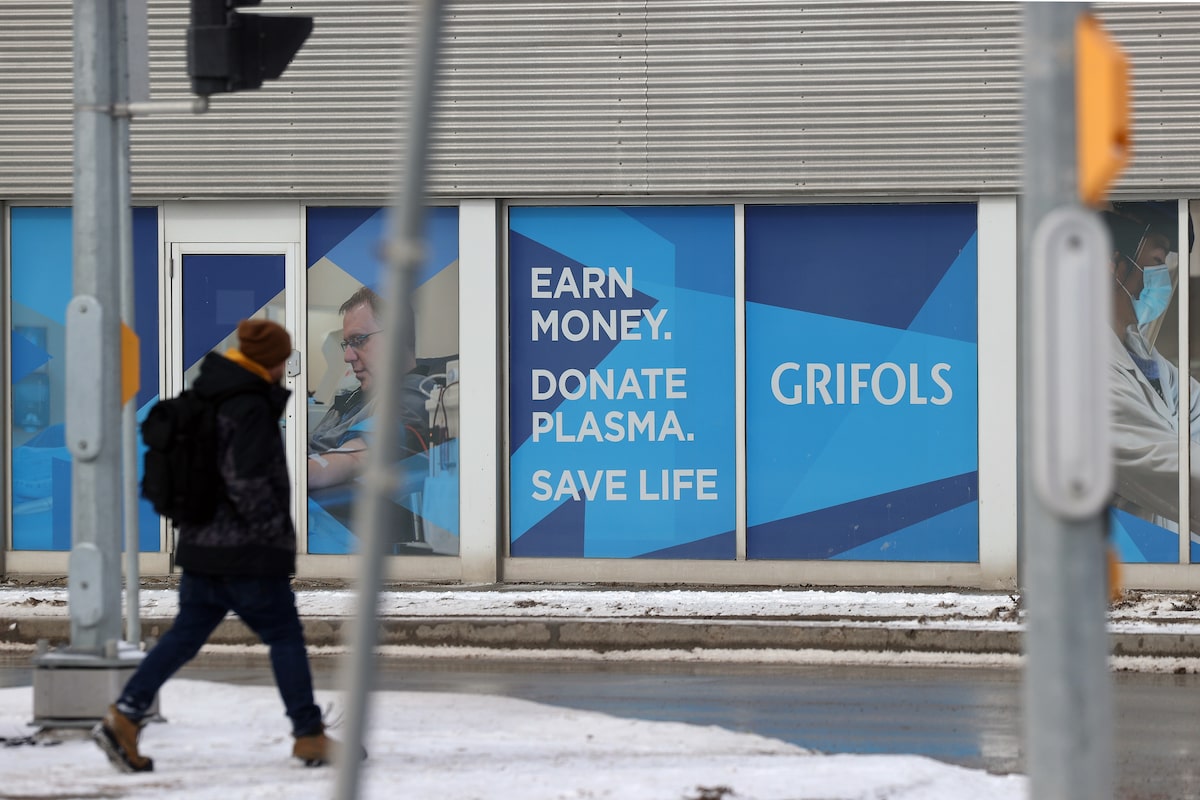
A Grifols Plasma Donation Centre on Taylor Ave. in Winnipeg. Two people have died in recent months after donating plasma at Grifols collection centres in Winnipeg.Shannon VanRaes/The Globe and Mail
Rodiyat Alabede had big dreams when she moved to Canada nearly four years ago at 19. As a high school student in Nigeria, living away from her family in Côte d’Ivoire, she decided to enrol at the University of Winnipeg, where she quickly fell in love with social work.
Funny, kind, generous with her laughter, and a devout Muslim, her closest friends say she wanted to help vulnerable people. She was especially concerned about fellow immigrants in her West African community.
Paying bills was tough; she could attest herself to the high cost of living, recalled Ms. Alabede’s family friend, Ifeoluwa Oyewumi.
At some point last year, Mr. Oyewumi remembers Ms. Alabede signing up to give routine blood donations, though he didn’t know the specifics. But soon after, on Oct. 25, a windy Saturday, Mr. Oyewumi got a call as her emergency contact about Ms. Alabede fainting while visiting a Grifols plasma collection centre. He was terrified.
He rushed to Winnipeg’s St. Boniface Hospital, where she was taken by ambulance, only to find her dead.
“All the doctors could tell us is that her heart stopped beating during the plasma procedure,” he said in an interview. “We still have no idea why. No answers. Nothing.”
The Manitoba’ government is considering a ban on accumulating plasma for pay as Health Canada continues its investigations.Shannon VanRaes/The Globe and Mail
Ms. Alabede, 22, who was expected to graduate university this year, is one of two people who have died in recent months after donating plasma at Grifols collection centres in Winnipeg.
Earlier this week, referring to the cases as “fatal adverse reactions,” Health Canada confirmed that it was notified of the other Winnipeg death on Jan. 30 by Spanish pharmaceutical company Grifols, which runs the only for-profit, paid plasma centres in this country.
On Friday, the federal regulator told The Globe and Mail that a new review suggests a total of four such deaths have occurred in the last 10 years in Canada. Very little has been disclosed about those deaths.
“Three of the adverse reactions occurred in Manitoba, including the two that have been reported recently, and the other one occurred in Quebec,” spokesperson Mark Johnson said in an e-mail, without identifying the deceased. “To date, Health Canada’s assessment of these reports has not identified a link between the death and the plasma donation.”
While the regulator continues to investigate the matter, Manitoba’s government is considering a ban on accumulating plasma for pay, said Health Minister Uzoma Asagwara.
Health Canada reviewing deaths of two people who donated plasma at private centres in Winnipeg
Asked whether the province would support an inquest to determine the cause of the deaths, Mx. Asagwara told reporters at an unrelated event Friday: “We’re going to do everything we can to make sure that the families have all the answers that they need and deserve here.”
At the same event, Manitoba Premier Wab Kinew said calling for an inquest is the jurisdictional responsibility of the province’s chief medical examiner, Dr. John Younes. His office declined to comment.
Grifols has long been a supplier of plasma-derived products to Canadian Blood Services. But in 2022, CBS, which runs the blood system everywhere in Canada except Quebec, announced a partnership with Grifols to collect plasma. Grifols, according to its website, operates 17 centres in the country, including in Alberta, Saskatchewan, Manitoba, Ontario, New Brunswick and Nova Scotia.
A straw-coloured fluid, plasma is a component of blood used for transfusions and to make therapy products such as immunoglobulin.
Donating plasma can take up to 90 minutes, as blood is taken then separated into its parts, before being returned to the donor as replacement fluid with parts that aren’t plasma.
Spanish drugmaker using Canadian-donated blood plasma for products sold abroad
At Grifols, donors are allowed to give plasma twice a week if they pass health screenings, and are paid between $30 and $100 per donation, depending on the volume and frequency. They are also paid $50 bonuses for donating 10 times within six weeks and $100 bonuses for donating 100 times within a calendar year.
Shortly after Health Canada’s confirmation of the deaths, Grifols posted a policy change on its website. Starting this month, donors must wait at least 48 hours between consecutive sessions.
In an unsigned statement, Grifols told reporters there is “no reason to believe that there is a correlation between the donors’ passing and plasma donation,” offering condolences to affected families.
Paid plasma donations have been denounced by several public-health groups, who argue it incentivizes a frequency of collection that is detrimental to donors. But proponents say it is the only way to reliably collect large volumes of the fluid.
In Ontario, British Columbia and Quebec, paying for plasma donations is banned, although Grifols has been allowed to operate in Ontario because of its partnership with CBS.
Now, as Manitoba mulls a prohibition on the practice, local donors have mixed feelings about losing what has become crucial income during times of hardship.
Canadian Blood Services, which runs the blood system everywhere in Canada except Quebec, announced a partnership with Grifols to collect plasma in 2022. The Spanish company operates 17 centres in the country, according to its website.Jeff McIntosh/The Canadian Press
After learning of the deaths in Winnipeg, many donors at the two Grifols locations in the city expressed worries about vetting procedure and follow-up care.
“It’s hard to say it’s about the money, but how could it not be?” said Brian Friesen, 34, outside the busy south-central Grifols site on Winnipeg’s Taylor Avenue, where seating at the waiting area has remained at capacity this week.
He has experienced painful bruising and collapsed veins after donations, he said.
“I know this is the same place where that young woman died. I know that. But all the people still here are going to tell you the same, if they tell you the truth: We need the cash.”
At the Grifols location near the University of Manitoba, Shawna Wiebe, 28, agreed. “To be honest, because I’ve seen so many bad things here before hearing about these deaths, I’m still not sure if I’ll back out today at the last minute,” she said, walking into the facility.
Mr. Johnson from Health Canada said it conducted “onsite compliance verifications” in Winnipeg after the deaths. He said where non-compliance was identified, immediate actions were requested, though did not note what those actions were or when they would be completed.
Noah Schulz, director of the Manitoba Health Coalition, said the situation shows the importance of transparency. His advocacy group and several others are calling for CBS and Grifols to fully reveal the terms of their agreement.
“These tragic deaths provide enough reason to end this predatory practice of collecting plasma for pay,” he said Friday, alongside the Ontario Health Coalition and the Committee to Protect Ontario’s Blood System.
For Ms. Alabede’s loved ones, who fondly called her Rody, her death has laid bare “how little these systems care for their own donors,” said her friend Chioma Ijoma.
An Islamic burial was held for Ms. Alabede in November, Mr. Oyewumi said. But her mother, back in Côte d’Ivoire, is heartbroken, as she and most of her family couldn’t be there, he said.
“Last I spoke to her, she was just exhausted. It is the greatest sadness of her life to lose her daughter in this way, so young and with so much potential and hopes from all of us.”