
The war in Iran broke into the news cycle quickly and dramatically two weeks ago today. Within hours it was dominating international headlines, raising fears of wider conflict across the Middle East, and prompting urgent debate among Western allies about how they should respond.
Canada was not immune to that debate.
Prime Minister Mark Carney found himself under pressure after offering what many critics saw as a shifting explanation of Canada’s position. Initially, the government signalled support for the U.S. action to prevent Iran from obtaining nuclear weapons while emphasizing that Canada had not been involved in the military planning. Days later, Carney described the strikes as regrettable and raised concerns about their consistency with international law. He also suggested Canada could not categorically rule out involvement if allies called. Then, after criticism mounted, he clarified that Canada would not participate in offensive operations.
To critics, the problem was inconsistency. To supporters, it was a government trying to navigate a complicated moment in real time.
But before judging the politics of the response, it is worth looking at how Canadians themselves are reacting to the conflict. Because the data tells a story that helps explain why this issue has become politically sensitive so quickly.
This data comes from an Abacus Data survey conducted with 1,931 Canadian adults from March 4 to 11, 2026.
First, Canadians are paying attention.
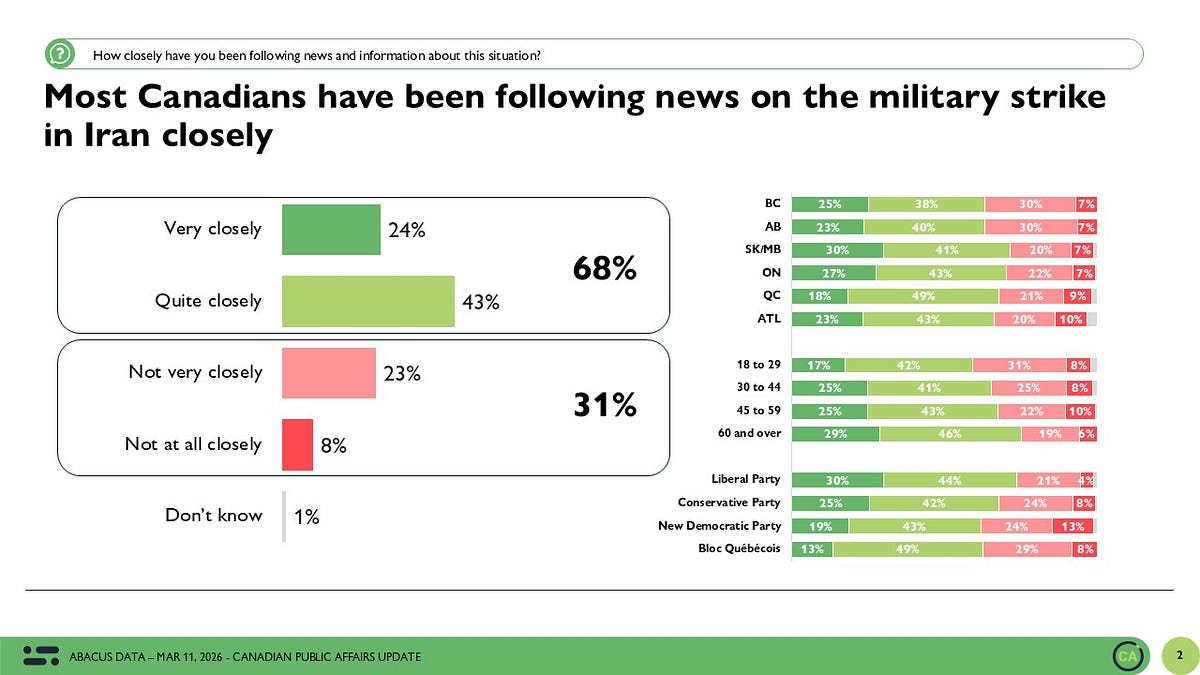
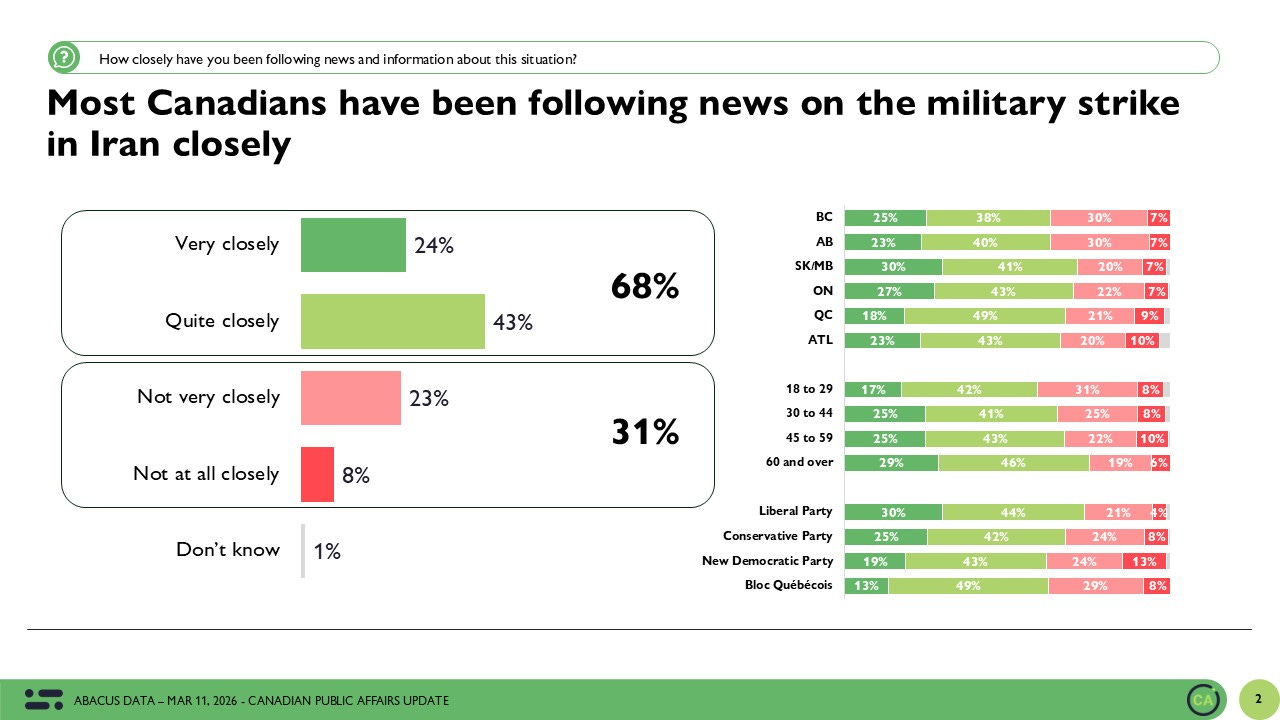
Nearly nine in ten say they had already heard something about the strikes, and more than two thirds say they had been following the situation closely. This conflict has captured public attention in a way some foreign policy issues do not.
And once you look beyond awareness, the emotional response becomes clearer.
Most Canadians see the strikes as a bad development. Concern about escalation is widespread. Eight in ten worry that the conflict could expand into a much larger war. The same proportion believe it will have at least some impact on Canada.