

Listen to this article
Estimated 4 minutes
The audio version of this article is generated by AI-based technology. Mispronunciations can occur. We are working with our partners to continually review and improve the results.
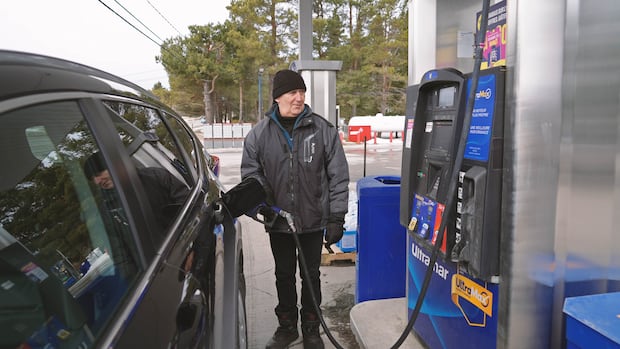
As the war in the Middle East enters its third week and the price of crude oil increases, motorists across Quebec are feeling the impact at the pump.
On Saturday afternoon, the average price for a litre of gas in the province was 171.8 cents, according to GasBuddy — a crowd-sourced price aggregator. In Montreal, prices were significantly higher with the lowest recorded price being 179.4 cents per litre.
The only other provinces or territories with higher averages than Quebec, were Newfoundland, the Northwest Territories and British Columbia with the latter averaging 183.54 cents per litre.
The issue of soaring gas prices has even made its way into the race to replace François Legault as premier of Quebec and leader of the Coalition Avenir Québec (CAQ), with both leadership hopefuls pledging to put money back into the pockets of Quebecers.
Christine Fréchette promised to reduce vehicle registration fees as a way to redistribute any additional government revenues derived from the increase in gas prices.
In a statement posted to Facebook earlier this week, Fréchette pointed out that she was responsible for getting rid of the minimum floor price on gas during her time as Quebec’s economy minister.
“We must continue to act,” she said.
Bernard Drainville, for his part, agreed with Fréchette on the need to reimburse Quebecers.
In a publication on X, Drainville wrote that when gas prices rise, the government also collects more.
“I believe this money belongs to Quebecers,” he said.
Drainville, however, was less specific than Fréchette in terms of how he would reimburse Quebecers, saying only that it could be done in several ways, including in the form of a cheque, tax credit or equivalent measure.
Quebec needs to promote other modes of transportation
Meanwhile, experts have differing opinions on what approach Quebec should take.
Pierre-Olivier Pineau, chair in energy sector management at HEC Montréal said a tax credit on fuel would not provide drivers with a long-term solution.
Instead, he says, it will increase the reliance on cars by creating the illusion of cheap prices, with motorists saving a few cents.
“But these few cents won’t change the core dynamic of the oil market,” he said. “So what we need is to change the fundamentals of our approach to mobility.”
Pineau believes Quebec needs to do more to promote and facilitate other modes of transportation, including public transit, ride-sharing services and active transportation.
“The goal is to go from point A to B. It is not to bring my vehicle from point A to B,” he said.
An example of that could be to incentivize the use of carpooling platforms through something like a tax credit, Pineau said.
CAA is also encouraging motorists to carpool or consider taking public transit or active transportation as a way to save money.
But when taking your car is the only option, CAA says adapting your driving by reducing your speed and accelerating smoothly, can help increase your fuel efficiency. Similarly, keeping up with vehicle maintenance and planning your route to combine trips can also make a difference.
Quebecers should get rebates, group says
Dan McTeague, with advocacy group Canadians for Affordable Energy, says it’s not just about the price at the pump.
The former MP says fuel prices will have an impact on supply chains.
“Any product, anything that you buy, eventually —like groceries — everything will increase,” he said.
McTeague says the government should provide gas rebates since it’s collecting more taxes.
“Call it what it is: ill-gotten gains. I mean you take advantage of a crisis by having a tax on these higher costs,” he said.
As for Quebec Finance Minister Eric Girard, a spokesperson for his office told Radio-Canada that while the province is following the situation and the conflict in the Middle East, it’s still too early to make a decision one way or the other.