
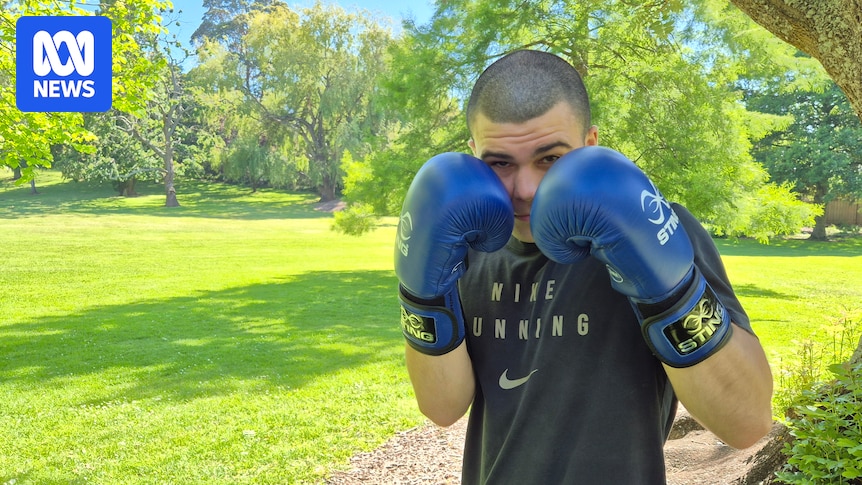
When Brody Masterson straps on his boxing gloves and steps in the ring, he becomes a new person: a focused, driven fighter.
On the other side of the ropes, the youth from Warragul in Victoria’s east is all smiles but few words, except to say how much the sport means to him.
“It gives me motivation to live,” he said.
“At the moment, it’s the only thing that really gets me going.”
At 17, Brody is already a champion boxer with about 10 wins under his belt — and he believes there is more to come.
The 17-year-old wants to make it to the top of the sport. (ABC News: Danielle Kutchel)
Brody endured a rough childhood, leaving home when he was 15.
He began boxing at the age of 10, and it it in his blood — his great uncles were boxers too.
But it was not love at first sight for Brody, who initially hated the sport “with a passion” and refused to go to the gym.
However, when COVID hit, he realised how much he missed sparring.
“When it came back, I fully committed to it,” Brody said.Dreaming of the top
It was not long before he was hooked, and after winning his first at 14, he found the motivation to keep training.
Now, Brody says boxing makes him feel better about the world.
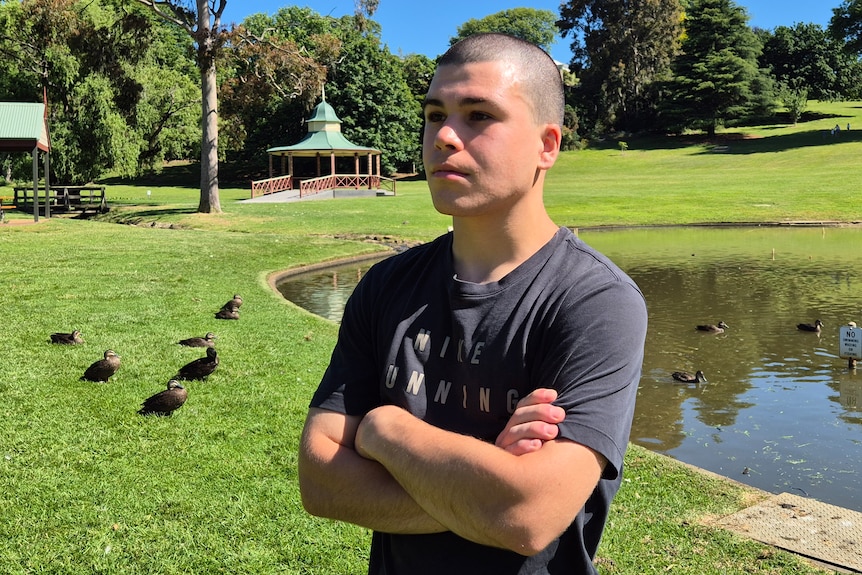
Brody Masterson is focused on his future, rather than his past. (ABC News: Danielle Kutchel)
He trains twice a day, waking up at 5:30am to fit it in before school, and then heading to the gym again after school for another round.
Brody has his eye on the state titles this year, but his “top dream” is to be an Olympian.
“I want to be in the top one per cent,” he said.
He knows there is lots of hard training ahead of him if he wants to achieve that dream, along with a lot of luck.
“It gives me something to focus on … to stay away from a bad life,” Brody said.
“I’m always doing something instead of hanging out in the streets with silly kids.
“I just think about the future and trying to get better. I don’t think about what I have done, I just think about getting to the top.”
More than just jabs
Federation University sport science professor Rochelle Eime said sport could be a positive vehicle for at-risk young people, often steering them away from poor choices.
“Sport can also provide an outlet. It’s something to get away from the stress of everyday life,” she said.
“You can stop and not think about all those other things, and connect with others and have an enjoyable experience.”
But Professor Eime said people from disadvantaged groups faced additional barriers to entering sport, such as a lack of programs or facilities in their area, or even a big enough population to warrant starting a sports program.
“We do know there is a big disparity in participation — those who can afford it are more likely to play,” she said.
“Those who are disadvantaged are missing out.
“We do need to have more opportunities for those children. The more diversion programs we can have to support those children and youth … the better.”
A confidence booster
Paul Jenkins has been training young people in boxing for more than three decades at the Moe Youth Club Boxing Gym.
His dad was a fighter, so Mr Jenkins grew up with an urge to get in the ring himself.
“My mother was dead against it but when I got to a stage where she couldn’t stop me, she was my biggest fan,” he said.
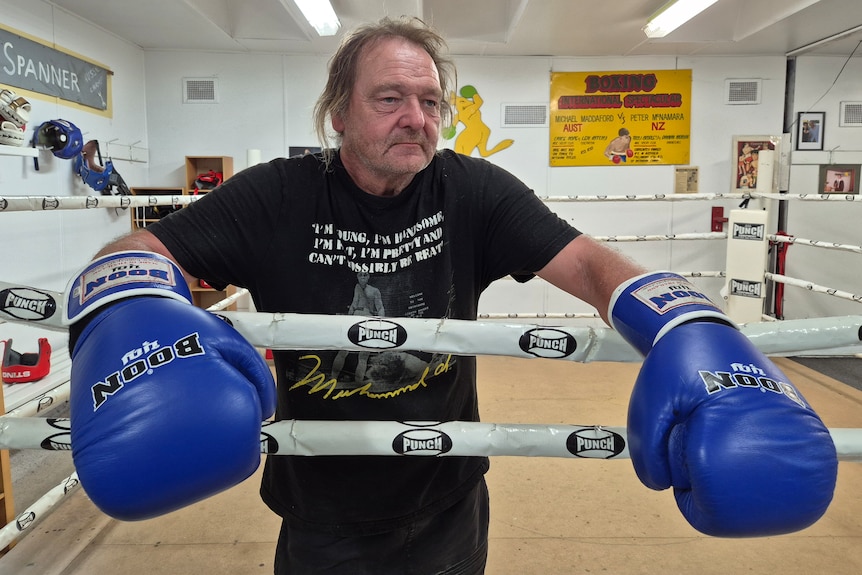
Paul Jenkins has been training young people for more than three decades. (ABC News: Danielle Kutchel)
Over his time as a coach, Mr Jenkins said he had watched countless young boxers step over the ropes and grow — not just as athletes, but as community members too.
“I’ve met so many great young blokes and, more recently, young ladies,” Mr Jenkins said.
“Most will come from humble backgrounds — commission-area type thing, as I did. The stories [you hear] are the ones that succeed, but then there’s the ones that don’t get in the ring but they train for a long time and walk away a lot more confident.
“You later run into them and see they’re successful tradesmen, home owners, family men … boxing can really build character.”
Mr Jenkins said when young people stepped inside the gym and put on the gloves, the problems they faced could disappear as they focused on the rhythm of jabs and crosses.
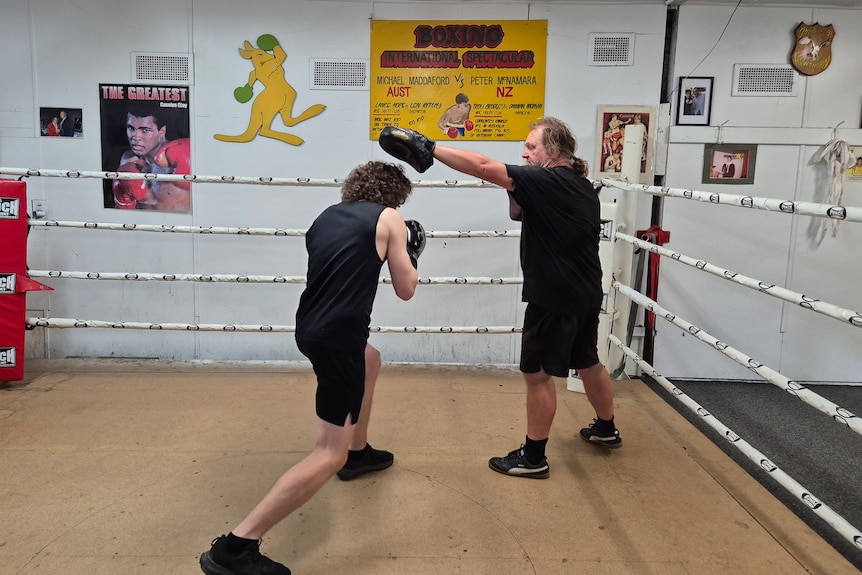
Paul Jenkins (right) training with student Kolt Flintrop. (ABC News: Danielle Kutchel)
He believes boxing can help people from disadvantaged backgrounds overcome challenges, giving them a purpose and opportunities to do things that would otherwise be out of reach, like travelling interstate for competitions.
“There are so many barriers in front of you. When you’re young, to overcome these barriers [through boxing] is so good for your self-esteem and self-belief … and humility,” Mr Jenkins said.
“Later in life they can say, ‘Yes, I was good at that.'”