

Two next-generation turbines powered by river currents are set to be lowered into the St. Lawrence Seaway off Montreal this autumn, marking the first installation of the pioneering renewable energy technology in Canada.
The “urban-scale” project is being developed using US technology outfit ORPC’s RiverGen units — which resemble a push lawnmower mounted on steel pontoons — and could lead to a bigger array capable of generating enough power for hundreds of homes and businesses in the country’s second-largest city.
Though new to Canada, ORPC’s hydrokinetic generation technology (see factbox below) has been in development for more than 15 years, with a prototype of a similar model that harnessed tidal power tested in the Gulf of Maine as early as 2010 and units operating in Igiugig, Alaska, 400 km southwest of Anchorage, since 2015.
ORPC‘s RiverGen turbine looks a little like the blades of two push lawnmowers, mounted end-to-end on a steel frame with pontoons.
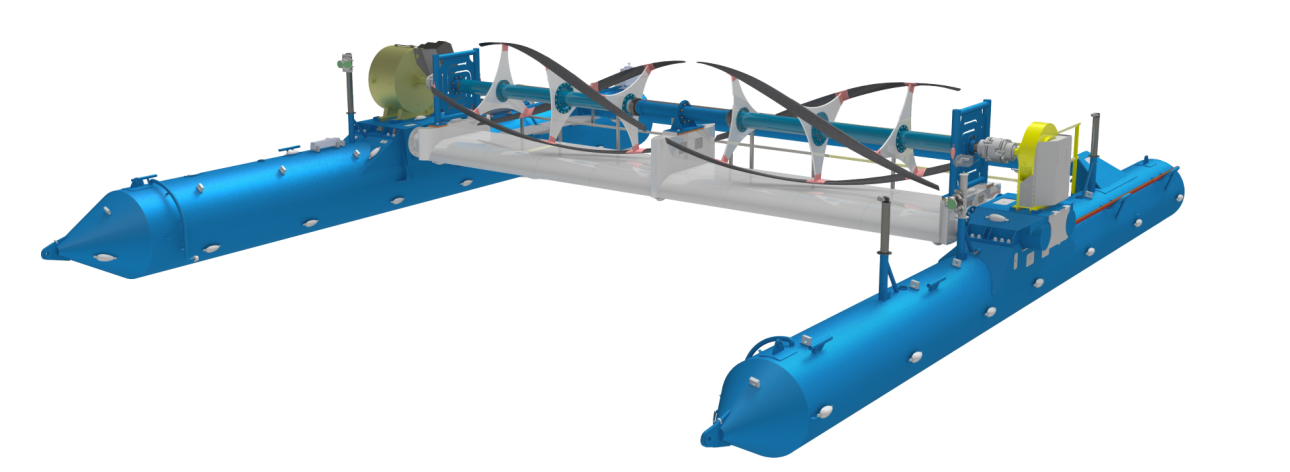
Installed on a riverbed, its helical blades turn in the current, spinning a generator to produce power that is then sent via an underwater cable to the grid. When the unit needs to be serviced or repaired, it can be floated up to the surface along attached mooring lines.
The RiverGen design derived from an earlier tidal power concept called TidGen, which was engineered to generate power from the heavy tidal currents flowing through the Gulf of Maine. After prototype testing in the early 2010s, ORPC shifted focus to smaller-scale models, installing two RiverGens in Igiugig, Alaska in 2015. The TidGen remains in development.
One 80 kilowatt RiverGen produces baseload power of up to 600 megawatt-hours a year, enough to supply electricity to 25 homes.
Various other so-called in-stream designs — including the Verdant turbine installed for a short time on the US side of the St. Lawrence River — look more like a short-bladed wind turbine on top of a steel foundation.
“This project is first and foremost about water — a resource that moves constantly — that cities have lived alongside for centuries and that can now be part of how we power them,” said Alexandre Paris, CEO of ORPC Canada, the Canadian arm of the US-headquartered company.
“What we are doing in Montreal is rooted in long-term experience, but it looks forward toward energy solutions that work with natural flows, respect their environments and can be adapted well beyond a single site.”
“The resource has always been there, and the technology is now ready,” said Paris, formerly Hydro-Québec’s head of innovation commercialization.
‘The river power resource has always been there and the technology is now ready,” says ORPC’s CEO, Alexandre Paris.
The three-year project received a $4-million boost last month from Natural Resources Canada (NRCan) as part of the government’s strategy to develop “a more diversified, resilient and lower-carbon energy mix, by advancing technologies capable of delivering predictable, locally generated power,” said Energy Minister Tim Hodgson at the time.
Built around two 80-kilowatt RivGens, the project off Montreal is modest in size, but ORPC aims to wire in further units to expand it into a seven megawatt (MW) development and potentially connect it to another nearby site where an array could produce 10 MW. “This could be just the start,” Paris noted, pointing to NRCan’s estimates of 100 MW potential in the waters off the shores of Montreal.
‘Reliable, consistent power’
“This is reliable, consistent power that is going to be installed for usage by critical grid infrastructure in Quebec,” he told Canada’s National Observer.
A study by Canada’s National Research Council estimated the St. Lawrence River represents around 1.5 gigawatts (GW) of hydrokinetic power, while the country’s total river system holds a potential as high as 750 GW, 30 times the capacity of wind and solar farms operating in Canada today.
Marine Renewables Canada, an industry body, suggested in its Vision 2050 report that a first gigawatt of tidal and in-current arrays could be online by mid-century.
Fabienne Joly, ORPC Canada’s director of development, noted that the company is working with Hydro-Québec to “better define and determine the value of this energy,” as the provincial utility adds new power sources to offset falling reservoir levels in its industrial-scale network of hydroelectric dams.
“[Determining this value] is one of the main objectives of this project,” she added. “The cost of energy’s affordability, energy sovereignty, grid resilience,” she said.
ORPC has also been studying the potential for future installations in both the St. Lawrence and Niagara rivers in Ontario, said Paris, “where there are very powerful currents, and we believe hundreds of our units could be deployed to harness this energy.”
In the last 20 years, so-called “run-of-river” or in-stream turbines, such as ORPC’s RiverGen, saw early prototype installations, including in New York’s Hudson River and on the US side of the St. Lawrence.
But the design of these machines, which looked more like short-bladed wind turbines set atop three-legged foundations, did not reach commercialization due to a combination of technological stumbles and regulatory barriers.
“In those days, the technology really wasn’t quite ready and this left a bad taste in the mouths of investors and government agencies,” said Paris.
“The backing from NRCan — and we have been talking to them for years — makes us believe they understand things have changed, the technology is tested, proven, shown itself to be much more robust. So it’s back into the water now, in the St. Lawrence.”