
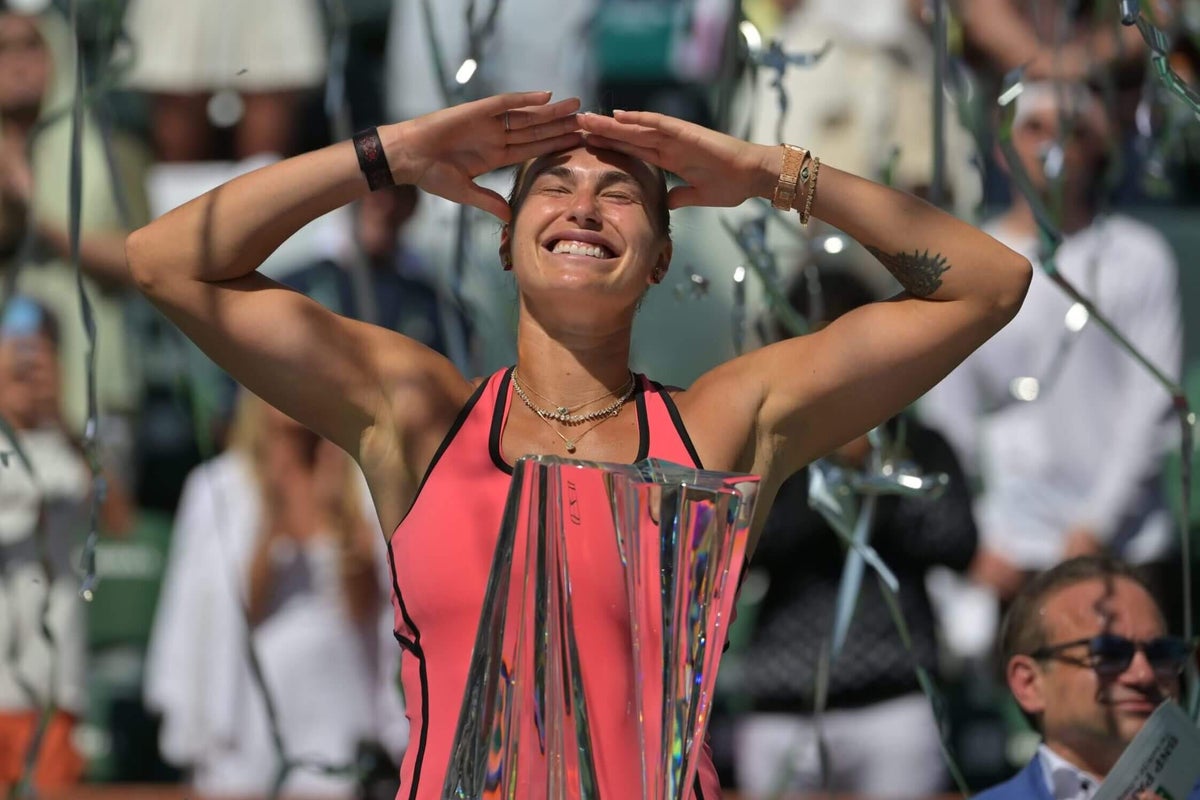
INDIAN WELLS, Calif. — Twelve months ago, Aryna Sabalenka softened the disappointment of a second consecutive loss in the BNP Paribas Open final with humor. The runner-up’s trophy is a miniature replica of the winner’s — an opulent, Baccarat crystal sculpture, so heavy it requires a sturdy heave from any champion privileged to lift it.
Sabalenka joked that if she stacked her two runner-up trophies on top of each other, she might be able to convince herself she had won the real thing.
It was a good line from someone who appreciates bling, as evidenced by the luxe engagement ring she debuted ahead of her first-round match last week. But the runner-up trophies Sabalenka has collected throughout her career have come to represent pain so visceral that when she arrives on the doorstep of a championship, she speaks about wanting to avoid the ache of loss more than she does her desire to win.
For a player with a game as devastating as Sabalenka’s, a 22-20 record in finals — many of them lost in agonizing ways — feels much more dire than it is.
But in beating Elena Rybakina 3-6, 6-3, 7-6(6) on Sunday, to win her first Indian Wells title in a puzzle box of a match, Sabalenka took a step toward constantly seizing the big moments that she creates more often than any of her peers.
“I said before going to this final, I am so tired of losing these big finals,” Sabalenka said in her news conference.
“Players were playing incredible tennis, but still I managed to fight through and to get my opportunity, and I didn’t use it so many times.
“So in this final … I was just trying to find something, find a way to get this win for myself, to feel more confident going into the next final.”
Sunday’s win reinforced Sabalenka’s mental and physical fortitude in a match played in 95-degree heat, less than a year after she imploded in the French Open final against Coco Gauff, before blaming her loss to the American on rainy, windy conditions and her own poor play.
Sabalenka’s deceptively controlled aggression, into which she appears to pour her entire being, means she could never be credibly given the moniker of “ball basher.” But at Indian Wells, she showed just how much she has diversified her game by mixing in instinctive net play and adding drop shots to her arsenal.
She beat the old guard of hard-court tennis, Naomi Osaka, with little complication and plenty of variety in the fourth round. She beat a shape-shifting up-and-comer, Victoria Mboko, in the quarterfinals. She pushed Linda Nosková, a steady youngster on the brink of the top 10, in the semifinals.
None of them required as much of her as Rybakina, who entered Sunday’s match having won her previous 12 bouts against top-10 players.
After losing a quick first set, Sabalenka rifled through backup plans without losing her cool or second-guessing herself. She flexed the nuance in her game, not by showing Rybakina a wide array of shots, but by homing in on the variations available to her when serving. When the sun was at her back, she took speed off her serve and produced return errors from a blinking Rybakina. She nailed sharp, short angles on command. And when she needed to, she could still dole out her original recipe and rocket a 111 mph ace.
“The whole point was to have A, B, C, D, E, and blah, blah, blah plans. Today, A, B, C definitely didn’t work,” Sabalenka said.
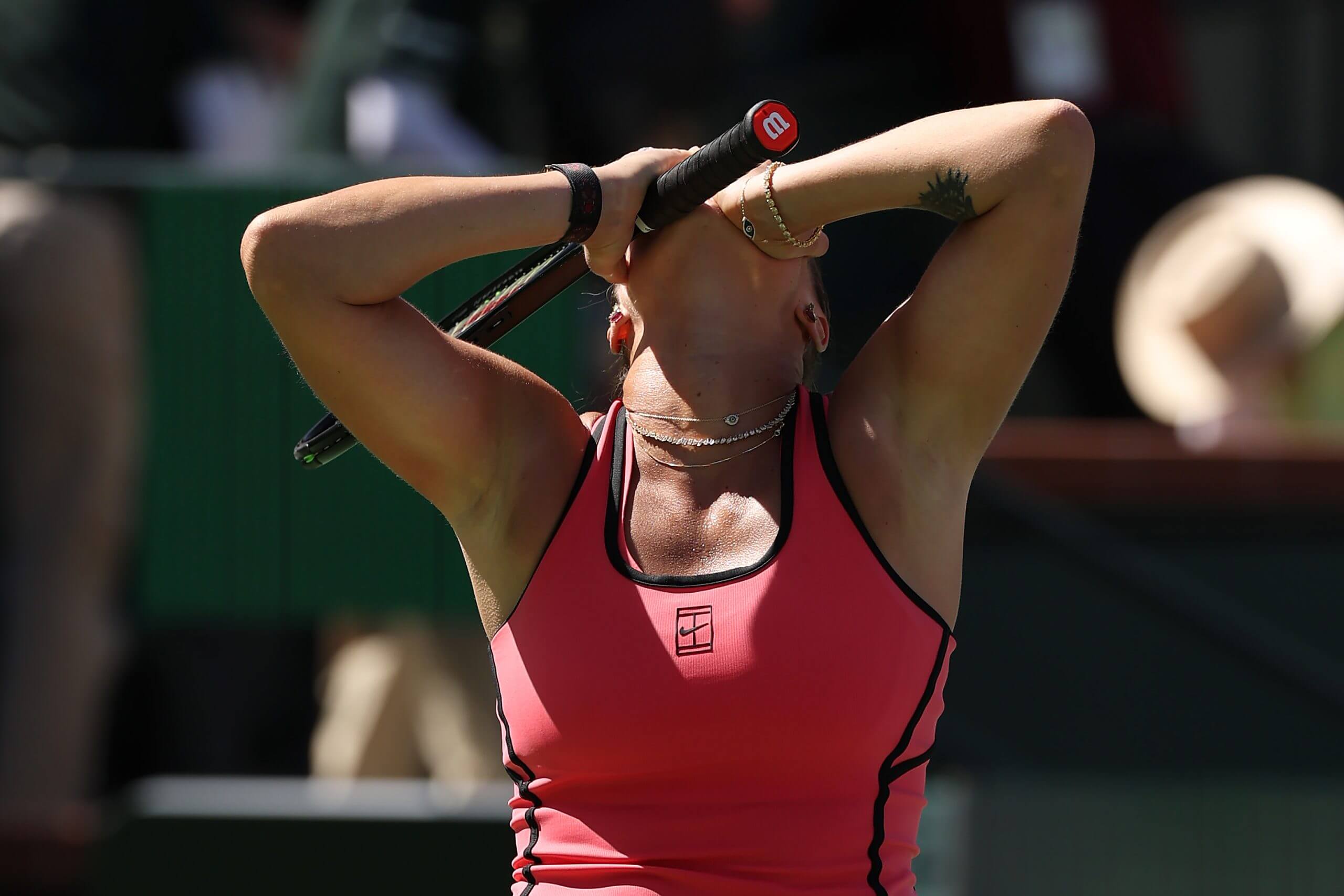
Aryna Sabalenka recovered from a first-set barrage from Elena Rybakina to win the BNP Paribas Open title. (Clive Brunskill / Getty Images)
“So I had to just, I don’t know, basically run there and put as much ball back at her as possible. Then, when I felt more confident, I went back to my usual game, which is aggressive and dominating.”
Two moments stood out as evidence of Sabalenka’s trust in herself to produce exactly what she needed, when she needed it, despite her past disappointments. The first came after Rybakina had rebounded from a 3-1 deficit in the third set and was on serve at 5-5.
Rybakina saved five break points, and after 11 minutes, she took a 6-5 lead. Sabalenka held at love in the next game to force a tiebreak.
The second moment was Rybakina’s championship point in that tiebreak. She sent a 121 mph ad-side serve screaming wide across the net, but Sabalenka was ready and whipped a backhand winner at a perfect acute angle.
Sabalenka had been studying. Relieving pain, in hopes of avoiding it again.
“I have seen that match point at the Australian Open that she had, I don’t know how many times it was in my face,” Sabalenka said.
“I was standing there thinking, OK, I’ve got to cover a wide serve, and I left T serve for her to ace it or whatever.
“So lucky me, she served again a wide serve, and I just covered that side. And doesn’t matter how fast the serve is, I know that I can block it and I can return. So I got super lucky in that point. … I feel like that was the moment that gave me so much … I don’t know, so much mental power.”
Two quick points later, and Sabalenka had her win, the world No. 1 making a statement in the face of the woman who will rise to No. 2 on Monday.
She also had her trophy, which, during the on-court ceremony, proved to be a fittingly heavy lift.
“This trophy is so heavy. To be honest, I was so done. I had cramps after the match. It was so hot,” Sabalenka said, smiling.
“I was, like, come on, I need the good picture. I’ve got to lift it up. I took all of the power left and I did it.”