
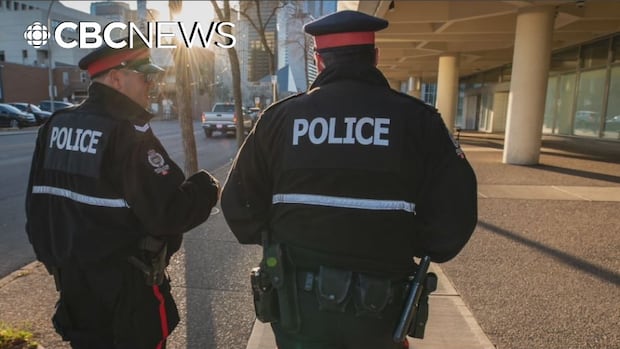
On a July morning in 2024, Dwayne Cardinal was packing up his tent outside the Bissell Centre when a police cruiser pulled up and two officers got out.
What happened next is the subject of an ongoing lawsuit, but both sides agree on one thing: an Edmonton police officer deployed a Taser on Cardinal repeatedly.
“It felt like they were burning me, not electrocuting,” said Cardinal. “Like I was on fire.”
Cardinal is suing the Edmonton Police Service over the incident; EPS and the officers deny misconduct.
Cardinal is one of hundreds of people in Edmonton each year who are shocked with Tasers by police, a number which has steadily risen for more than a decade, according to EPS statistics.
Over a two-year period, covering 2023 and 2024, Edmonton police used a Taser on someone more than 1,000 times.
But aside from high-level figures, the public has had little information about how EPS deploys these high-voltage weapons.
In an effort to increase public understanding of how Tasers are used in local policing, CBC News obtained through an access to information request all EPS use-of-force reports involving Tasers for 2023 and 2024.
CBC News also obtained EPS policies and procedures regarding Tasers, documents which have not previously been made public.
Key findings from the data:
EPS used Tasers on people as old as 75 and as young as 12People who police identified as having addictions or mental health issues are among those EPS most frequently shocked with stun guns.Taser use occurred throughout the city, but most heavily in central communities
Temitope Oriola, a criminologist at the University of Alberta who has published research on police use of Tasers, believes transparency is needed because of the sheer power of the weapons.
“It is capable of emitting 50,000 volts of electricity per use,” he said.
“This is not a toy. This is a tool that can do considerable damage to the human body.”
Statistics compiled by CBC News from annual reports to the Edmonton police commission show that use of Tasers by EPS has steadily grown over the past 15 years — from 30 use of force reports involving Tasers in 2010 to 574 in 2024, an increase of 1813 per cent.
Tasers and tactics
Tasers are the most well-known brand name of conducted electrical weapons, and the only brand approved for use in Alberta.
They deliver an electrical shock to a person, typically either through barbed electrodes fired as projectiles, known as probe mode, or by placing the device directly on the subject’s body, known as stun mode.
The intention is for electricity to incapacitate a subject by temporarily causing pain and disrupting voluntary muscle function. In most cases, there is no lasting physical injury. However, stun guns can cause serious injury or death, and are often referred to by law enforcement and experts as ‘less-lethal’ weapons.
EPS procedure documents for the use of Tasers, not previously made public, state that likelihood of injury to the officer, the subject or the public would be grounds for deployment.
The data obtained by CBC News is taken from control tactics reports — records that capture basic information about an incident involving the use of force or injury to a person.
CBC News obtained 1,033 control tactics reports for 2023 and 2024 involving Taser use by police.
These reports only capture basic information such as the estimated height, weight and age of the person the force was used on; the lighting and environmental conditions; and whether the person had a weapon.
They record minimal details about the force used — for example, whether a Taser was used in probe or stun mode, what part of the body the shock was applied to, and whether the recipient of the shock or the reporting officer was injured.
Some of the information provided to CBC News was redacted, such as serial numbers, officer names and officer injuries.
Findings
Since 2009, Edmonton police have deployed their Tasers more than 3,000 times, according to data compiled by CBC News from EPS reports to the Edmonton police commission.
According to EPS policy, each officer who uses force in an incident must write a control tactic report. This means that multiple control tactic reports may exist for a single incident, all with the same event number.
The reports obtained by CBC News contained 793 unique event numbers, correlating to an equal number of incidents with at least one Taser deployment against at least one person.
CBC News provided EPS with a list of questions and requested an interview with an officer from the organizational unit responsible for Tasers.
In response, EPS provided a written statement that did not address most of the questions. The interview request was declined.
“The Edmonton Police Service follows strict policies and procedures for the use of Tasers, in alignment with current Canadian case law, the Alberta Association of Chiefs of Police guidelines and medical standards informed by peer-reviewed research,” said the statement.
Estimations
In some instances, multiple reports exist for an incident but with varying estimated ages, heights or weights.
For these incidents, it’s unclear whether the reports are referencing the same person or multiple people.
Despite this, the data does show that the vast majority of people shocked by EPS are estimated at ages between 21 and 40, with roughly a quarter of them recorded as 26 to 30 years old.
Six people were over 60, with the oldest being 75 years old. Ten people were minors, with the youngest person being a 12-year-old girl.
Due to the limited nature of the control reports, few details about these incidents are known.
The officer who used force against the 12-year-old recorded that she was “mentally unstable,” had a “history of violence” and was observed committing a criminal offence. The report also says she had an edged weapon and was estimated by police to be five-foot-eight-inches tall and 190 pounds.
According to the report, the girl was shocked with Taser probes, which were recorded as “effective.”
In a different incident another minor, a 15-year-old girl, was estimated by police at four-foot-eight inches tall and 71 pounds and had an edged weapon. The reporting officer recorded her as “mentally unstable” and intoxicated by alcohol, and listed her behaviour as “assaultive” when they shocked her with probes on her front torso and front left leg.
The reason given for using the Taser: “Risk of injury to third party (police/public); Risk of subject self-harm.” Following the shocks, the girl had “no complaint of pain,” according to the officer who used the Taser.
EPS did not answer a question from CBC News about whether there were restrictions for using Tasers on minors.
“Officers are trained to assess the level of risk in each incident and to judge the appropriate response at the time of response,” said EPS in a statement, noting that a range of factors are considered, including age, physical size and condition, and presence of a weapon.
“In a case where a subject’s actions are likely to result in harm to themselves or others, force may need to be applied even if the subject is, for example, elderly, intoxicated by drugs, or displaying signs of mental illness.”
Location
Most reports listed an address or other specific location, such as a transit station.
However, of the 793 unique file numbers obtained by CBC News, 328 had the location fully redacted. EPS did not answer questions about why some locations were considered more sensitive than others.
The Edmonton neighbourhoods that appeared most frequently among the unique file numbers were:
Downtown, 66McCauley, 26Boyle Street, 22Central McDougall, 13Wîhkwêntôwin, 12Risk factors
The ‘risk factors’ field consists of a list of selected criteria that the officer perceived during the encounter that contributed to the decision to use force. Each report may have multiple entries.
Among the most frequent risk factors were ‘subject mentally unstable’ (360 times) and ‘subject drug intoxication’ (330 times).
“Those who are experiencing some type of mental health crisis are more likely than those who are not to be involved in use-of-force incidents generally, but also specifically in conducted energy weapons incidents,” said Victoria Sytsma, a criminologist at Queens University.
Weapons
Subject weapons were recorded by the officer selecting one or more of several pre-determined categories, or choosing “other” and adding a description.
“Edged weapons,” such as knives, were overwhelmingly the most common weapons, appearing 206 times.
The descriptions for “Other” weapons are one of the few areas of the report where officers can use their own words.
Among the entries:
“nun chucks”“[subject] had a lighter and threaten to use it while in a shed that smelled like gasoline”“unknown at time force was used, later determined to be a pop bottle”“Shopping cart full of items that could be used as weapons”“fire hydrant”
Two reports listed Tasers, including one described as “EPS CEW.”
Notably, 16 reports stated that the subject had no weapon or none was observed at the time force was used. In one of those, a gun was found afterward.
Cardinal lawsuit
Dwayne Cardinal did not have a weapon.
In his lawsuit, he says the officers told him to put the tent down and placed him under arrest without giving a reason, which would be a breach of his Charter rights. Cardinal says they forced him to the ground, handcuffed him, and used a Taser on him several times before dragging him across the ground to their vehicle.
He was charged with resisting arrest, examined by paramedics while sitting in the police car, driven to a shelter and released. He is now suing the officers and former chief Dale McFee, alleging negligence, false arrest and assault, and seeking $75,000 in damages from EPS.
In a statement of defence, the officers — Const. Matthew Bruno and Const. Levi Clarke — say that Cardinal was immediately aggressive, confrontational and disrespectful upon their arrival. He refused multiple requests to co-operate, and was told he was under arrest for obstruction and trespassing.
They say Cardinal resisted being handcuffed. In an effort to restrain him, Bruno pulled him to the ground and Clarke used his Taser on him multiple times.
Due to the limited information in the reports — which unlike a full police report do not include a summary of events — it is hard to know what transpired.
For example, the control tactic report for Cardinal’s arrest records the Taser stun contacting his back, and probes contacting the front of his torso.
But there’s no way to know from the report that probes were deployed more than once, as the officers acknowledge in their statement of defence.
Photographs of Cardinals injuries taken by his lawyer show eight small round marks clustered on his shoulder blade. EPS declined to comment on any aspect of the lawsuit. A formal complaint against the officers was dismissed last week by Chief Warren Driechel.
While under arrest, city workers arrived, collected his tent and other belongings, which were later thrown out. The lawsuit seeks $7,000 in damages from the City of Edmonton.
The city’s statement of defence argues the removal of his belongings was reasonable and justified, and that they had “no monetary value.” A spokesperson for the city declined to comment further.
Tomorrow, in the second part of the series: Police data and policy documents about how and when officers use Tasers are not always easy to get. Experts say that needs to change.