
Ontario Construction News staff writer
The City of Mississauga is doubling down on its efforts to jump-start a stalled housing market, expanding a program that eliminates development charges for specific types of rental housing in an attempt to turn a “record-setting” volume of permits into actual construction.
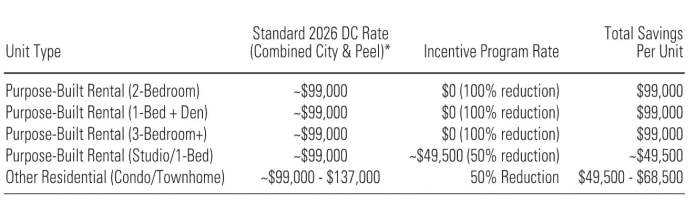
The city’s latest move, approved by council in February 2026, eliminates development charges (DCs) for one-bedroom-plus-den and two-bedroom rental units. The policy expansion is aimed at addressing a specific bottleneck: a gap between the city’s high volume of building permit approvals and the number of projects actually breaking ground.
 While the city issued a record-setting number of permits in 2022 and reported “all-time high” permit activity in the first quarter of 2023, the actual impact of these incentives on construction starts remains in its early stages.
The primary evidence of the policy’s impact is its use as a “closer” for developers who have already secured permits but have yet to start building. To be eligible for the latest 100 per cent DC reduction, developers must pull a building permit before Nov. 13, 2026.
“As a city, we have to do what we can to get rental developments across the finish line and shovels in the ground,” Mayor Carolyn Parrish said in a statement.
The city reported that as of early 2026, there were more than 12,000 residential units under construction. However, the city has also faced challenges meeting provincial targets for “housing starts”—a metric that measures when construction actually begins—despite the high volume of approved permits. In 2023, the provincial government deemed Mississauga ineligible for the Building Faster Fund because it did not meet its specific housing start targets, a decision the city contested by pointing to the thousands of units already in its development pipeline.
The incentive program, which launched in January 2025 with a 50 per cent reduction for most residential projects, was a direct response to a “cost to build crisis.”
Industry advocates, including the Building Industry and Land Development Association (BILD), have credited the program with addressing the “financial viability challenges” that caused many projects to stall. Before the incentives, an analysis by N. Barry Lyon Consultants for the city indicated that rising construction costs and high interest rates were making many high-density projects unviable.
By eliminating the DCs, which can exceed $135,000 per single-detached unit and tens of thousands per apartment unit, the city is attempting to offset the “hard costs” of construction that have risen faster than residential prices.
Key statistics and milestones
Record activity: In 2022, Mississauga issued permits for 6,491 residential units with a total construction value of $2.5 billion.
Pipeline vs. starts: By early 2026, the city reported more than 11,600 units under inspection, with 95 per cent of those being high-rise apartments.
Federal support: The city is using a portion of $84 million in federal Housing Accelerator Fund (HAF) grants to offset the revenue lost from these DC reductions.
Peel Region match: The Region of Peel voted in June 2025 to match the city’s incentives, effectively doubling the financial relief for eligible developers.