
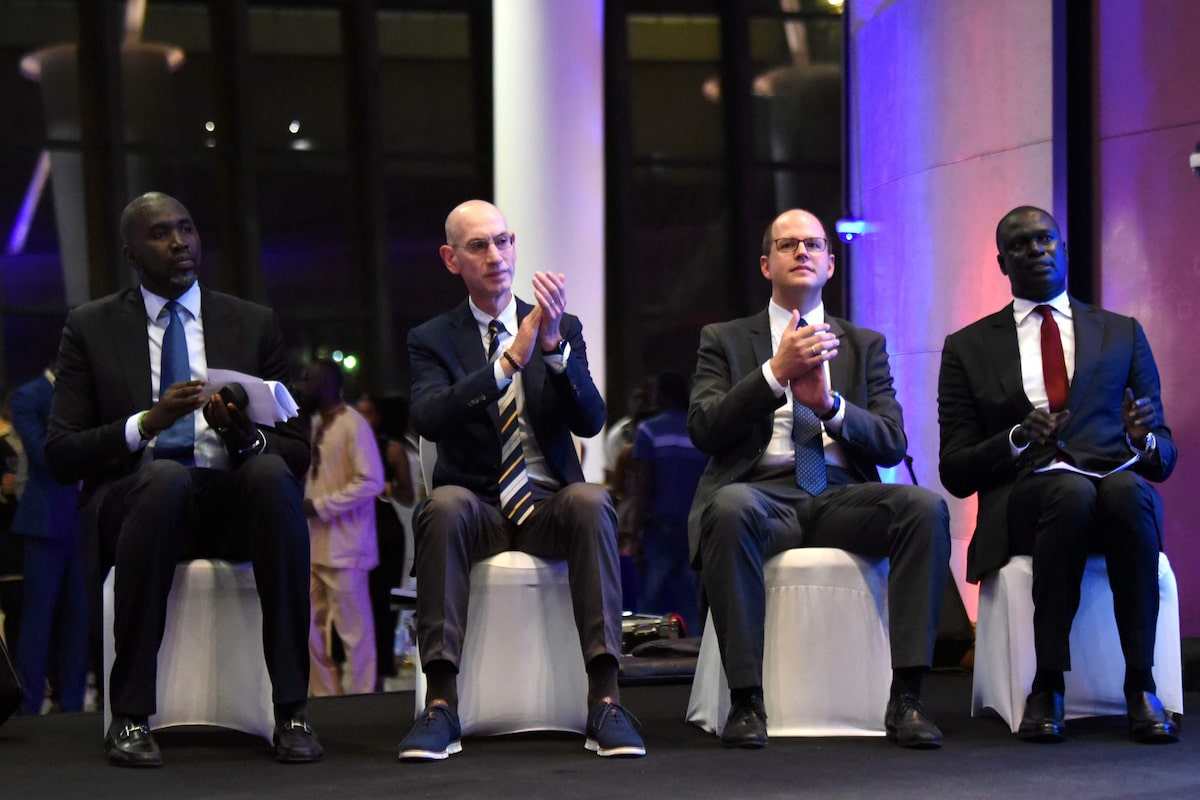
From left to right; Senegalese presidential advisor for sports Ndongo Ndiaye, NBA commissioner Adam Silver, secretary general of the International Basketball Federation Andreas Zagklis and the president of the Basketball Africa League Amadou Gallo Fall at the announcement of the the NBA-backed Basketball Africa League in Dakar, Senegal, in July, 2019.SEYLLOU/AFP/Getty Images
The NBA’s efforts to expand into the African market have suffered an embarrassing setback after a top team was forced to quit the continental league because of U.S. sanctions against its military sponsor.
The abrupt withdrawal of the team, owned by the Rwandan army, has raised new questions about the NBA’s close links to Rwanda’s authoritarian government, which is often accused of human rights abuses and cross-border military aggression.
The Trump administration imposed sanctions on Rwanda’s army in early March because of its abuses in the Democratic Republic of the Congo, where it reportedly provides weapons and thousands of troops to support an atrocity-committing rebel militia that has captured major cities in eastern Congo.
Former Toronto Raptors president Masai Ujiri, a close friend of Rwandan President Paul Kagame, is a key architect of the 12-team Basketball Africa League (BAL), which was co-founded by NBA Africa and the International Basketball Federation in 2019 and held its first season in 2021.
Last week, just four days before its sudden withdrawal from the league, the army team had released a slickly produced video of its latest Rwandan championship season, with hip-hop music and the caption: “Locked in and ready for BAL season 6.” It was seemingly unaware that the U.S. sanctions would prevent the NBA from doing business with any entity owned by the Rwandan army.
Its connections to the Rwandan army are close. After winning the Rwandan championship last July, it posted photos of a victory reception with Rwandan army officers and defence ministry officials.
The team – officially the Armée Patriotique Rwandaise Basketball Club, nicknamed the Lions – announced on March 9 that it had signed Quinn Cook, a two-time NBA champion. But Cook realized that the deal was in trouble when his plane ticket to Rwanda never arrived, according to an ESPN report.
On Friday, the league announced that the army team “will no longer participate” in its new season, which begins on March 27. The Rwandan basketball federation said the team had decided to “step aside.”
Neither the league nor the federation mentioned the U.S. sanctions, but one of the federation’s media partners, X Ball Africa, confirmed that the withdrawal was because of the sanctions.
Rwanda has been central to the NBA’s plans to boost its popularity on the continent. The African league’s playoffs are usually held in a new 10,000-seat basketball arena in Rwanda’s capital, Kigali, where Kagame is a major booster of the league. Ujiri is developing a multimillion-dollar sports and entertainment complex, including a hotel and restaurants, on a large site adjoining the Rwandan arena.
Ujiri did not respond to Globe and Mail questions – e-mailed to him on Monday through his organization, Giants of Africa – about the U.S. sanctions and the withdrawal of the Rwandan team. But as early as 2019, he was urging business leaders to invest in African sports and build new stadiums. “Sports is the next big thing in Africa,” he told investors in Johannesburg, describing the new league as “spectacular.”
Jeffrey Smith, founder of pro-democracy organization Vanguard Africa, said the NBA and Ujiri “should have realized they were getting into bed with a regime directly linked to atrocities in Congo.”
Responding to questions from The Globe, he said the withdrawal of the army team will be embarrassing to the Rwandan government, since Kagame uses basketball as a personal and national branding tool and a way of whitewashing abuses. Kagame has ruled Rwanda for the past 32 years, routinely winning elections with 98 to 99 per cent of the vote.
The NBA “willfully ignored” the warning signs, Smith said. “The NBA didn’t stumble into this; it chose to ignore the blood on the hands of its host partner.”
After the withdrawal of the army team, Rwanda announced that it would be replaced in the league by another local team, RSSB Tigers. The army team’s American coach, James Maye Jr., and several of his players were dispatched to join the Tigers.
But this is just a transparent ploy by the Rwandan president, Smith said. “He can swap teams all he wants; the world now sees the regime’s military fingerprints on everything, including sports.”