
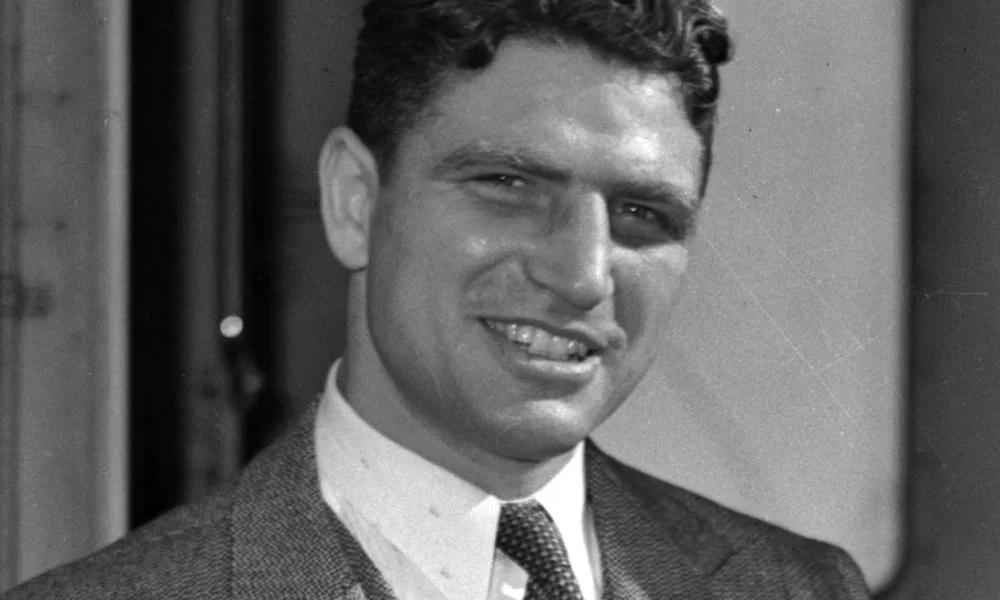
Lou Nova Brought Style, Humor, and Hollywood to the Ring
By any measure, the heavyweight division of the late 1930s and early 1940s was populated by outsized personalities and dangerous men. It was an era bridging two legends: Jack Dempsey, whose ferocity defined the 1920s, and Joe Louis, whose calm efficiency would dominate the following decade. In between stood contenders, colorful figures who added texture and life to boxing’s grandest stage.
One of the most memorable among them was Lou Nova, a talented heavyweight and an unabashed showman. He later became a character actor in Hollywood who seemed as comfortable in front of a movie camera as he did beneath the bright lights of boxing’s biggest arenas.
Nova built a respectable career record, punctuated by moments of drama and spectacle. His persona reflected an era when fighters were more than athletes; they were colorful public figures who captured the imagination of fans and sportswriters alike.
California Roots
Jay Louis Nova was born on March 16, 1913, in Los Angeles, a city that was already beginning to grow into a sports and entertainment hub. He attended Alameda High School in Oakland, CA, graduating in 1931. He played football and baseball and also threw the javelin in track and field, where he set a high school record.
Nova found success in amateur boxing, capturing the National AAU heavyweight championship in 1935, one of the most prestigious amateur titles in the United States at the time.
By the mid-1930s, Lou Nova entered the professional ranks, bringing with him an athletic frame, confidence, and a willingness to entertain. On January 24, 1936, Nova defeated Ralph Barbara on points in a scheduled four to get on the scoreboard. And with that, The Alameda Assassin’s career began.
Nova started out with 16 wins against 4 draws before tasting defeat in his 21st bout to Maxie Rosenbloom on June 3, 1938 at Gilmore Stadium in Los Angeles. Rosenbloom, 190 lbs, captured the California State Heavyweight Title via a 10 round decision. (Nova weighed in at 202.) It should be noted Rosenbloom came into the fight with over 200 wins on his record in a career that was fast approaching 300 fights if newspaper decisions were to be included. It should also be noted that it is believed that legendary boxing scribe Arne K Lang was on hand for all of Rosenbloom’s wins and virtually none of his losses. While there is no documented proof, it has allegedly been said that Slapsie Maxie considered Lang to be a lucky charm. (wink, wink)
A Heavyweight with a Flair for Theater
It wasn’t just Nova’s ability that made him stand apart from many heavyweights of his era, it was also his personality.
At a time when fighters often projected grim seriousness, Nova injected humor and theatricality into his appearances. Nova was also articulate and approachable with reporters, something that helped build his reputation during the golden age of newspaper sports pages. Sportswriters appreciated a fighter who was well spoken and was capable of delivering a colorful quote. Nova obliged them often. His blend of showmanship and genuine fighting ability made him a natural attraction on major cards.
Nova’s unusual training ideas also fascinated the press. He was sometimes referred to as “The Cosmic Puncher,” because of his interest in yoga and Eastern philosophy; practices virtually unheard of in boxing gyms of the era. Nova believed controlled breathing and mental focus could generate greater punching power, an idea that intrigued sportswriters even if many treated it with amusement.
Joe Louis himself once joked about Nova’s much-publicized technique, remarking that whatever “cosmic punch” the challenger possessed had felt more like “an earth punch” in the ring.
A Breakthrough Against Max Baer
Nova’s defining victory over Max Baer came on June 1, 1939, before a large crowd at Yankee Stadium. Baer entered the ring weighing 211 pounds to Nova’s 202, still carrying the reputation of one of boxing’s most dangerous punchers. What followed was a bruising, competitive fight that swung back and forth in the early rounds before Nova’s relentless pressure began to take hold. Baer suffered a severe cut inside his mouth that caused heavy bleeding and made breathing increasingly difficult as the bout progressed. By the eleventh round referee Frank Fullam had seen enough, halting the contest at 1:21 of the round and awarding Nova a technical knockout victory.
From press row, longtime The Ring editor Nat Fleischer later described the fight as fiercely competitive until the injury and mounting punishment overwhelmed Baer. Ringside reports noted that Baer had endured one of the most punishing beatings of his long career, his nose and mouth bloodied and both eyes swelling as Nova continued to press the action. The punishment Baer absorbed was severe, prompting the former champion to reflect afterward with characteristic bluntness: “Maybe I ought to quit and keep the brains I got!”
An unofficial United Press scorecard had Nova comfortably ahead through ten rounds, though the fight had included its share of rough moments, with Nova losing a round on a penalty for low blows and Baer another for striking after the bell. The bout would gain an additional place in boxing history as the first prizefight ever televised, giving a new audience a glimpse of Nova’s relentless performance and helping propel him toward a long-anticipated title opportunity.
For a fighter seeking a title opportunity during the reign of Joe Louis, defeating a former champion carried enormous significance. The triumph over Baer marked Nova’s arrival among the division’s serious challengers.
Their rivalry would continue, with a second bout on April 4, 1941. Nova won by technical knockout in round 8 of a scheduled 10. This would prove to be Baer’s final outing.
A Shot at the Brown Bomber
If beating Baer brought Nova into contention, his next major test would place him before the most dominant champion of the era.
Nova’s shot at the title came on the heels of light heavyweight champion Billy Conn trying to wrest the title from the legendary Brown Bomber, Joe Louis. Few fighters in history have reigned with the authority Louis displayed during that period. By the time Nova received his opportunity, Louis had already dismantled an impressive list of contenders.
On September 29, 1941, Nova stepped into the ring at the Polo Grounds in New York City to challenge Joe Louis for the world heavyweight championship. Nova outweighed Louis by 4 ounces on the scale (202.5 to 202.25 pounds); he had a weight advantage, and that’s pretty much where the advantages ended.
The bout itself unfolded according to a familiar script of the Louis era. The champion’s precision, timing, and punching power gradually wore Nova down. In the sixth round, referee Arthur Donovan stopped the bout one second short of the bell.
For Nova, the loss illustrated the reality faced by many talented heavyweights of the time: the road to the championship ran through Joe Louis, and very few survived the journey.
After almost a decade of fighting professionally, he competed in a total of 63 outings, winning 49 of which 31 were by knockout. He lost 9 bouts and had 5 draws.
Nova had a variety of interests outside of the boxing ring. He studied Eastern philosophy (Hindu theistic philosophy) and practiced yoga long before it became widely accepted in American athletics. Historians have noted that he was deeply interested in metaphysical ideas and believed mental discipline could improve athletic performance. At various points in his career Nova also followed a vegetarian diet, believing it contributed to physical and mental clarity.
Hollywood Beckons
Nova’s colorful reputation endured long after his fighting career ended. Various reports have Nova listed between 6’2″ – 6’3″ feet tall. He was known for both his athletic ability and eccentric interests, and he became one of boxing’s most recognizable personalities of the late 1930s and early 1940s.
His career naturally segued into acting, where he appeared in a variety of films and television productions, often cast in adventure or action roles that made use of his athletic build and commanding presence.
He also remained connected to the sport through commentary, writing, and public appearances. Having been around Dempsey who acted in the role of an advisor during the lead up to the Louis fight and having faced the formidable Joe Louis, Nova possessed a firsthand perspective on boxing’s golden age.
The Legacy of a Colorful Contender
Lou Nova’s career unfolded during one of boxing’s most fascinating transitions.
The brutal intensity of Jack Dempsey’s era still echoed in the sport’s mythology, while Joe Louis was establishing a model of disciplined dominance that would define modern championship boxing.
Nova was talented enough to defeat elite opponents like Max Baer and popular enough to headline major arenas. He was also charismatic enough to remain a recognizable public figure long after his fighting days were finished.
Nova died on September 29, 1991, leaving behind a career that bridged the golden age of heavyweight boxing and Hollywood, blending athletic skill with a charisma that ensured he would be remembered long after the final bell.
Honoring Lou Nova on what would have been his 113th birthday.
To comment on this article in the Fight Forum, please CLICK HERE