

Listen to this article
Estimated 4 minutes
The audio version of this article is generated by AI-based technology. Mispronunciations can occur. We are working with our partners to continually review and improve the results.
The City of Montreal is scrapping a plan to remove trash cans from La Fontaine Park this summer.
The pilot project was developed under the previous Projet Montréal administration as a potential solution to bin overflow, but Claude Pinard canned it Monday.
“This is not the vision we sold to Montreal voters. We do not believe this project would help us reach our cleanliness goals,” said Pinard, chair of the city’s executive committee.
The plan involved removing approximately 80 garbage cans from the park’s interior and replacing them with large collection bins located exclusively at the park’s exits. The goal was to encourage parkgoers to carry their waste to the perimeter, a strategy the Plateau-Mont-Royal borough argued would promote responsibility and improve waste management.
However, the proposal met immediate pushback from blue-collar workers responsible for the park’s upkeep. Union representatives expressed concerns that the move would lead to increased littering in a park where some bins currently require emptying up to five times a day.
Plateau-Mont-Royal Mayor Cathy Wong said the city should have tested the project before tossing it out. She said the borough intended to take a progressive approach rather than removing all bins at once.
Wong also pointed to similar initiatives in the Saint-Léonard borough, which she described as successful.
In 2022, Saint-Léonard removed all the small garbage cans from two parks, replacing them with a few larger bins in the centres and exits. The borough said the parks were cleaner and that residents embraced the change.
Expert says it can work with awareness
Reducing bin availability tends to work better in small communities, where people frequent the same park or area on a regular basis, according to Richard Shearmur, an urban planning professor at McGill University. He said, in those cases, there’s a sense of ownership of the park and people tend to be more responsible with their garbage.
To make it work in larger areas, people need to be informed, he said.
“Say students going around over the summer explaining to people, not punishing people, but explaining the new approach. There has to be a process put in place to effect this change,” he said.
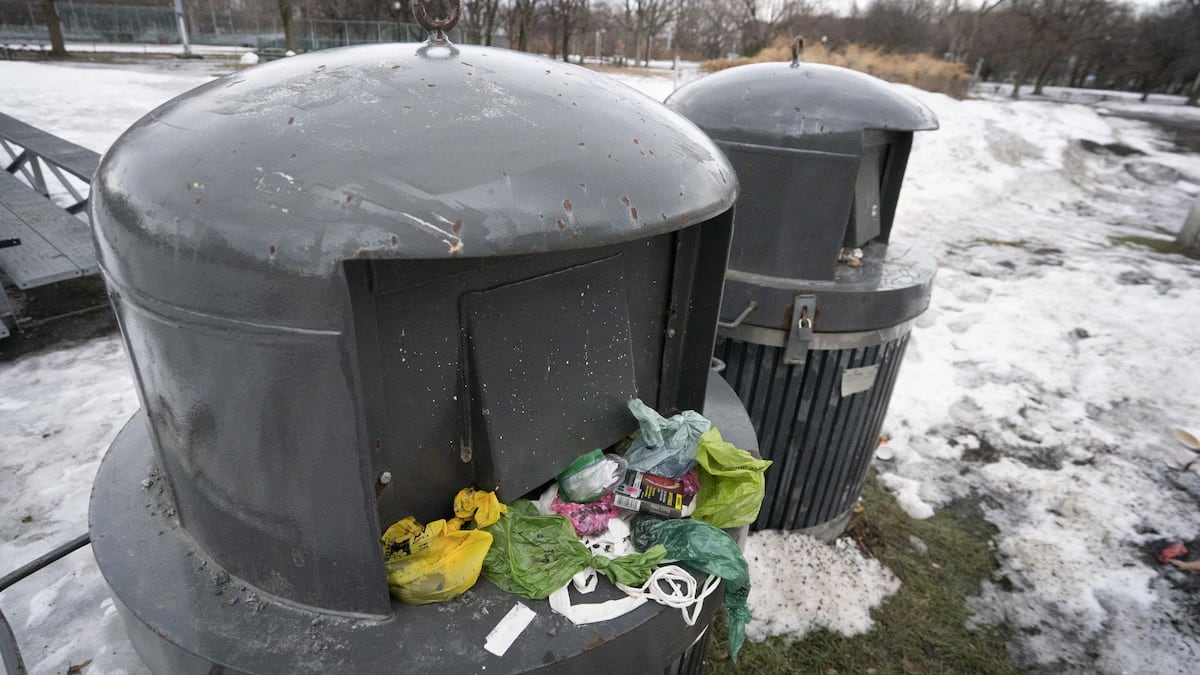 Overflowing trash bins are a common site around Montreal, including La Fontaine Park. But the city won’t try eliminating trash cans as a solution this summer. (Ivanoh Demers/Radio-Canada)
One environmental group that advocates for better waste management says putting more garbage cans in a park doesn’t necessarily lead to cleanliness either.
“The more you have garbage cans in a park or on a street, the more you have garbage,” said Karel Ménard, managing director of the Front commun québécois pour une gestion écologique des déchets.
He said having fewer bins in strategic areas can help, but the change must be paired with other measures such as educating the public and eventually fining those who litter.
Lachine Canal project canned
In 2024, Parks Canada reinstalled around 30 garbage bins along Montreal’s Lachine Canal after some visitors bemoaned their sudden disappearance.
At the time, it was a pilot project to encourage visitors to take responsibility for waste destined for landfills.
At that time, Shearmur said this has been tried in other locations, such as national parks, where it has worked because people are educated about the policy as they enter the park.
He cited the example of Ocean Beach in San Francisco. The National Park Service removed the bins in 2015, and not only did it upset people in the area, it was unclear if the move helped reduce littering, he said.
“In fact, people started piling the trash where the cans used to be,” said Shearmur. “Eventually, two years later, the trash cans were put back.”