
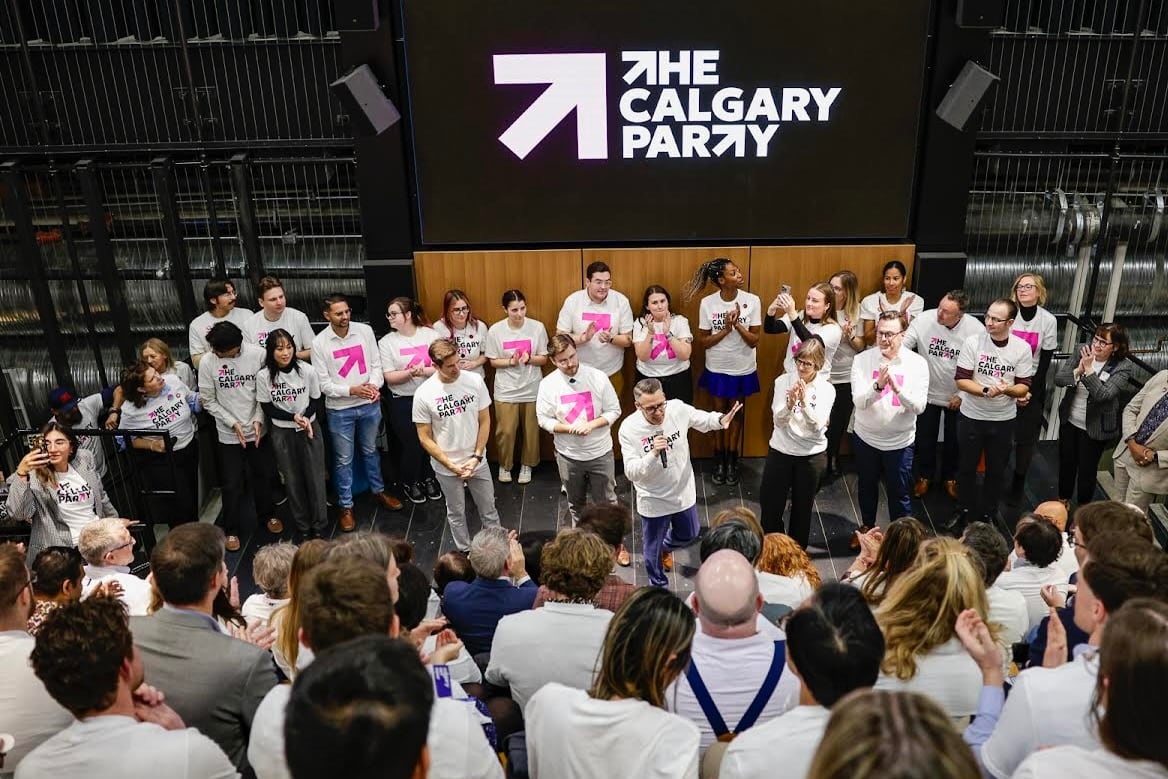
At a Calgary council committee meeting in early February, a pair of members from the same party found themselves on opposite sides on back-to-back votes.
Ward 13 Coun. Dan McLean, who ran under the Communities First banner in last fall’s municipal election, advocated for a motion calling on council to support the province’s decision to close Calgary’s lone supervised consumption site.
Ward 10 Coun. Andre Chabot, also a Communities First candidate, opposed it. The proposal was shot down in an 8-7 decision.
Minutes later, McLean voted against Chabot’s motion to explore creating a municipal bylaw offence for low-value shoplifting.
McLean said he’s not working with Communities First councillors behind the scenes on policy ideas at all. Rather, he talks to every councillor on their initiatives before they come to a vote, and makes his own decisions on whether to support them.
“If that happens to be a councillor from a different party or an independent, that doesn’t matter to me,” said McLean.
It was one of the signs emerging that five months after the first Calgary municipal election in decades to feature political parties, votes are not being whipped along party lines.
Meanwhile, most parties that ran in last fall’s election face an uncertain future.
Blurred party lines
In October’s election, six out of 15 city council seats were won by candidates from one of the city’s three new parties. Communities First elected four candidates, while the Calgary Party and A Better Calgary each elected one.
Some Calgarians may have wondered if elected party members would vote as one bloc.
The four Communities First councillors have been united on one of city hall’s most discussed issues, as they all support repealing blanket rezoning and ran on doing so.
But they’ve been divided on other debates like raising national flags or hiking transit fares.
The result is consistent with what Communities First promised on the campaign trail, Chabot said.
He points out that, as the name states, the party’s candidates always promised to put their constituents’ needs first, even if it meant opposing their party colleagues.
“That should give some confidence to the electorate that we are not only aligned from a philosophical perspective, but that our intent is to continue to represent the interests of our constituents,” said Chabot.
The veteran politician, who’s sat on city council longer than any other member of council, argued Calgary’s system isn’t designed for party politics, and that he’s never been a fan of the party system.
But he said he thinks it’s been valuable to communicate to voters what kind of candidates they’re choosing.
McLean said he always believed that while Communities First ran on some platform points collectively, like blanket rezoning, they wouldn’t always vote together on council.
“The Ward 13 issues may differ from Ward 1 or Ward 10, so I’m not going to vote as a bloc,” the second-term member said.
Calgary and Edmonton are both piloting municipal parties due to provincial legislation enabling them on ballots for the 2025 election. Shortly after last year’s election, Municipal Affairs Minister Dan Williams said he wanted political parties to remain, to see how the system evolved over multiple election cycles.
Both cities’ mayors ran as independent candidates last year, and most council seats were won by unaffiliated contenders as well.
Since then, Ward 4 Coun. DJ Kelly, the only Calgary Party candidate elected to council, said the party system has had little impact on how council governs.
Because of its lack of relevance in council’s daily operations, Kelly said he thinks the experiment is “DOA,” with each party now questioning its purpose moving forward.
“The leaders of these parties were the mayoral candidates, none of them were elected,” Kelly said. “As a result, you can’t really even have a caucus in terms of what you’re doing and how you’re going to work together. Nobody has a majority.”
A Better Calgary looks to 2029
Since last fall, both of the city’s self-proclaimed centrist parties, Communities First and the Calgary Party, have taken down their websites. Neither one is active on social media.
But the city’s right-wing party, A Better Calgary (ABC), has continued to organize.
The party elected just one candidate to council, Mike Jamieson in Ward 12.
ABC is the only party acting like a true political party, said Marilyn Elliott, its president. She criticized Communities First and the Calgary Party for not taking policy ideas from party members or introducing their own internal bylaws.
Elliott said ABC plans to be in the public eye more often this year.
It wants to organize more ward associations to nominate candidates, and hold a policy conference to ask members what they want the party to push for at the municipal level, she said.
The party’s main purpose, Elliott said, is to reduce vote-splitting between right-wing candidates.
“Historically, in Calgary municipal politics, the right side of things have had many many people run in particular for mayor, and the vote-splitting has just been ridiculous, so left-leaning people have been elected far too often for my liking,” said Elliott.
Elliott said she wants her party to treat elections like a marathon rather than a 100-yard dash, ensuring candidates are selected a year ahead of a the next election in 2029, and meeting with more constituents before the vote.
Independents rare in Vancouver
In Edmonton’s introduction to political parties last year, just three council seats went to a party candidate. Less than a month later, two of those councillors walked away from their party.
It’s different farther west in Vancouver, where parties have been part of city hall for decades.
Some high-profile independent candidates have been elected, like when Kennedy Stewart won the 2018 mayoral race. But every member of council today is party-affiliated, which is the norm for the city.
Stewart Prest, a University of British Columbia political scientist, said there’s a public expectation in Vancouver that parties not whip votes, and instead hold debates out in the open. But this isn’t how city hall always operates in practice.
“The reality is that there’s quite a bit of coordination between parties, but we don’t have that traditional whipping that we see at the provincial or federal level,” said Prest.
Are the parties over?
While ABC has ambitions to grow its profile this year, candidates elected from both Communities First and the Calgary Party are unsure whether their parties will still be around in 2029.
Chabot and McLean both said they haven’t been involved with the party since the election, with the Ward 13 councillor adding the party currently isn’t active at all.
However, both councillors also said they’re still in regular contact with former Communities First mayoral candidate and leader Sonya Sharp. She closely follows city hall and still wants to stay involved in municipal politics, McLean said.
Neither Chabot or McLean would confirm whether they would run under a party banner again.
For Kelly, running with the Calgary Party helped keep campaign costs down, even if it didn’t result in more donations or revenue for his campaign. But he said he’s unsure what the purpose of keeping political parties would be, and that his party’s future is up in the air.
“We’re definitely starting a conversation about what should the party be afterwards. Should it continue as a party, should it be a think-tank, should it be something else entirely?” said Kelly.
“But at the end of the day, when it comes to how we’re governing, the party structure really hasn’t made too much of a difference at all.”