
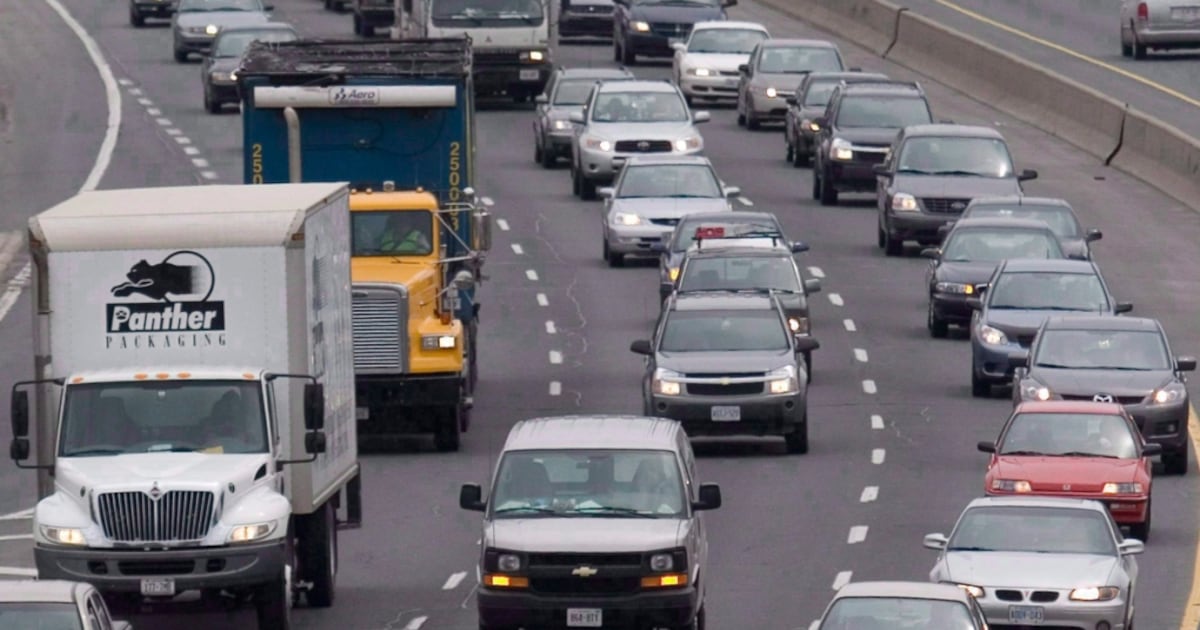
Ontario is considering updating the Highway Traffic Act to allow all drivers to use HOV lanes during off-peak hours.
Lone drivers battling gridlock may soon be able to make use of carpool lanes to get around Ontario highways faster during certain times of the day.
The Ford government is proposing changes to the Highway Traffic Act that would allow single-occupant vehicles to use High Occupancy Vehicle (HOV) lanes during off-peak hours.
“Gridlock is costing our economy billions of dollars every year and robbing Ontario drivers of valuable time and quality of life,” Ontario Transportation Minister Prabmeet Sarkaria said.
“By allowing single-occupant vehicles to use HOV lanes during off-peak hours, we would help keep drivers moving across the province, so they can spend less time in traffic and more time with their families and friends.”
The government has not yet defined what times would constitute off-peak hours, but officials say that will be determined through consultations and by analyzing traffic data.
The new off-peak hours would be set out in regulation after being finalized later this year. The changes would apply to all existing, planned and future HOV lanes.
If finalized, the proposed changes would be implemented by the end of the year.
Changes would save drivers time, province says
Government data show that as of 2022, single-occupant vehicles represented 72 per cent of vehicles on provincial highways.
Sarkaria’s office said Ministry of Transportation modelling shows the proposed changes would improve travel times for all users, with average speeds increasing in both HOV and general-purpose lanes across major highways during off-peak hours.
Details about the projected time savings from the modelling have not yet been shared publicly.
Currently, HOV lanes are restricted to vehicles with two or more occupants. Other vehicles that are allowed to use the lanes include buses, licensed taxis, green-plate vehicles, airport limousines, motorcycles and emergency vehicles.
Lone drivers who win High-Occupancy Toll permits through a lottery can also pay to access HOV lanes on sections of the Queen Elizabeth Way, Highway 403 and Highway 410.
There are currently 237 kilometres of HOV lanes in the province, with another 146 kilometres planned.
Commercial vehicles longer than 6.5 metres would still be restricted from using HOV lanes under the proposed changes, the province says.
A study released in late 2024 estimated that congestion costs the Greater Toronto and Hamilton Area close to $50 billion a year.
Last year Manhattan, N.Y. introduced a congestion toll to deal with gridlock, a move many congestion experts applauded, but some politicians decried.
The Ford government has vowed never to add tolls or congestion pricing to Ontario roads and has passed legislation in 2024 to prevent any future administration from taking that step.