
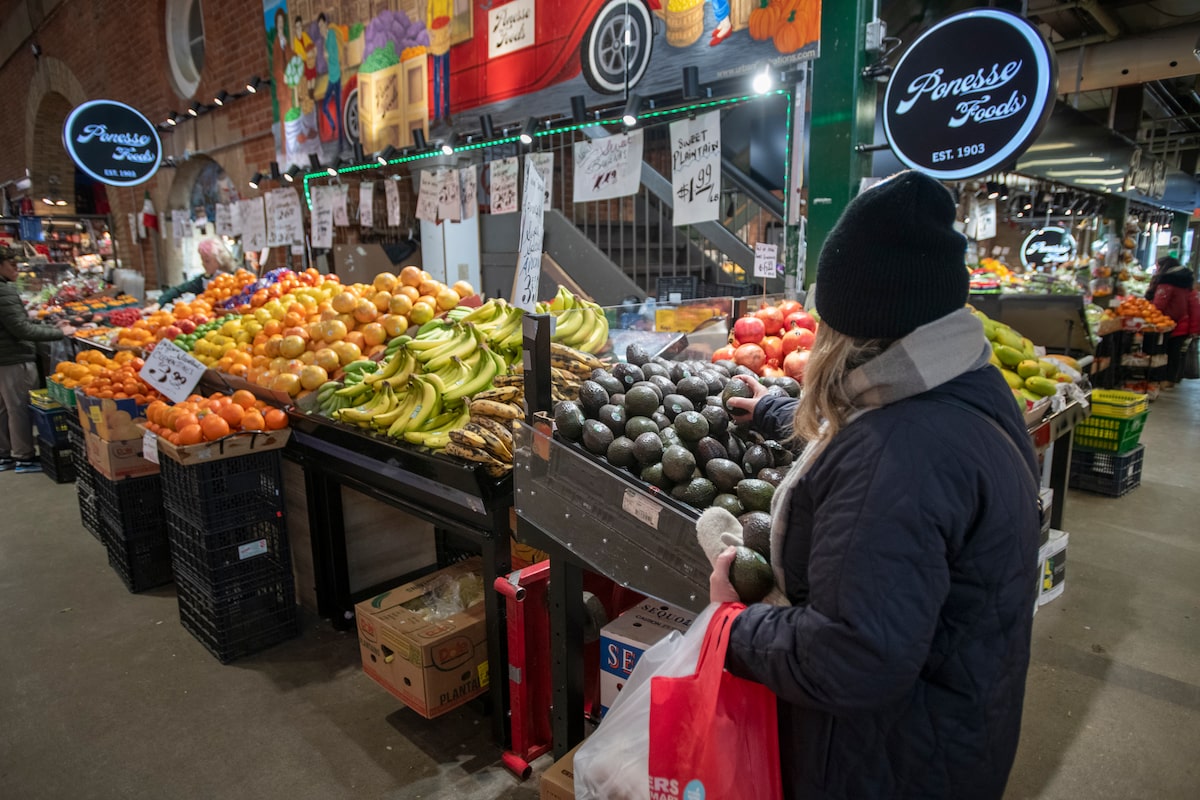
In Canada, grocery prices have been rising faster than broader inflation for the past year.Fred Lum/The Globe and Mail
Canadians can expect bigger grocery bills next month if oil prices remain high due to the conflict in the Middle East. But the immediate financial hit will come from a limited number of food staples that are particularly susceptible to energy costs.
Crude oil prices have climbed above US$100 per barrel this month, up as much as 50 per cent since the start of the year, as the U.S.-Israel war with Iran reaches its third week.
Higher energy costs typically trickle down to nearly every stage of the food supply chain, raising the cost of anything from operating farm machinery to crop drying and food processing – but not everything is reflected in the grocery bill right away. Transportation costs, however, have the most immediate impact.
It’s why heavier, perishable foods transported over long distances are the first to see modest price increases when the cost of gasoline goes up. For Canadians, it would mean slightly higher prices for items such as lettuce and spinach, citrus fruits and pulses, among other essentials, experts say.
“If transportation costs went up 5 per cent, that would be a 0.5-per-cent increase at the grocery store,” said Michael von Massow, an economist and professor in the Department of Food, Agricultural and Resource Economics at the University of Guelph.
Bank of Canada expected to hold rates amid oil-driven inflation risk
Today, it costs about 26 per cent more to fuel a food delivery semi-truck than it did at the end of February, with the total rising from $711 to $895, according to energy firm En-Pro International Inc.
The oil price spike came after the United States and Israel launched military strikes against Iran, which has retaliated by bombing neighbouring countries and disrupting tanker traffic through the Strait of Hormuz, a critical throughway for the world’s oil supply.
For some fresh produce, delivery costs can account for as much as 9 to 10 per cent of the retail price, Prof. Von Massow said. Lettuce from California or Mexico, for example, not only travels a long way to Canada but must also be refrigerated.
“That’s burning even more fuel.”
In comparison, for a loaf of bread, transportation costs account for an average of about 3.5 per cent of the retail price, he said.
Canada’s inflation rate eased to 1.8% in February before oil prices surged
Widely traded commodities such as wheat, rice, corn and soy are also vulnerable to rising energy costs because of their reliance on transportation and chemical inputs, said Jennifer Clapp, a professor in Global Food Security and Sustainability at the University of Waterloo.
“India is the biggest rice exporter in the world,” Prof. Clapp said. “And they’re slowing down some of their shipments right now because the cost of shipping is going up.”
Fertilizer prices are another factor that could put upward pressure on food production costs because the Strait of Hormuz is a crucial corridor for global sulphur and urea exports, said Richard Barichello, a professor of Food and Resource Economics at the University of British Columbia.
However, he said, the overall impact of fertilizer costs on food inflation is less obvious, as a myriad of other factors can influence crop prices, including weather, disease outbreaks and trade restrictions. Price increases at the farm level will have much smaller effects on food prices at retail levels.
In Canada, grocery prices have been rising faster than broader inflation for the past year. Food price growth also outstripped the general consumer price index during the bout of inflation that started early in the COVID-19 pandemic.
Opinion: Iran oil shock means central bankers need to be foreign policy experts too
Statistics Canada data shows that food prices jumped about 10 per cent between 2015 and 2020, compared to 22 per cent in the following four years.
Though food inflation in Canada eased slightly year-over-year in February compared to January, oil price hikes now present “a double whammy,” said Royal Bank of Canada chief economist Frances Donald.
“Everyone has to eat,” she said. “When you see gasoline and food prices go up, people will look at other areas to cut.”
That might translate into trimming back on discretionary spending but also drawing down on savings, she said.
Still, warmer weather could soften the impact of higher oil prices on food inflation in Canada in the coming months, as the domestic supply of produce ramps up, lowering transportation costs, Prof. von Massow said.
It also helps that meat prices are showing some signs of stabilizing as the sizes of cattle herds throughout North America recover from the impact of severe droughts. Beef prices had risen nearly 20 per cent over the past year but started to drop slightly in February.
“I think in the next couple of months, we’ll feel the effect of fuel costs, but some of that will be moderated,” Prof. von Massow said. “This isn’t going to be a 5- or 10-per-cent increase in some prices. These will be smaller percentages and they’ll only last as long as the fuel price is high.”