
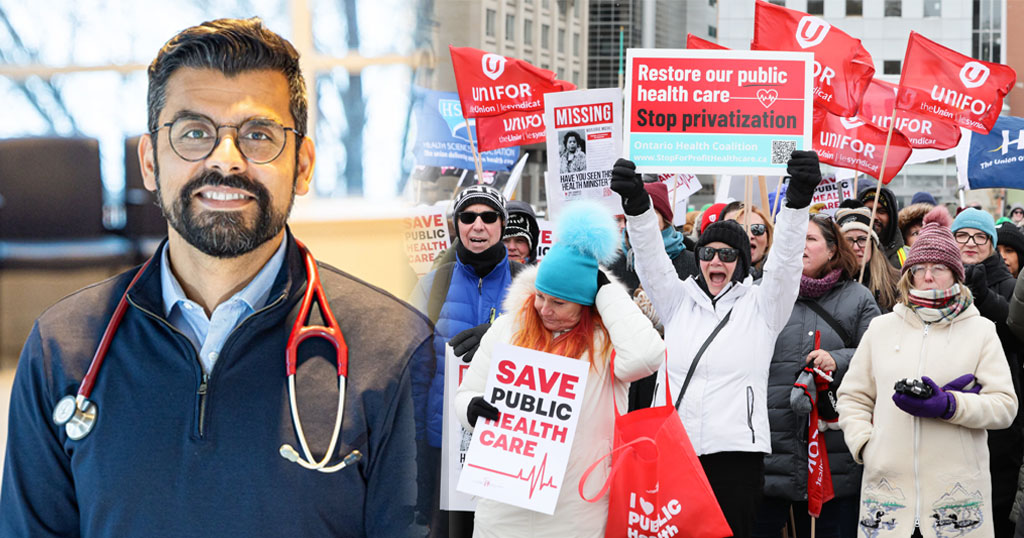
As a family doctor in Toronto, Dr. Danyaal Raza has a team-based care practice.
“That means that when a patient shows up for their appointment, yes, of course, they’ll have a doctor there to quarterback their care, but they’ll have access in that same building or in that same community to a social worker if they need it, to a dietitian, to a physiotherapist, and it’s all publicly covered,” Raza explains.
It’s a model that already exists across Canada and, for Raza, could be part of the solution to our healthcare crisis. But investments in this team-based care model fall short, while provinces — like Alberta, at the moment — instead move towards privatization and the creation of a two-tier model of healthcare.
For this episode of Sources, we sat down with Raza, who, in addition to being a family doctor at St. Michael’s Hospital in Toronto, is an assistant professor at the University of Toronto, a board member at Canadian Doctors for Medicare and a research fellow at the Broadbent Institute. (PressProgress is an editorially independent division of the institute.)
We talked about what the federal government has — and hasn’t — done to address the country’s ongoing shortage of access to care; policies and practices to improve this response; and the need for the Carney government to invest in healthcare at least as much as it invests in defence and resource extraction.
This interview took place on Friday, March 6, at the Broadbent Institute’s annual Progress Summit in Ottawa. It has been edited for clarity and length.
BRISHTI BASU: Tell me about the press conference that you were at yesterday.
DR. DANYAAL RAZA: We hosted a press conference on the Hill — and by we, I mean Canadian Doctors for Medicare, in collaboration with the Canadian Health Coalition and the Canadian Medical Association — calling on the federal government, the prime minister and the minister of health, to act on Bill 11, which is legislation that was passed in Alberta that will essentially allow two-tier healthcare or dual practice for physicians.
We’re asking for the federal government to enforce the Canada Health Act to make sure that Danielle Smith’s plan for essentially privatized healthcare doesn’t go through.
And how did that go, what kind of responses did you receive from the federal government and Alberta?
The press conference actually followed a letter that we sent to the prime minister and the minister of health. It was signed by 23 major health and labour organizations.
So we’ve had, including the press conference, two explicit reach-outs to the minister and to the prime minister. We haven’t heard back yet, but the letter and the presser did pick up some media coverage, including in places like the CBC and CTV. In fact, the question about our concerns with Bill 11 was put to Danielle Smith, and she was forced to respond.
No surprise, she disagreed with the fact that her own legislation is harmful, but it at least has got her attention, and I’m sure has got the attention of the federal minister of health.
Why is Alberta’s Bill 11 such a threat to public healthcare in Canada?
The challenge with introducing a dual-practice system is that we don’t have an unlimited supply of healthcare workers. Every country, every jurisdiction, only has so many doctors or nurses. So when you introduce a private-pay system, you drain and you divert scarce doctors, scarce nurses and other healthcare workers away from the public system to folks who can pay their way to the front of the line ahead of other people in Canada who, frankly, need more urgent care. It’s a really cruel and, I think, regressive way to allocate healthcare workers.
Anyone who’s ever heard the term “social determinants of health” knows that the communities that have the highest health needs are the lowest-income, and those who tend to be the healthiest are also the wealthiest. When you introduce a dual practice, you’re putting resources not where they’re most needed.
This is not just a theoretical concern. We’ve seen wait lists get longer in places that have instituted dual practice, including places like Australia, the UK and Ireland.
In fact, at the Cambie Surgeries trial — which was a major legal challenge to medicare in British Columbia — we had legal experts and healthcare experts come from these countries and warn the courts, saying that if Canada, whether it’s through legal means or legislative means, moves to a two-tier healthcare system, then Canadians will suffer.
Can you expand on that? What was the Cambie trial about?
Before there was Bill 11 in Alberta, there was the Cambie Surgeries trial in British Columbia that was heard at the BC Supreme Court.
It was brought forward by an orthopedic surgeon who owns and runs a private, for-profit surgical centre. He was attempting to make the argument that by not allowing doctors to bill patients for medically necessary care, their Charter rights were being violated.
This trial concluded in 2020, but it took 10 years to get there. It involved lots of parties. There was the attorney general of BC, who was the defendant in the case, but there were also third parties, including Canadian Doctors for Medicare. We were there as interveners. So was the attorney general of Canada.
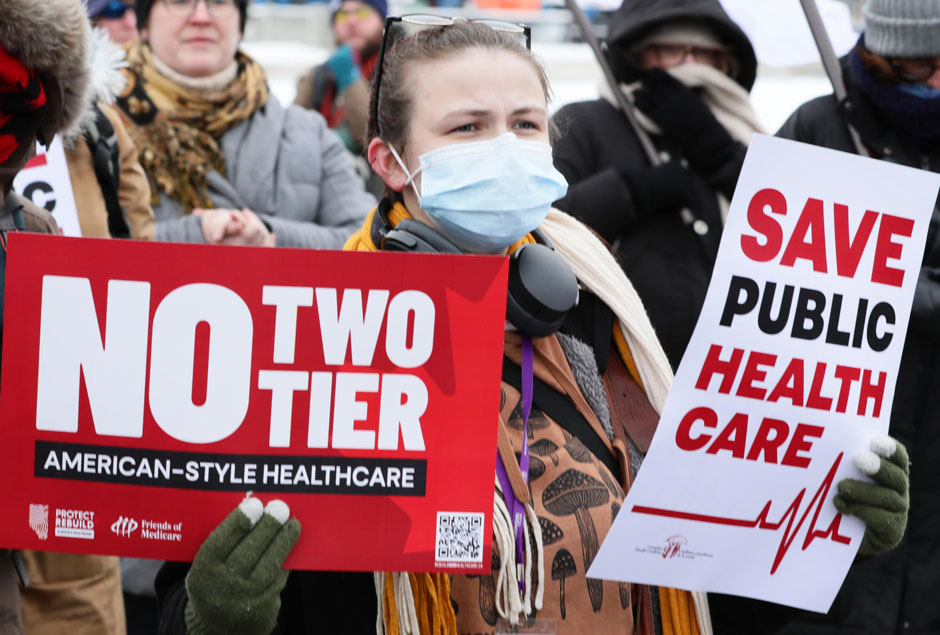
Healthcare advocates rallied on Parliament Hill on Feb. 10. (photo by John Major / Canadian Health Coalition)
When the judge finally did issue his ruling, it was a definitive dismissal of the plaintiff’s case. Not only that, but if you go to the Canadian Doctors for Medicare website, we have a summary of the parts of the case that really highlight the international evidence and underpinned the judge’s decision. The judgment was so comprehensive that the plaintiffs lost at the appeals court in BC, and then when they attempted to take the case to the Supreme Court of Canada, the Supreme Court of Canada didn’t even entertain the case in court.
We know that there are aspects of Canadian healthcare right now that are already privatized. In addition, there are more and more doctors moving to platforms like telehealth. What kinds of impacts have we seen of, say, diagnostics being privatized and telehealth?
I think that we — and I mean “we” broadly, including our political leaders — have been pretty inattentive to the public healthcare system. When you look at every dollar that’s spent on healthcare in Canada, 70 cents or 70% is public, and 30 cents or 30% is private. But what does that mean?
When you compare Canada to other countries — and let’s put the US to the side, we’re not looking to the US anymore — let’s look at the Europeans, countries like the Netherlands, France, Germany, the UK, the Nordic countries. They all spend 80% or more of every dollar from public sources on their healthcare system, compared to our 70%.
When you look at the last five years of data and you look at the growth of spending on healthcare, both public and private, private spending has outpaced public spending for four of the past five years. I bring this up because the narrative that we often hear is that healthcare spending in Canada is out of control and we can’t afford any more public investments.
But if you actually look at the numbers, it’s actually private healthcare spending that is out of control, and — at least if we are comparing ourselves to Europe and not the United States — we’re under-investing in our public healthcare system. So we need to change the narrative and the way that we’re talking about care.
The reason I bring this up in response to the question about the rise of things like virtual care — in particular, private-pay virtual care, or other sorts of private-pay services that are coming up — is that the inattention to the public healthcare system means that, I think, our shared sense of purpose and our social solidarity is starting to fray.
“So many of us think about our healthcare system as part of what makes us Canadian — as, I would argue, one of the highest expressions of us caring for one another.”
Folks who can or will pay to jump the line, even if it comes at the expense of everyone else, will do so, and there will be investors who will give them opportunities to do that. I would argue it’s actually fine for them to pay more for care.
But we have two choices: We can allow the status quo to continue and allow folks to jump the line at the expense of others. Or we can have an adult conversation about increasing funding for the public healthcare system and having the wealthy pay more through things like robust, progressive taxation. The money for the healthcare system has to come from somewhere, and I’m not afraid, and we shouldn’t be afraid, of having that conversation. That includes progressive taxation to support the sort of system that I think we all know we need.
You touched on social determinants of health and this whole conversation about how privatization is the divide between haves and have-nots. There’s another divide that already exists in access to care in Canada, between urban communities and rural and particularly Indigenous communities. In your primary-care philosophy, what are the solutions that you envision for that?
People living in rural Canada have some of the largest challenges to accessing care and accessing services. There are almost 6 million people in our country who don’t have access to a family doctor or a nurse practitioner, and nowhere is this a larger problem than in rural Canada.
I think a big part of the solution to rural healthcare is really doubling down on primary care. And not the old way of doing primary care, where the doctor could open an office with a secretary and provide pretty good care — that made sense 30 years ago.
But medicine and health is way more complex now. We do so much more chronic-disease management. That model of taking care of people, it doesn’t do the job anymore.
It’s not just about new money, but it’s about investing new money in more creative ways. In primary care, that’s team-based care. That means that when a patient shows up for their appointment, yes, of course, they’ll have a doctor there to quarterback their care, but they’ll have access in that same building, or in that same community, to a social worker if they need it, to a dietitian, to a physiotherapist, and it’s all publicly covered.
That’s something we need everywhere in the country, but I think we need it in rural Canada more, really, than anywhere else.
Kind of like the community-health-clinic model?
Exactly. And that’s the good news.
We have, actually, a model of care everywhere in this country where that’s already happening. Community health centres are a great example. In Ontario, we also have family health teams, which are another model. But even in Ontario, where I practice, only 20% of people in the province have access to team-based care, whether it’s a family health team or a community health centre. I think both are great ways to do this sort of care — every province, every community, I think may be better served by one model or the other. But the point is that we need more of both.
The fundamental problem of Canada not having enough doctors, I suppose we’re now addressing that by courting doctors that are trying to get out of the US because of that administration and RFK Jr.’s brain worms. But in addition to that, there’s med schools being built across Canada — I think there’s six new ones. Is that promising as a way to address the shortage?
I’m a doctor. I love being a doctor. But it’s also very obvious to me and my colleagues that just training more doctors is not going to fix the problem, and that recruiting doctors from other countries — it will help — but it’s also not going to fix the problem. And frankly, I don’t want to fix the problem in Canada at the expense of people who need healthcare otherwise, whether it’s in the United States or whether it’s in low- and middle-income countries that have far greater healthcare needs than we do. We face serious challenges, but so do other folks, and I don’t want to fix healthcare in Canada on the backs of other folks who are also struggling.
We really need a made-in-Canada solution, and I think the way that we do that is we recognize, again, that healthcare is best delivered not by a single person, but by a team. Healthcare has evolved and changed a lot over the past 40 years since the Canada Health Act was passed.
I am not the only person who is capable of looking after a patient. I work as part of a team, so that if a patient comes and sees me and they have questions about how their medications interact with one another, I could talk to them about it. But I also have an amazing pharmacist whose office is right across the hall from me. It makes a lot of sense for the patient to talk with our team pharmacist.
If a patient comes in, they’re going through a tough time, there’s a diagnosis of depression, I will spend time with them. I will prescribe medication, if it makes sense. But hey, three doors down, we have our social work team. It probably makes sense that they meet with them as well.
I think that is how every single doctor can take care of even more patients, and patients can be matched with the most appropriate person to take care of their needs. Yes, we need more doctors and yes, we need other folks to also work as part of a medical team to take care of patients. That’s, I think, how we can make the biggest progress on filling this care gap.
At a national level in Canada, advocacy in healthcare is a little difficult, because obviously the provision of healthcare is provincial jurisdiction. Can you talk a little bit about where the federal government’s role is, as we head into this year of healthcare experiments by the provinces?
We have a federal minister of health and something called the Canada Health Act for a reason, right? Because the federal government has a fundamental role in healthcare in Canada, even though healthcare systems are, by and large — not for everyone, but by and large — administered provincially. That’s because the provinces can’t do their jobs without the funding that comes through the Canada Health Transfer from the federal government. It’s the federal government’s responsibility to make sure that in exchange for that funding, provinces uphold the core sets of principles, and right now that’s through the Canada Health Act.
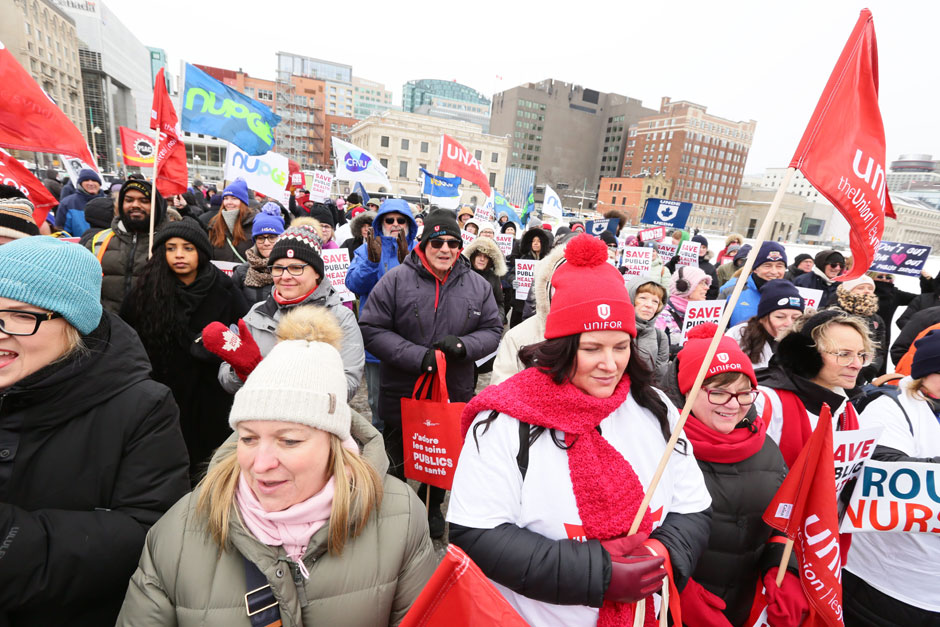
Healthcare advocates rallied on Parliament Hill on Feb. 10. (photo by John Major / Canadian Health Coalition)
But the Canada Health Act only applies to two types of services: to doctors and to hospitals. For everything else, we periodically have these health accords that are signed — but they’re usually time-limited, there’s not really any hard criteria for results or reporting, they lapse and they’re very episodic.
I think we have seen signs of more sustained engagement from the federal government. Most recently, there was the Pharmacare Act that was passed, that was modelled on the same five principles that you can find in the Canada Health Act. Even though the legislation is not the true universal pharmacare program that I think many of us want, it is at least a start for diabetes and contraception.
To the credit of the former minister of health, Mark Holland, he and his team really hustled to get those four deals signed for BC, Manitoba, PEI and Yukon. The premiers of those provinces and of the Yukon really hustled, also, to work with his team to get those done. But we’ve heard nothing since.
We’ve heard nothing since Prime Minister Carney, in his election campaign, committed to protect pharmacare. But I think in many of our eyes, that didn’t mean to also protect inequities that exist within the country. It doesn’t make sense to me.
“If we not only want to protect the values upon which medicare was built, but use those values to make something better, we have to start playing offence.”
I am extremely happy for folks in BC, who as of March 1st, can access not just contraception and diabetes, but also menopause treatments for free. It’s going to be so exciting when that comes online for people in Manitoba, PEI and Yukon. But it doesn’t make sense that my patients in Ontario also can’t have access to it. Or people in Newfoundland, where the premier, who wants to sign a deal and is ready to do it, can’t do it. Or anywhere else in this country.
So for me, the protection of pharmacare is not just protecting existing deals and being okay with the inequity that that creates in this country. The protection includes actually finishing the job that the last government started. Amongst many other things, I would love to see the federal government do that.
If pharmacare is not the federal government’s priority on healthcare, what is?
I honestly wish that I could tell you, because I do not know.
This government has, I think rightly so, talked about the need for Canada to nation-build. We are in a very precarious time. There’s a lot of anxiety for good reasons. Our traditional relationships with allies like the US are fraying, and so we really need to figure out, “How do we shore ourselves up as a nation?”
So many of us think about our healthcare system as part of what makes us Canadian — as, I would argue, one of the highest expressions of us caring for one another. I can think of nothing more worthy of nation-building than that, and I would love it if the prime minister shared that point of view, but I am struggling to see that right now.
I think many of us who are just grinding away in the system, working, taking care of patients, we all have stories of people who can’t access a family doctor, who are waiting longer than they should be for that specialist appointment or that surgical procedure. I would love the prime minister to spend a day with us, so he can recognize that this is part of how we take care of each other, and this is how we build a stronger Canada.
Have you made that ask of the prime minister, to sit down with you?
No, but I think I just did.
Well, listeners heard it here first on Sources.
There is one other thing I want to add.
Because medicare is regularly under attack, I think those of us who believe in universal healthcare sometimes feel the need to circle the wagons and play defence, and that puts us in a scarcity mindset.
I actually think the best defence is a good offence. If we not only want to protect the values upon which medicare was built, but use those values to make something better, then I think we have to start playing offence. Pharmacare is a part of that, but so is primary care. So are even more technocratic things, like ways we can redesign how we do referral systems to make sure that people get more timely access to care. But so is a really adult conversation about how we need to pay for this care.
There are only so many savings we can get from efficiency before new calls for efficiency equal service cuts. Our federal government is committing — and I’m not saying whether this is a good or bad thing — but we are committing 5% of our GDP to defence. We are making major investments in the resource sector, and we are also cutting taxes — the digital services tax, these luxury taxes on yachts and private jets, this corporate super tax deduction. So where is all the money going to come from? Where’s the money going to come from, also, for healthcare? So let’s have that conversation, too.
I’m tired of being put in a corner and being asked, “Where’s the money coming from?”
So yeah, let’s talk about it. Let’s talk about progressive taxation. Let’s talk about a wealth tax. Let’s talk about an estate tax. Let’s talk about other ways we can capture our communal wealth to actually look after each other.
Our journalism is powered by readers like you.
We’re an award-winning non-profit news organization that covers topics like social and economic inequality, big business and labour, and right-wing extremism.
Help us build so we can bring to light stories that don’t get the attention they deserve from Canada’s big corporate media outlets.